

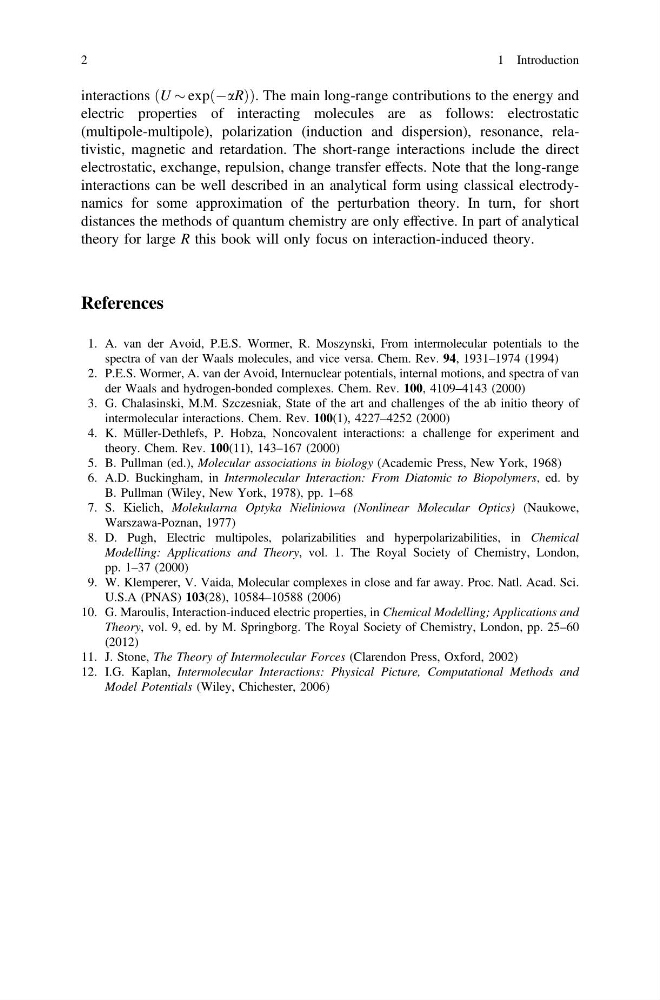
interactions U $ expðÀaRÞ
ð
Þ . The main long-range contributions to the energy and
electric properties of interacting molecules are as follows: electrostatic
(multipole-multipole), polarization (induction and dispersion), resonance, relativistic, magnetic and retardation. The short-range interactions include the direct
electrostatic, exchange, repulsion, change transfer effects. Note that the long-range
interactions can be well described in an analytical form using classical electrodynamics for some approximation of the perturbation theory. In turn, for short
distances the methods of quantum chemistry are only effective. In part of analytical
theory for large R this book will only focus on interaction-induced theory.
References
1. A. van der Avoid, P.E.S. Wormer, R. Moszynski, From intermolecular potentials to the
spectra of van der Waals molecules, and vice versa. Chem. Rev. 94, 1931–1974 (1994)
2. P.E.S. Wormer, A. van der Avoid, Internuclear potentials, internal motions, and spectra of van
der Waals and hydrogen-bonded complexes. Chem. Rev. 100, 4109–4143 (2000)
3. G. Chalasinski, M.M. Szczesniak, State of the art and challenges of the ab initio theory of
intermolecular interactions. Chem. Rev. 100(1), 4227–4252 (2000)
4. K. Müller-Dethlefs, P. Hobza, Noncovalent interactions: a challenge for experiment and
theory. Chem. Rev. 100(11), 143–167 (2000)
5. B. Pullman (ed.), Molecular associations in biology (Academic Press, New York, 1968)
6. A.D. Buckingham, in Intermolecular Interaction: From Diatomic to Biopolymers, ed. by
B. Pullman (Wiley, New York, 1978), pp. 1–68
7. S. Kielich, Molekularna Optyka Nieliniowa (Nonlinear Molecular Optics) (Naukowe,
Warszawa-Poznan, 1977)
8. D. Pugh, Electric multipoles, polarizabilities and hyperpolarizabilities, in Chemical
Modelling: Applications and Theory, vol. 1. The Royal Society of Chemistry, London,
pp. 1–37 (2000)
9. W. Klemperer, V. Vaida, Molecular complexes in close and far away. Proc. Natl. Acad. Sci.
U.S.A (PNAS) 103(28), 10584–10588 (2006)
10. G. Maroulis, Interaction-induced electric properties, in Chemical Modelling; Applications and
Theory, vol. 9, ed. by M. Springborg. The Royal Society of Chemistry, London, pp. 25–60
(2012)
11. J. Stone, The Theory of Intermolecular Forces (Clarendon Press, Oxford, 2002)
12. I.G. Kaplan, Intermolecular Interactions: Physical Picture, Computational Methods and
Model Potentials (Wiley, Chichester, 2006)
2
1 Introduction
ð
Þ . The main long-range contributions to the energy and
electric properties of interacting molecules are as follows: electrostatic
(multipole-multipole), polarization (induction and dispersion), resonance, relativistic, magnetic and retardation. The short-range interactions include the direct
electrostatic, exchange, repulsion, change transfer effects. Note that the long-range
interactions can be well described in an analytical form using classical electrodynamics for some approximation of the perturbation theory. In turn, for short
distances the methods of quantum chemistry are only effective. In part of analytical
theory for large R this book will only focus on interaction-induced theory.
References
1. A. van der Avoid, P.E.S. Wormer, R. Moszynski, From intermolecular potentials to the
spectra of van der Waals molecules, and vice versa. Chem. Rev. 94, 1931–1974 (1994)
2. P.E.S. Wormer, A. van der Avoid, Internuclear potentials, internal motions, and spectra of van
der Waals and hydrogen-bonded complexes. Chem. Rev. 100, 4109–4143 (2000)
3. G. Chalasinski, M.M. Szczesniak, State of the art and challenges of the ab initio theory of
intermolecular interactions. Chem. Rev. 100(1), 4227–4252 (2000)
4. K. Müller-Dethlefs, P. Hobza, Noncovalent interactions: a challenge for experiment and
theory. Chem. Rev. 100(11), 143–167 (2000)
5. B. Pullman (ed.), Molecular associations in biology (Academic Press, New York, 1968)
6. A.D. Buckingham, in Intermolecular Interaction: From Diatomic to Biopolymers, ed. by
B. Pullman (Wiley, New York, 1978), pp. 1–68
7. S. Kielich, Molekularna Optyka Nieliniowa (Nonlinear Molecular Optics) (Naukowe,
Warszawa-Poznan, 1977)
8. D. Pugh, Electric multipoles, polarizabilities and hyperpolarizabilities, in Chemical
Modelling: Applications and Theory, vol. 1. The Royal Society of Chemistry, London,
pp. 1–37 (2000)
9. W. Klemperer, V. Vaida, Molecular complexes in close and far away. Proc. Natl. Acad. Sci.
U.S.A (PNAS) 103(28), 10584–10588 (2006)
10. G. Maroulis, Interaction-induced electric properties, in Chemical Modelling; Applications and
Theory, vol. 9, ed. by M. Springborg. The Royal Society of Chemistry, London, pp. 25–60
(2012)
11. J. Stone, The Theory of Intermolecular Forces (Clarendon Press, Oxford, 2002)
12. I.G. Kaplan, Intermolecular Interactions: Physical Picture, Computational Methods and
Model Potentials (Wiley, Chichester, 2006)
2
1 Introduction