

viii
Preface for the Second Edition
Main-Group Chemistry” (Wiley; authors T.M. Klapötke and A. Schulz),
pp. 217-250 (1998)). (d) Eur. J. Inorg. Chem. 1901-1916 (2000). (e) in “Valence-bond Theory” (Elsevier Science B.V.; editor D.L. Cooper) pp. 349-378
(2002).
7) R.D. Harcourt and T.M. Klapötke, Pauling three-electron bonds and
increased-valence structures as components of the "intellectual heritage" of
qualitative valence-bond theory. Trends Inorg. Chem. 9, 11-22 (2006).
8) T.M. Klapötke in “Moderne Anorganische Chemie” (de Gruyter, Berlin:
editor, E. Riedel) 3rd edition (2007).
9) The Chemical Bond (Wiley-VCH; editors G. Frenking and S. Shaik) (a) Fundamental Aspects of Chemical Bonding, pp. 1-411 (2014); (b) Chemical
Bonding Across the Periodic Table, pp. 1-544 (2014).
For readers who wish to give primary consideration to the “increased-valence”
theory, Sections 3-6, 3-9, 4-1 to 4-7, 6-1, 7-1 and 7-2 are the main components of
the earlier chapters that are required as background for chapters 10 to 25. A
reading of chapter 2 might also be appropriate in order to obtain a rationalization
of the need for an “increased-valence” theory.
The “increased-valence” theory represents a natural extension of the more
familiar Lewis-Pauling valence-bond theory. Therefore an understanding of it may
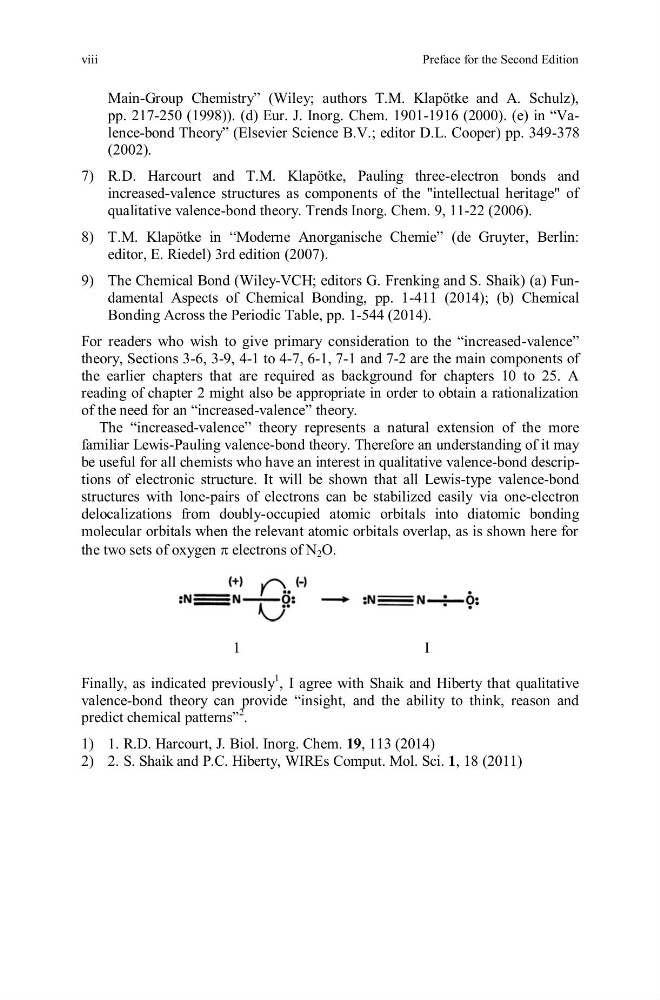
be useful for all chemists who have an interest in qualitative valence-bond descriptions of electronic structure. It will be shown that all Lewis-type valence-bond
structures with lone-pairs of electrons can be stabilized easily via one-electron
delocalizations from doubly-occupied atomic orbitals into diatomic bonding
molecular orbitals when the relevant atomic orbitals overlap, as is shown here for
the two sets of oxygen electrons of N 2 O.
1
I
Finally, as indicated previously
1 , I agree with Shaik and Hiberty that qualitative
valence-bond theory can provide “insight, and the ability to think, reason and
predict chemical patterns”
2
.
1) 1. R.D. Harcourt, J. Biol. Inorg. Chem. 19, 113 (2014)
2) 2. S. Shaik and P.C. Hiberty, WIREs Comput. Mol. Sci. 1, 18 (2011)
Preface for the Second Edition
Main-Group Chemistry” (Wiley; authors T.M. Klapötke and A. Schulz),
pp. 217-250 (1998)). (d) Eur. J. Inorg. Chem. 1901-1916 (2000). (e) in “Valence-bond Theory” (Elsevier Science B.V.; editor D.L. Cooper) pp. 349-378
(2002).
7) R.D. Harcourt and T.M. Klapötke, Pauling three-electron bonds and
increased-valence structures as components of the "intellectual heritage" of
qualitative valence-bond theory. Trends Inorg. Chem. 9, 11-22 (2006).
8) T.M. Klapötke in “Moderne Anorganische Chemie” (de Gruyter, Berlin:
editor, E. Riedel) 3rd edition (2007).
9) The Chemical Bond (Wiley-VCH; editors G. Frenking and S. Shaik) (a) Fundamental Aspects of Chemical Bonding, pp. 1-411 (2014); (b) Chemical
Bonding Across the Periodic Table, pp. 1-544 (2014).
For readers who wish to give primary consideration to the “increased-valence”
theory, Sections 3-6, 3-9, 4-1 to 4-7, 6-1, 7-1 and 7-2 are the main components of
the earlier chapters that are required as background for chapters 10 to 25. A
reading of chapter 2 might also be appropriate in order to obtain a rationalization
of the need for an “increased-valence” theory.
The “increased-valence” theory represents a natural extension of the more
familiar Lewis-Pauling valence-bond theory. Therefore an understanding of it may
be useful for all chemists who have an interest in qualitative valence-bond descriptions of electronic structure. It will be shown that all Lewis-type valence-bond
structures with lone-pairs of electrons can be stabilized easily via one-electron
delocalizations from doubly-occupied atomic orbitals into diatomic bonding
molecular orbitals when the relevant atomic orbitals overlap, as is shown here for
the two sets of oxygen electrons of N 2 O.
1
I
Finally, as indicated previously
1 , I agree with Shaik and Hiberty that qualitative
valence-bond theory can provide “insight, and the ability to think, reason and
predict chemical patterns”
2
.
1) 1. R.D. Harcourt, J. Biol. Inorg. Chem. 19, 113 (2014)
2) 2. S. Shaik and P.C. Hiberty, WIREs Comput. Mol. Sci. 1, 18 (2011)