

64
Chapter 4 Valence-Bond Structures for some Diatomic and related Molecules
h 3a = 2s a – za , h 4b = 2s b + zb , h 5a = za + 2s a , h 6b = - zb + 2s b
(3)
for which the hybridization parameters and can be determined variationally.
To determine the strength of each valence shell electron-pair bond with a
Heitler-London wavefunction, the energy of a(1)b(2) is compared with that of
a(1)b(2) + b(1)a(2), to give a spin-coupling or constructive interference energy.
For the eight valence shell electrons, a calculation with one a(1)b(2) configuration
and three a(1)b(2) + b(1)a(2) configurations involves eight instead of 16 Slater
determinants.
If each of the eight valence shell atomic orbitals in Equation (3) is replaced by
a 2-centre Coulson-Fischer type orbital, for example the a and b atomic orbitals
are replaced by a + kb and b + ka, ionic configurations of the type a(1)a(2) +
b(1)b(2) can be introduced. The equivalent treatment in the molecular orbital
formulation involves replacing each of the (1)(2) – *(1)*(2) with (1)(2)
– *(1)*(2). For these two equivalent formulations, the parameters k and ,
with 2k/(1 + k
2 ) = (1 +)/(1 – ), can be determined variationally.
3. One-electron and two-electron transfers
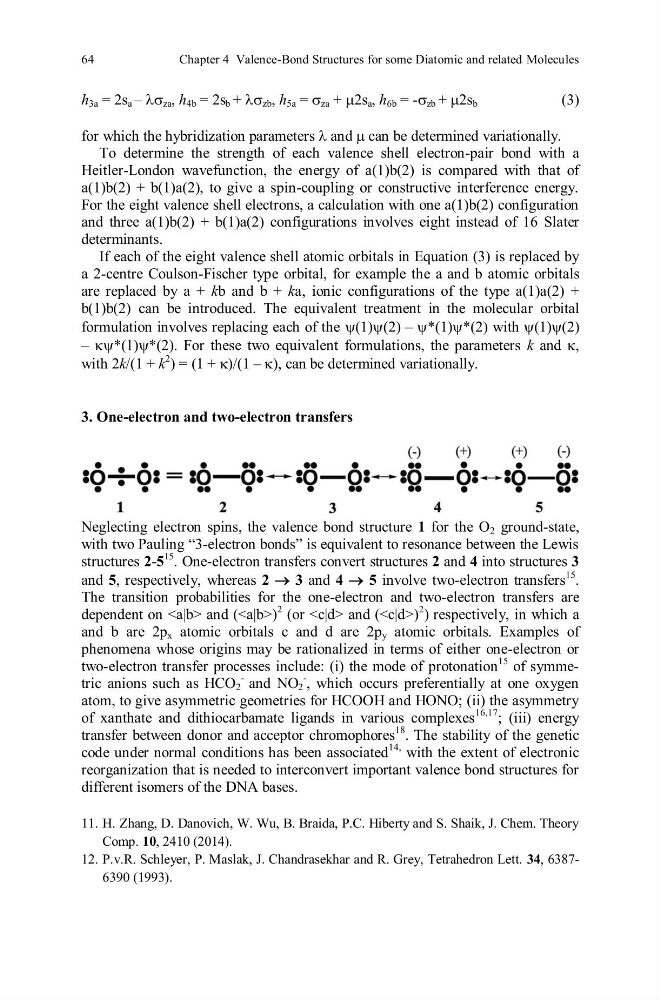
Neglecting electron spins, the valence bond structure 1 for the O 2 ground-state,
with two Pauling “3-electron bonds” is equivalent to resonance between the Lewis
structures 2-5
15 . One-electron transfers convert structures 2 and 4 into structures 3
and 5, respectively, whereas 2 3 and 4 5 involve two-electron transfers
15
.
The transition probabilities for the one-electron and two-electron transfers are
dependent on and ()
2 (or and ()
2 ) respectively, in which a
and b are 2p x atomic orbitals c and d are 2p y atomic orbitals. Examples of
phenomena whose origins may be rationalized in terms of either one-electron or
two-electron transfer processes include: (i) the mode of protonation
15 of symmetric anions such as HCO 2
- and NO 2
- , which occurs preferentially at one oxygen
atom, to give asymmetric geometries for HCOOH and HONO; (ii) the asymmetry
of xanthate and dithiocarbamate ligands in various complexes
16,17 ; (iii) energy
transfer between donor and acceptor chromophores
18 . The stability of the genetic
code under normal conditions has been associated
14, with the extent of electronic
reorganization that is needed to interconvert important valence bond structures for
different isomers of the DNA bases.
11. H. Zhang, D. Danovich, W. Wu, B. Braida, P.C. Hiberty and S. Shaik, J. Chem. Theory
Comp. 10, 2410 (2014).
12. P.v.R. Schleyer, P. Maslak, J. Chandrasekhar and R. Grey, Tetrahedron Lett. 34, 63876390 (1993).
Chapter 4 Valence-Bond Structures for some Diatomic and related Molecules
h 3a = 2s a – za , h 4b = 2s b + zb , h 5a = za + 2s a , h 6b = - zb + 2s b
(3)
for which the hybridization parameters and can be determined variationally.
To determine the strength of each valence shell electron-pair bond with a
Heitler-London wavefunction, the energy of a(1)b(2) is compared with that of
a(1)b(2) + b(1)a(2), to give a spin-coupling or constructive interference energy.
For the eight valence shell electrons, a calculation with one a(1)b(2) configuration
and three a(1)b(2) + b(1)a(2) configurations involves eight instead of 16 Slater
determinants.
If each of the eight valence shell atomic orbitals in Equation (3) is replaced by
a 2-centre Coulson-Fischer type orbital, for example the a and b atomic orbitals
are replaced by a + kb and b + ka, ionic configurations of the type a(1)a(2) +
b(1)b(2) can be introduced. The equivalent treatment in the molecular orbital
formulation involves replacing each of the (1)(2) – *(1)*(2) with (1)(2)
– *(1)*(2). For these two equivalent formulations, the parameters k and ,
with 2k/(1 + k
2 ) = (1 +)/(1 – ), can be determined variationally.
3. One-electron and two-electron transfers
Neglecting electron spins, the valence bond structure 1 for the O 2 ground-state,
with two Pauling “3-electron bonds” is equivalent to resonance between the Lewis
structures 2-5
15 . One-electron transfers convert structures 2 and 4 into structures 3
and 5, respectively, whereas 2 3 and 4 5 involve two-electron transfers
15
.
The transition probabilities for the one-electron and two-electron transfers are
dependent on
2 (or
2 ) respectively, in which a
and b are 2p x atomic orbitals c and d are 2p y atomic orbitals. Examples of
phenomena whose origins may be rationalized in terms of either one-electron or
two-electron transfer processes include: (i) the mode of protonation
15 of symmetric anions such as HCO 2
- and NO 2
- , which occurs preferentially at one oxygen
atom, to give asymmetric geometries for HCOOH and HONO; (ii) the asymmetry
of xanthate and dithiocarbamate ligands in various complexes
16,17 ; (iii) energy
transfer between donor and acceptor chromophores
18 . The stability of the genetic
code under normal conditions has been associated
14, with the extent of electronic
reorganization that is needed to interconvert important valence bond structures for
different isomers of the DNA bases.
11. H. Zhang, D. Danovich, W. Wu, B. Braida, P.C. Hiberty and S. Shaik, J. Chem. Theory
Comp. 10, 2410 (2014).
12. P.v.R. Schleyer, P. Maslak, J. Chandrasekhar and R. Grey, Tetrahedron Lett. 34, 63876390 (1993).