

4-3 O2, O2
+ , O2
– and O2
2–
57
4-2 Li 2 , Be 2 , N 2 , F 2 and
2
2
O
For 2
Li and
2
Be , the molecular orbital configurations of Table 4-1 generate the
valence-bond structures Li — Li and :Be Be: , with one bond and no bonds,
respectively. In contrast to what is the case for Li 2 , the diatomic molecule Be 2
does not exist as a stable species. For N 2 and F 2 , we obtain the Lewis octet
structures (namely :N N:
and :F—F :
) from the molecular orbital configurations, (with . These structures have triple and single bonds, respectively. The peroxide anion
2
2
O
is isoelectronic with 2
F , and its valence-bond structure
(–)
:O – O:
(–)
also involves a single bond. The bond-lengths
i for ( 2
F and
2
2
O
are
1.43 and 1.48 Å – both of which are appreciably longer than the 1.10 Å for the
triple-bonded N 2 . These lengths for the single-bonds of 2
F and
2
2
O
are also much
shorter than the 2.67 Å for the single-bond of Li 2 . No doubt this reflects (at least
partially) the different nature of the atomic orbitals that are used to form the
bonds, namely (primarily) 2s for 2
Li and 2pσ for 2
F and
2
2
O
.
4-3 O 2 , O 2
+
, O 2
–
and
2
2
O
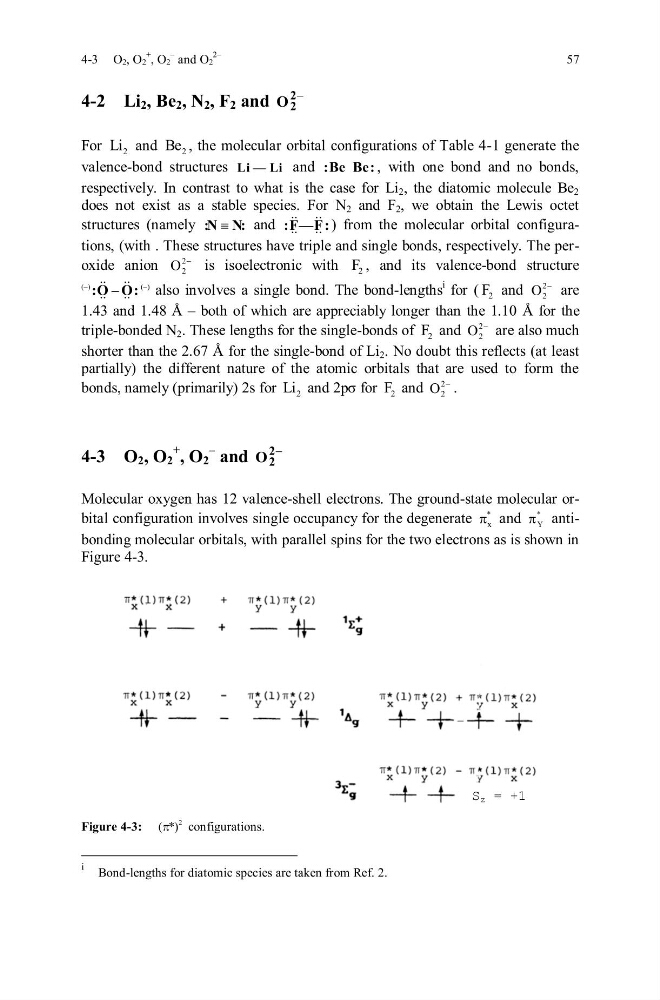
Molecular oxygen has 12 valence-shell electrons. The ground-state molecular orbital configuration involves single occupancy for the degenerate
*
x
and
*
Y
antibonding molecular orbitals, with parallel spins for the two electrons as is shown in
Figure 4-3.
Figure 4-3:
2
( *)
configurations.
i Bond-lengths for diatomic species are taken from Ref. 2.
S z = +1
–
+ , O2
– and O2
2–
57
4-2 Li 2 , Be 2 , N 2 , F 2 and
2
2
O
For 2
Li and
2
Be , the molecular orbital configurations of Table 4-1 generate the
valence-bond structures Li — Li and :Be Be: , with one bond and no bonds,
respectively. In contrast to what is the case for Li 2 , the diatomic molecule Be 2
does not exist as a stable species. For N 2 and F 2 , we obtain the Lewis octet
structures (namely :N N:
and :F—F :
) from the molecular orbital configurations, (with . These structures have triple and single bonds, respectively. The peroxide anion
2
2
O
is isoelectronic with 2
F , and its valence-bond structure
(–)
:O – O:
(–)
also involves a single bond. The bond-lengths
i for ( 2
F and
2
2
O
are
1.43 and 1.48 Å – both of which are appreciably longer than the 1.10 Å for the
triple-bonded N 2 . These lengths for the single-bonds of 2
F and
2
2
O
are also much
shorter than the 2.67 Å for the single-bond of Li 2 . No doubt this reflects (at least
partially) the different nature of the atomic orbitals that are used to form the
bonds, namely (primarily) 2s for 2
Li and 2pσ for 2
F and
2
2
O
.
4-3 O 2 , O 2
+
, O 2
–
and
2
2
O
Molecular oxygen has 12 valence-shell electrons. The ground-state molecular orbital configuration involves single occupancy for the degenerate
*
x
and
*
Y
antibonding molecular orbitals, with parallel spins for the two electrons as is shown in
Figure 4-3.
Figure 4-3:
2
( *)
configurations.
i Bond-lengths for diatomic species are taken from Ref. 2.
S z = +1
–