

32
Chapter 2 Pauling “3-Electron Bonds”, 4-Electron 3-Centre Bonding, and the Need …
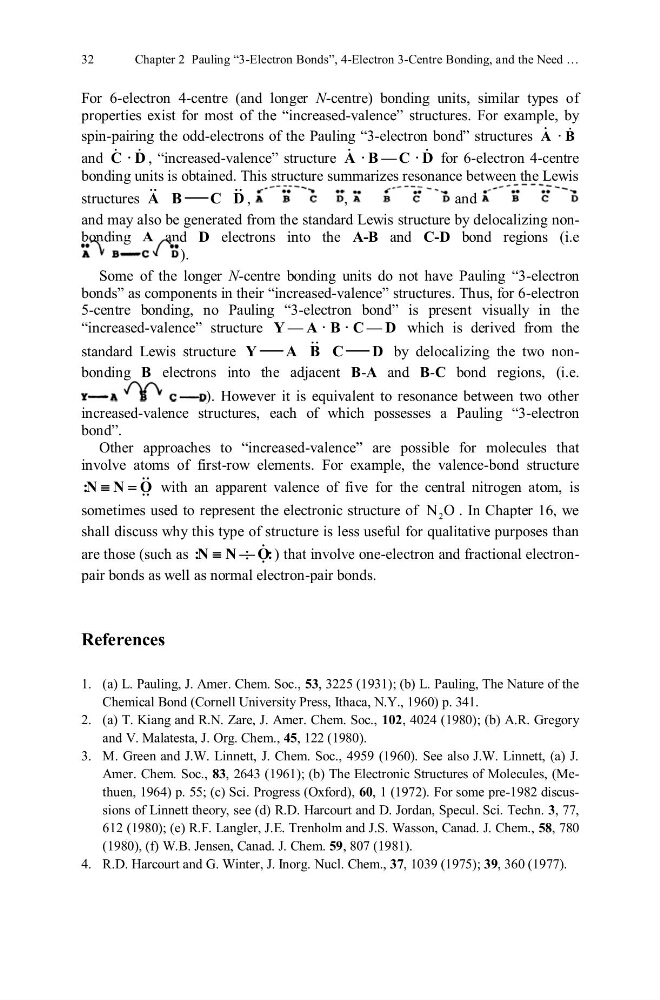
For 6-electron 4-centre (and longer N-centre) bonding units, similar types of
properties exist for most of the “increased-valence” structures. For example, by
spin-pairing the odd-electrons of the Pauling “3-electron bond” structures A · B
and C · D
, “increased-valence” structure A · B — C · D
for 6-electron 4-centre
bonding units is obtained. This structure summarizes resonance between the Lewis
structures A B
C D
—
,
,
and
and may also be generated from the standard Lewis structure by delocalizing nonbonding A and D electrons into the A-B and C-D bond regions (i.e
).
Some of the longer N-centre bonding units do not have Pauling “3-electron
bonds” as components in their “increased-valence” structures. Thus, for 6-electron
5-centre bonding, no Pauling “3-electron bond” is present visually in the
“increased-valence” structure Y — A · Β · C — D which is derived from the
standard Lewis structure Y
Α Β C
D
—
—
by delocalizing the two nonbonding Β electrons into the adjacent B-A and B-C bond regions, (i.e.
). However it is equivalent to resonance between two other
increased-valence structures, each of which possesses a Pauling “3-electron
bond”.
Other approaches to “increased-valence” are possible for molecules that
involve atoms of first-row elements. For example, the valence-bond structure
:N N O
with an apparent valence of five for the central nitrogen atom, is
sometimes used to represent the electronic structure of 2
N O . In Chapter 16, we
shall discuss why this type of structure is less useful for qualitative purposes than
are those (such as :N N — O:
) that involve one-electron and fractional electronpair bonds as well as normal electron-pair bonds.
References
1. (a) L. Pauling, J. Amer. Chem. Soc., 53, 3225 (1931); (b) L. Pauling, The Nature of the
Chemical Bond (Cornell University Press, Ithaca, N.Y., 1960) p. 341.
2. (a) T. Kiang and R.N. Zare, J. Amer. Chem. Soc., 102, 4024 (1980); (b) A.R. Gregory
and V. Malatesta, J. Org. Chem., 45, 122 (1980).
3. M. Green and J.W. Linnett, J. Chem. Soc., 4959 (1960). See also J.W. Linnett, (a) J.
Amer. Chem. Soc., 83, 2643 (1961); (b) The Electronic Structures of Molecules, (Methuen, 1964) p. 55; (c) Sci. Progress (Oxford), 60, 1 (1972). For some pre-1982 discussions of Linnett theory, see (d) R.D. Harcourt and D. Jordan, Specul. Sci. Techn. 3, 77,
612 (1980); (e) R.F. Langler, J.E. Trenholm and J.S. Wasson, Canad. J. Chem., 58, 780
(1980), (f) W.B. Jensen, Canad. J. Chem. 59, 807 (1981).
4. R.D. Harcourt and G. Winter, J. Inorg. Nucl. Chem., 37, 1039 (1975); 39, 360 (1977).
Chapter 2 Pauling “3-Electron Bonds”, 4-Electron 3-Centre Bonding, and the Need …
For 6-electron 4-centre (and longer N-centre) bonding units, similar types of
properties exist for most of the “increased-valence” structures. For example, by
spin-pairing the odd-electrons of the Pauling “3-electron bond” structures A · B
and C · D
, “increased-valence” structure A · B — C · D
for 6-electron 4-centre
bonding units is obtained. This structure summarizes resonance between the Lewis
structures A B
C D
—
,
,
and
and may also be generated from the standard Lewis structure by delocalizing nonbonding A and D electrons into the A-B and C-D bond regions (i.e
).
Some of the longer N-centre bonding units do not have Pauling “3-electron
bonds” as components in their “increased-valence” structures. Thus, for 6-electron
5-centre bonding, no Pauling “3-electron bond” is present visually in the
“increased-valence” structure Y — A · Β · C — D which is derived from the
standard Lewis structure Y
Α Β C
D
—
—
by delocalizing the two nonbonding Β electrons into the adjacent B-A and B-C bond regions, (i.e.
). However it is equivalent to resonance between two other
increased-valence structures, each of which possesses a Pauling “3-electron
bond”.
Other approaches to “increased-valence” are possible for molecules that
involve atoms of first-row elements. For example, the valence-bond structure
:N N O
with an apparent valence of five for the central nitrogen atom, is
sometimes used to represent the electronic structure of 2
N O . In Chapter 16, we
shall discuss why this type of structure is less useful for qualitative purposes than
are those (such as :N N — O:
) that involve one-electron and fractional electronpair bonds as well as normal electron-pair bonds.
References
1. (a) L. Pauling, J. Amer. Chem. Soc., 53, 3225 (1931); (b) L. Pauling, The Nature of the
Chemical Bond (Cornell University Press, Ithaca, N.Y., 1960) p. 341.
2. (a) T. Kiang and R.N. Zare, J. Amer. Chem. Soc., 102, 4024 (1980); (b) A.R. Gregory
and V. Malatesta, J. Org. Chem., 45, 122 (1980).
3. M. Green and J.W. Linnett, J. Chem. Soc., 4959 (1960). See also J.W. Linnett, (a) J.
Amer. Chem. Soc., 83, 2643 (1961); (b) The Electronic Structures of Molecules, (Methuen, 1964) p. 55; (c) Sci. Progress (Oxford), 60, 1 (1972). For some pre-1982 discussions of Linnett theory, see (d) R.D. Harcourt and D. Jordan, Specul. Sci. Techn. 3, 77,
612 (1980); (e) R.F. Langler, J.E. Trenholm and J.S. Wasson, Canad. J. Chem., 58, 780
(1980), (f) W.B. Jensen, Canad. J. Chem. 59, 807 (1981).
4. R.D. Harcourt and G. Winter, J. Inorg. Nucl. Chem., 37, 1039 (1975); 39, 360 (1977).