

30
Chapter 2 Pauling “3-Electron Bonds”, 4-Electron 3-Centre Bonding, and the Need …
structure is equivalent to resonance between the Lewis structures (1), (5), (6) and
(9) of Figure 2-9, and only structure (1) has an N-N triple bond.
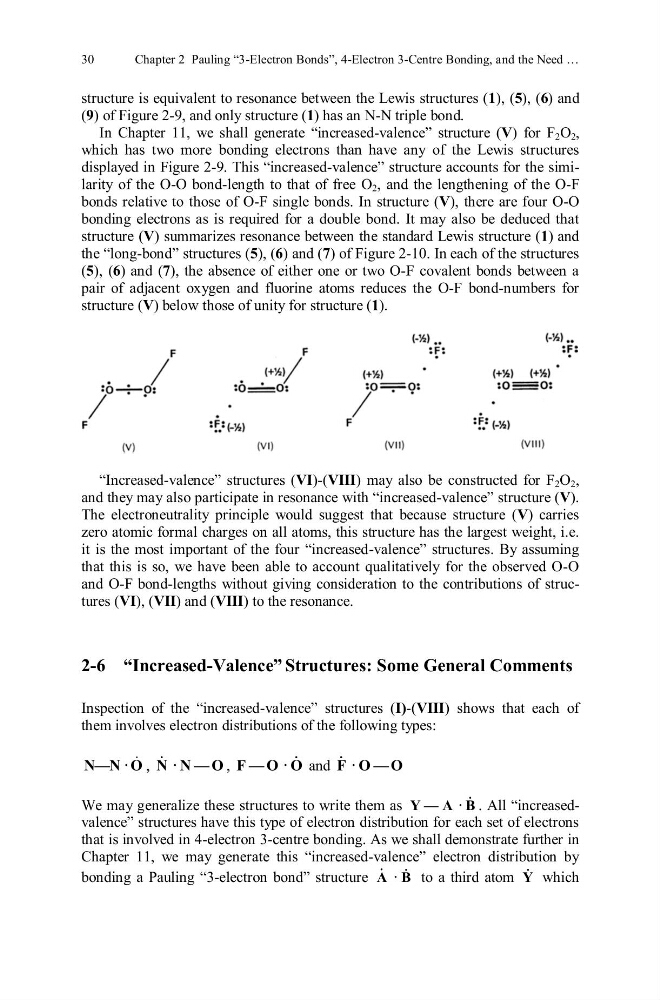
In Chapter 11, we shall generate “increased-valence” structure (V) for F 2 O 2 ,
which has two more bonding electrons than have any of the Lewis structures
displayed in Figure 2-9. This “increased-valence” structure accounts for the similarity of the O-O bond-length to that of free O 2 , and the lengthening of the O-F
bonds relative to those of O-F single bonds. In structure (V), there are four O-O
bonding electrons as is required for a double bond. It may also be deduced that
structure (V) summarizes resonance between the standard Lewis structure (1) and
the “long-bond” structures (5), (6) and (7) of Figure 2-10. In each of the structures
(5), (6) and (7), the absence of either one or two O-F covalent bonds between a
pair of adjacent oxygen and fluorine atoms reduces the O-F bond-numbers for
structure (V) below those of unity for structure (1).
“Increased-valence” structures (VI)-(VIII) may also be constructed for F 2 O 2 ,
and they may also participate in resonance with “increased-valence” structure (V).
The electroneutrality principle would suggest that because structure (V) carries
zero atomic formal charges on all atoms, this structure has the largest weight, i.e.
it is the most important of the four “increased-valence” structures. By assuming
that this is so, we have been able to account qualitatively for the observed O-O
and O-F bond-lengths without giving consideration to the contributions of structures (VI), (VII) and (VIII) to the resonance.
2-6
Structures: Some General Comments
Inspection of the “increased-valence” structures (I)-(VIII) shows that each of
them involves electron distributions of the following types:
Ν—Ν · O , Ν · Ν — O
, F — O · O and F · O — O
We may generalize these structures to write them as Y — A · Β . All “increasedvalence” structures have this type of electron distribution for each set of electrons
that is involved in 4-electron 3-centre bonding. As we shall demonstrate further in
Chapter 11, we may generate this “increased-valence” electron distribution by
bonding a Pauling “3-electron bond” structure A · Β
to a third atom Y which
“Increased-Valence”
Chapter 2 Pauling “3-Electron Bonds”, 4-Electron 3-Centre Bonding, and the Need …
structure is equivalent to resonance between the Lewis structures (1), (5), (6) and
(9) of Figure 2-9, and only structure (1) has an N-N triple bond.
In Chapter 11, we shall generate “increased-valence” structure (V) for F 2 O 2 ,
which has two more bonding electrons than have any of the Lewis structures
displayed in Figure 2-9. This “increased-valence” structure accounts for the similarity of the O-O bond-length to that of free O 2 , and the lengthening of the O-F
bonds relative to those of O-F single bonds. In structure (V), there are four O-O
bonding electrons as is required for a double bond. It may also be deduced that
structure (V) summarizes resonance between the standard Lewis structure (1) and
the “long-bond” structures (5), (6) and (7) of Figure 2-10. In each of the structures
(5), (6) and (7), the absence of either one or two O-F covalent bonds between a
pair of adjacent oxygen and fluorine atoms reduces the O-F bond-numbers for
structure (V) below those of unity for structure (1).
“Increased-valence” structures (VI)-(VIII) may also be constructed for F 2 O 2 ,
and they may also participate in resonance with “increased-valence” structure (V).
The electroneutrality principle would suggest that because structure (V) carries
zero atomic formal charges on all atoms, this structure has the largest weight, i.e.
it is the most important of the four “increased-valence” structures. By assuming
that this is so, we have been able to account qualitatively for the observed O-O
and O-F bond-lengths without giving consideration to the contributions of structures (VI), (VII) and (VIII) to the resonance.
2-6
Structures: Some General Comments
Inspection of the “increased-valence” structures (I)-(VIII) shows that each of
them involves electron distributions of the following types:
Ν—Ν · O , Ν · Ν — O
, F — O · O and F · O — O
We may generalize these structures to write them as Y — A · Β . All “increasedvalence” structures have this type of electron distribution for each set of electrons
that is involved in 4-electron 3-centre bonding. As we shall demonstrate further in
Chapter 11, we may generate this “increased-valence” electron distribution by
bonding a Pauling “3-electron bond” structure A · Β
to a third atom Y which
“Increased-Valence”