

22
Chapter 2 Pauling “3-Electron Bonds”, 4-Electron 3-Centre Bonding, and the Need …
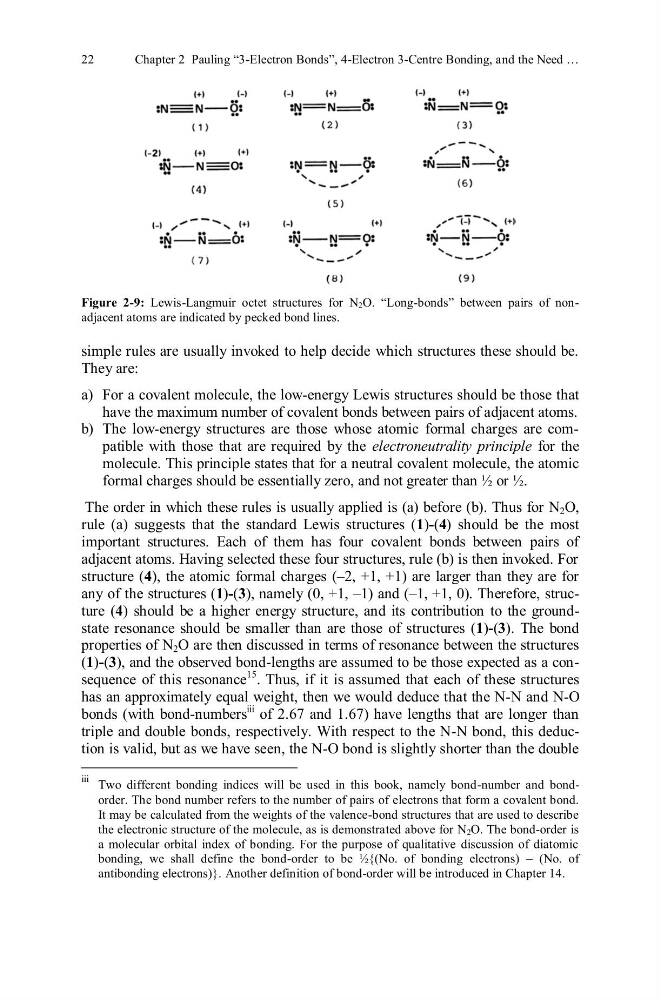
Figure 2-9: Lewis-Langmuir octet structures for N2O. “Long-bonds” between pairs of nonadjacent atoms are indicated by pecked bond lines.
simple rules are usually invoked to help decide which structures these should be.
They are:
a) For a covalent molecule, the low-energy Lewis structures should be those that
have the maximum number of covalent bonds between pairs of adjacent atoms.
b) The low-energy structures are those whose atomic formal charges are compatible with those that are required by the electroneutrality principle for the
molecule. This principle states that for a neutral covalent molecule, the atomic
formal charges should be essentially zero, and not greater than ½ or ½.
The order in which these rules is usually applied is (a) before (b). Thus for N 2 O,
rule (a) suggests that the standard Lewis structures (1)-(4) should be the most
important structures. Each of them has four covalent bonds between pairs of
adjacent atoms. Having selected these four structures, rule (b) is then invoked. For
structure (4), the atomic formal charges (–2, +1, +1) are larger than they are for
any of the structures (1)-(3), namely (0, +1, –1) and (–1, +1, 0). Therefore, structure (4) should be a higher energy structure, and its contribution to the groundstate resonance should be smaller than are those of structures (1)-(3). The bond
properties of N 2 O are then discussed in terms of resonance between the structures
(1)-(3), and the observed bond-lengths are assumed to be those expected as a consequence of this resonance
15 . Thus, if it is assumed that each of these structures
has an approximately equal weight, then we would deduce that the N-N and N-O
bonds (with bond-numbers
iii of 2.67 and 1.67) have lengths that are longer than
triple and double bonds, respectively. With respect to the N-N bond, this deduction is valid, but as we have seen, the N-O bond is slightly shorter than the double
iii Two different bonding indices will be used in this book, namely bond-number and bondorder. The bond number refers to the number of pairs of electrons that form a covalent bond.
It may be calculated from the weights of the valence-bond structures that are used to describe
the electronic structure of the molecule, as is demonstrated above for N2O. The bond-order is
a molecular orbital index of bonding. For the purpose of qualitative discussion of diatomic
bonding, we shall define the bond-order to be ½{(No. of bonding electrons) – (No. of
antibonding electrons)}. Another definition of bond-order will be introduced in Chapter 14.
Chapter 2 Pauling “3-Electron Bonds”, 4-Electron 3-Centre Bonding, and the Need …
Figure 2-9: Lewis-Langmuir octet structures for N2O. “Long-bonds” between pairs of nonadjacent atoms are indicated by pecked bond lines.
simple rules are usually invoked to help decide which structures these should be.
They are:
a) For a covalent molecule, the low-energy Lewis structures should be those that
have the maximum number of covalent bonds between pairs of adjacent atoms.
b) The low-energy structures are those whose atomic formal charges are compatible with those that are required by the electroneutrality principle for the
molecule. This principle states that for a neutral covalent molecule, the atomic
formal charges should be essentially zero, and not greater than ½ or ½.
The order in which these rules is usually applied is (a) before (b). Thus for N 2 O,
rule (a) suggests that the standard Lewis structures (1)-(4) should be the most
important structures. Each of them has four covalent bonds between pairs of
adjacent atoms. Having selected these four structures, rule (b) is then invoked. For
structure (4), the atomic formal charges (–2, +1, +1) are larger than they are for
any of the structures (1)-(3), namely (0, +1, –1) and (–1, +1, 0). Therefore, structure (4) should be a higher energy structure, and its contribution to the groundstate resonance should be smaller than are those of structures (1)-(3). The bond
properties of N 2 O are then discussed in terms of resonance between the structures
(1)-(3), and the observed bond-lengths are assumed to be those expected as a consequence of this resonance
15 . Thus, if it is assumed that each of these structures
has an approximately equal weight, then we would deduce that the N-N and N-O
bonds (with bond-numbers
iii of 2.67 and 1.67) have lengths that are longer than
triple and double bonds, respectively. With respect to the N-N bond, this deduction is valid, but as we have seen, the N-O bond is slightly shorter than the double
iii Two different bonding indices will be used in this book, namely bond-number and bondorder. The bond number refers to the number of pairs of electrons that form a covalent bond.
It may be calculated from the weights of the valence-bond structures that are used to describe
the electronic structure of the molecule, as is demonstrated above for N2O. The bond-order is
a molecular orbital index of bonding. For the purpose of qualitative discussion of diatomic
bonding, we shall define the bond-order to be ½{(No. of bonding electrons) – (No. of
antibonding electrons)}. Another definition of bond-order will be introduced in Chapter 14.