

Chapter 25 Some Additional Topics
1.
Recoupled-Pair Bonding
The concept of recoupled-pair bonding was introduced in 2009
1
, and applied in a
number of subsequent publications – see for example Refs. 1-4. A recoupled-pair
bond forms when an electron in a singly occupied ligand orbital recouples the pair
of electrons in a doubly occupied lone pair orbital on the central atom, leading to
a central atom-ligand bond
1-4 . A recoupled-pair bond dyad occurs when a
second ligand forms a bond with the orbital left over from the initial recoupled
pair bond
1-4
.
In Ref. 5, it is shown that for a 4-electron 3-centre bonding unit with one overlapping atomic orbital per atomic centre, recoupled pair bonding always occurs
when an electron is delocalized from a doubly-occupied atomic orbital into either
a bonding molecular orbital or an antibonding molecular orbital, to form a 1-electron bond and a fractional electron-pair bond. (This effect always occurs – see
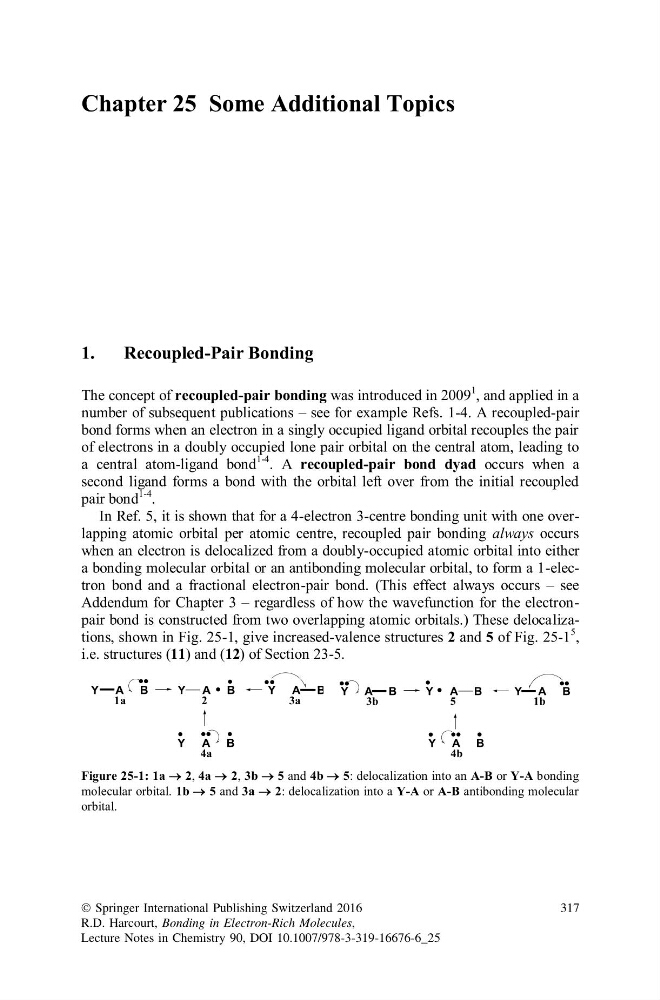
Addendum for Chapter 3 – regardless of how the wavefunction for the electronpair bond is constructed from two overlapping atomic orbitals.) These delocalizations, shown in Fig. 25-1, give increased-valence structures 2 and 5 of Fig. 25-1
5 ,
i.e. structures (11) and (12) of Section 23-5.
Y A B
Y A B
Y A B
1a
2
3a
Y A B
4a
Y A B
Y A B
Y A B
3b
5
1b
Y A B
4b
Figure 25-1: 1a 2, 4a 2, 3b 5 and 4b 5: delocalization into an A-B or Y-A bonding
molecular orbital. 1b 5 and 3a 2: delocalization into a Y-A or A-B antibonding molecular
orbital.
Ó Springer International Publishing Switzerland 2016
R.D. Harcourt, Bonding in Electron-Rich Molecules,
Lecture Notes in Chemistry 90, DOI 10.1007/978-3-319-16676-6_25
317
1.
Recoupled-Pair Bonding
The concept of recoupled-pair bonding was introduced in 2009
1
, and applied in a
number of subsequent publications – see for example Refs. 1-4. A recoupled-pair
bond forms when an electron in a singly occupied ligand orbital recouples the pair
of electrons in a doubly occupied lone pair orbital on the central atom, leading to
a central atom-ligand bond
1-4 . A recoupled-pair bond dyad occurs when a
second ligand forms a bond with the orbital left over from the initial recoupled
pair bond
1-4
.
In Ref. 5, it is shown that for a 4-electron 3-centre bonding unit with one overlapping atomic orbital per atomic centre, recoupled pair bonding always occurs
when an electron is delocalized from a doubly-occupied atomic orbital into either
a bonding molecular orbital or an antibonding molecular orbital, to form a 1-electron bond and a fractional electron-pair bond. (This effect always occurs – see
Addendum for Chapter 3 – regardless of how the wavefunction for the electronpair bond is constructed from two overlapping atomic orbitals.) These delocalizations, shown in Fig. 25-1, give increased-valence structures 2 and 5 of Fig. 25-1
5 ,
i.e. structures (11) and (12) of Section 23-5.
Y A B
Y A B
Y A B
1a
2
3a
Y A B
4a
Y A B
Y A B
Y A B
3b
5
1b
Y A B
4b
Figure 25-1: 1a 2, 4a 2, 3b 5 and 4b 5: delocalization into an A-B or Y-A bonding
molecular orbital. 1b 5 and 3a 2: delocalization into a Y-A or A-B antibonding molecular
orbital.
Ó Springer International Publishing Switzerland 2016
R.D. Harcourt, Bonding in Electron-Rich Molecules,
Lecture Notes in Chemistry 90, DOI 10.1007/978-3-319-16676-6_25
317