

23-6
“Improved” Ψ(IVBO) and Ψ(best)
305
23-5 “Increased-Valence”
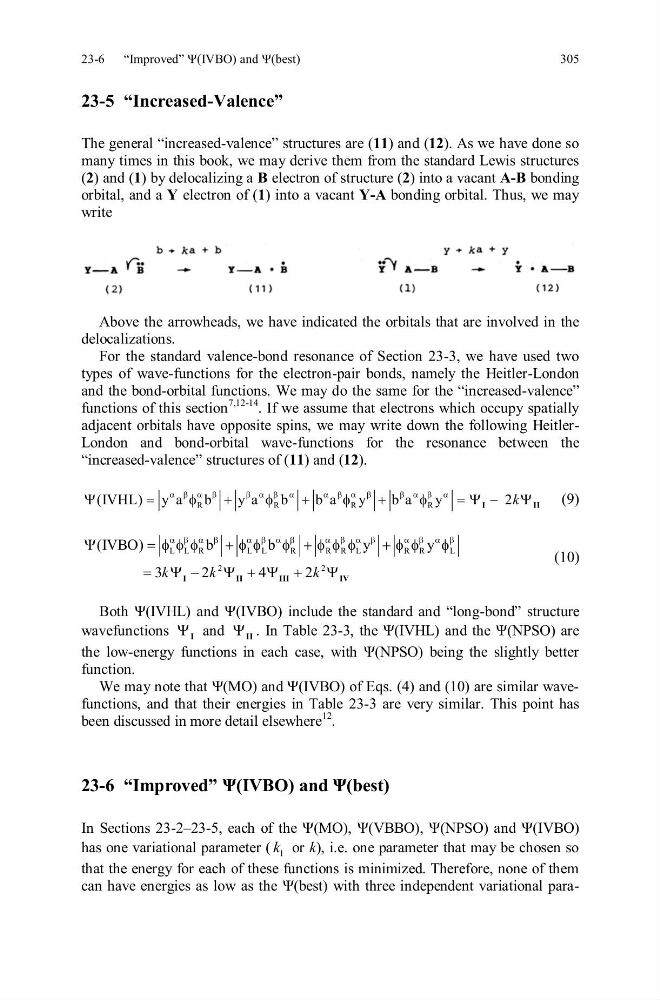
The general “increased-valence” structures are (11) and (12). As we have done so
many times in this book, we may derive them from the standard Lewis structures
(2) and (1) by delocalizing a B electron of structure (2) into a vacant A-B bonding
orbital, and a Υ electron of (1) into a vacant Y-A bonding orbital. Thus, we may
write
Above the arrowheads, we have indicated the orbitals that are involved in the
delocalizations.
For the standard valence-bond resonance of Section 23-3, we have used two
types of wave-functions for the electron-pair bonds, namely the Heitler-London
and the bond-orbital functions. We may do the same for the “increased-valence”
functions of this section
7,12-14
. If we assume that electrons which occupy spatially
adjacent orbitals have opposite spins, we may write down the following HeitlerLondon and bond-orbital wave-functions for the resonance between the
“increased-valence” structures of (11) and (12).
R
R
R
R
(IVHL) y a
b
y a
b
b a
y
b a
y
2k
I
II
(9)
L L R
L L
R
R R L
R R
L
2
2
(IVBO)
b
b
y
y
3
2
4
2
k
k
k
I
II
III
IV
(10)
Both Ψ(IVHL) and Ψ(ΙVΒΟ) include the standard and “long-bond” structure
wavefunctions I and II . In Table 23-3, the Ψ(IVHL) and the Ψ(NΡSO) are
the low-energy functions in each case, with Ψ(ΝΡSO) being the slightly better
function.
We may note that Ψ(MΟ) and Ψ(IVBO) of Eqs. (4) and (10) are similar wavefunctions, and that their energies in Table 23-3 are very similar. This point has
been discussed in more detail elsewhere
12
.
23-6 “Improved” Ψ(IVBO) and Ψ(best)
In Sections 23-2–23-5, each of the Ψ(MO), Ψ(VBBO), Ψ(NPSO) and Ψ(IVBO)
has one variational parameter ( 1
k or k), i.e. one parameter that may be chosen so
that the energy for each of these functions is minimized. Therefore, none of them
can have energies as low as the Ψ(best) with three independent variational para-
“Improved” Ψ(IVBO) and Ψ(best)
305
23-5 “Increased-Valence”
The general “increased-valence” structures are (11) and (12). As we have done so
many times in this book, we may derive them from the standard Lewis structures
(2) and (1) by delocalizing a B electron of structure (2) into a vacant A-B bonding
orbital, and a Υ electron of (1) into a vacant Y-A bonding orbital. Thus, we may
write
Above the arrowheads, we have indicated the orbitals that are involved in the
delocalizations.
For the standard valence-bond resonance of Section 23-3, we have used two
types of wave-functions for the electron-pair bonds, namely the Heitler-London
and the bond-orbital functions. We may do the same for the “increased-valence”
functions of this section
7,12-14
. If we assume that electrons which occupy spatially
adjacent orbitals have opposite spins, we may write down the following HeitlerLondon and bond-orbital wave-functions for the resonance between the
“increased-valence” structures of (11) and (12).
R
R
R
R
(IVHL) y a
b
y a
b
b a
y
b a
y
2k
I
II
(9)
L L R
L L
R
R R L
R R
L
2
2
(IVBO)
b
b
y
y
3
2
4
2
k
k
k
I
II
III
IV
(10)
Both Ψ(IVHL) and Ψ(ΙVΒΟ) include the standard and “long-bond” structure
wavefunctions I and II . In Table 23-3, the Ψ(IVHL) and the Ψ(NΡSO) are
the low-energy functions in each case, with Ψ(ΝΡSO) being the slightly better
function.
We may note that Ψ(MΟ) and Ψ(IVBO) of Eqs. (4) and (10) are similar wavefunctions, and that their energies in Table 23-3 are very similar. This point has
been discussed in more detail elsewhere
12
.
23-6 “Improved” Ψ(IVBO) and Ψ(best)
In Sections 23-2–23-5, each of the Ψ(MO), Ψ(VBBO), Ψ(NPSO) and Ψ(IVBO)
has one variational parameter ( 1
k or k), i.e. one parameter that may be chosen so
that the energy for each of these functions is minimized. Therefore, none of them
can have energies as low as the Ψ(best) with three independent variational para-