

Chapter 22 Free-Radical and Spin-Paired
Diradical Reactions
22-1 Types of Free Radical Reactions
Free radicals, with odd numbers of electrons, must have at least one orbital
(atomic or molecular) singly occupied. In the previous chapters, we have met with
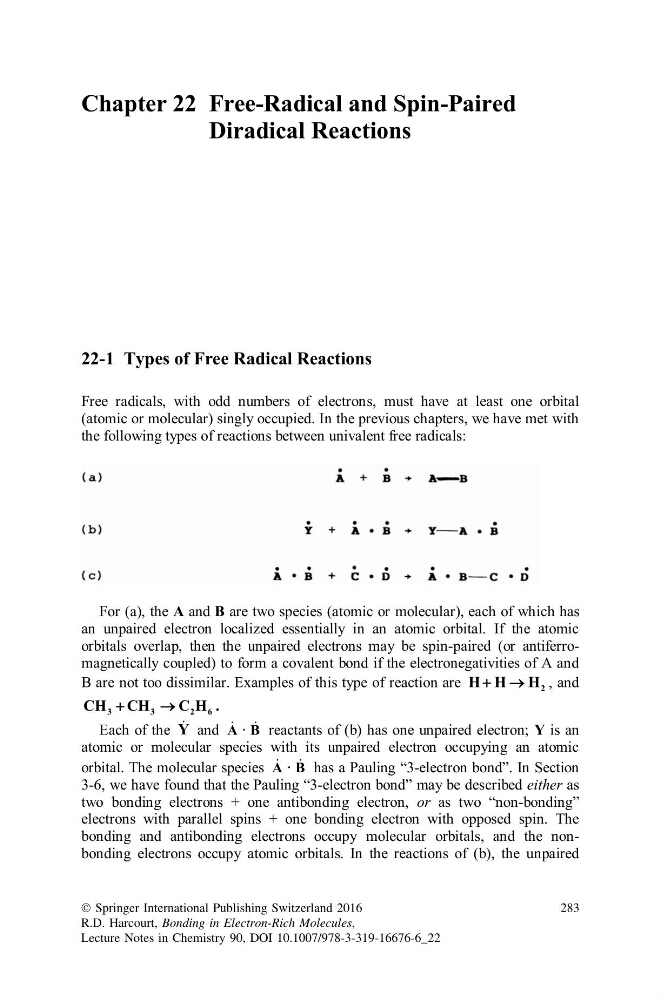
the following types of reactions between univalent free radicals:
For (a), the A and B are two species (atomic or molecular), each of which has
an unpaired electron localized essentially in an atomic orbital. If the atomic
orbitals overlap, then the unpaired electrons may be spin-paired (or antiferromagnetically coupled) to form a covalent bond if the electronegativities of A and
B are not too dissimilar. Examples of this type of reaction are
2
H H H
, and
3
3
2 6
CH CH
C H
.
Each of the Y and A · B
reactants of (b) has one unpaired electron; Υ is an
atomic or molecular species with its unpaired electron occupying an atomic
orbital. The molecular species A · B
has a Pauling “3-electron bond”. In Section
3-6, we have found that the Pauling “3-electron bond” may be described either as
two bonding electrons + one antibonding electron, or as two “non-bonding”
electrons with parallel spins + one bonding electron with opposed spin. The
bonding and antibonding electrons occupy molecular orbitals, and the nonbonding electrons occupy atomic orbitals. In the reactions of (b), the unpaired
Ó Springer International Publishing Switzerland 2016
R.D. Harcourt, Bonding in Electron-Rich Molecules,
Lecture Notes in Chemistry 90, DOI 10.1007/978-3-319-16676-6_22
283
Diradical Reactions
22-1 Types of Free Radical Reactions
Free radicals, with odd numbers of electrons, must have at least one orbital
(atomic or molecular) singly occupied. In the previous chapters, we have met with
the following types of reactions between univalent free radicals:
For (a), the A and B are two species (atomic or molecular), each of which has
an unpaired electron localized essentially in an atomic orbital. If the atomic
orbitals overlap, then the unpaired electrons may be spin-paired (or antiferromagnetically coupled) to form a covalent bond if the electronegativities of A and
B are not too dissimilar. Examples of this type of reaction are
2
H H H
, and
3
3
2 6
CH CH
C H
.
Each of the Y and A · B
reactants of (b) has one unpaired electron; Υ is an
atomic or molecular species with its unpaired electron occupying an atomic
orbital. The molecular species A · B
has a Pauling “3-electron bond”. In Section
3-6, we have found that the Pauling “3-electron bond” may be described either as
two bonding electrons + one antibonding electron, or as two “non-bonding”
electrons with parallel spins + one bonding electron with opposed spin. The
bonding and antibonding electrons occupy molecular orbitals, and the nonbonding electrons occupy atomic orbitals. In the reactions of (b), the unpaired
Ó Springer International Publishing Switzerland 2016
R.D. Harcourt, Bonding in Electron-Rich Molecules,
Lecture Notes in Chemistry 90, DOI 10.1007/978-3-319-16676-6_22
283