

Chapter 2 Pauling “3-Electron Bonds”,
4-Electron 3-Centre Bonding,
and the Need for an
“Increased-Valence” Theory
2-1 Introduction
In elementary chemical bonding theory, a rather neglected concept is a type of
chemical bond that Pauling has designated as the “3-electron bond”. This type of
bond is usually represented as A···Β and it involves three electrons distributed
amongst two overlapping atomic orbitals centred on the atoms A and B. Alternative designations
2 are either “3-electron 2-centre” bond or “3-electron 2-orbital”
bond.
In 1931, Pauling
1 introduced the “3-electron bond”, to help describe the electronic structures for a number of molecules and ions, such as NO,
2
He
, 2
O ,
2
NO and
2
ClO , whose ground-states are paramagnetic at room temperature.
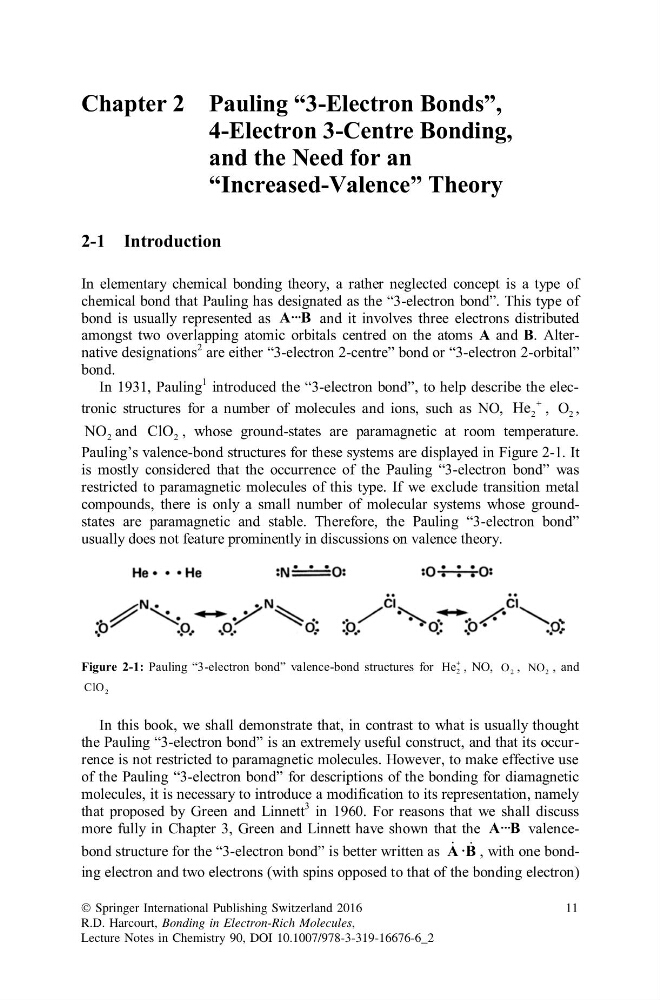
Pauling’s valence-bond structures for these systems are displayed in Figure 2-1. It
is mostly considered that the occurrence of the Pauling “3-electron bond” was
restricted to paramagnetic molecules of this type. If we exclude transition metal
compounds, there is only a small number of molecular systems whose groundstates are paramagnetic and stable. Therefore, the Pauling “3-electron bond”
usually does not feature prominently in discussions on valence theory.
Figure 2-1: Pauling “3-electron bond” valence-bond structures for
2
He
, NO, 2
O ,
2
NO , and
2
ClO
In this book, we shall demonstrate that, in contrast to what is usually thought
the Pauling “3-electron bond” is an extremely useful construct, and that its occurrence is not restricted to paramagnetic molecules. However, to make effective use
of the Pauling “3-electron bond” for descriptions of the bonding for diamagnetic
molecules, it is necessary to introduce a modification to its representation, namely
that proposed by Green and Linnett
3 in 1960. For reasons that we shall discuss
more fully in Chapter 3, Green and Linnett have shown that the A···Β valencebond structure for the “3-electron bond” is better written as
A ·Β , with one bonding electron and two electrons (with spins opposed to that of the bonding electron)
Ó Springer International Publishing Switzerland 2016
11
R.D. Harcourt, Bonding in Electron-Rich Molecules,
Lecture Notes in Chemistry 90, DOI 10.1007/978-3-319-16676-6_2
4-Electron 3-Centre Bonding,
and the Need for an
“Increased-Valence” Theory
2-1 Introduction
In elementary chemical bonding theory, a rather neglected concept is a type of
chemical bond that Pauling has designated as the “3-electron bond”. This type of
bond is usually represented as A···Β and it involves three electrons distributed
amongst two overlapping atomic orbitals centred on the atoms A and B. Alternative designations
2 are either “3-electron 2-centre” bond or “3-electron 2-orbital”
bond.
In 1931, Pauling
1 introduced the “3-electron bond”, to help describe the electronic structures for a number of molecules and ions, such as NO,
2
He
, 2
O ,
2
NO and
2
ClO , whose ground-states are paramagnetic at room temperature.
Pauling’s valence-bond structures for these systems are displayed in Figure 2-1. It
is mostly considered that the occurrence of the Pauling “3-electron bond” was
restricted to paramagnetic molecules of this type. If we exclude transition metal
compounds, there is only a small number of molecular systems whose groundstates are paramagnetic and stable. Therefore, the Pauling “3-electron bond”
usually does not feature prominently in discussions on valence theory.
Figure 2-1: Pauling “3-electron bond” valence-bond structures for
2
He
, NO, 2
O ,
2
NO , and
2
ClO
In this book, we shall demonstrate that, in contrast to what is usually thought
the Pauling “3-electron bond” is an extremely useful construct, and that its occurrence is not restricted to paramagnetic molecules. However, to make effective use
of the Pauling “3-electron bond” for descriptions of the bonding for diamagnetic
molecules, it is necessary to introduce a modification to its representation, namely
that proposed by Green and Linnett
3 in 1960. For reasons that we shall discuss
more fully in Chapter 3, Green and Linnett have shown that the A···Β valencebond structure for the “3-electron bond” is better written as
A ·Β , with one bonding electron and two electrons (with spins opposed to that of the bonding electron)
Ó Springer International Publishing Switzerland 2016
11
R.D. Harcourt, Bonding in Electron-Rich Molecules,
Lecture Notes in Chemistry 90, DOI 10.1007/978-3-319-16676-6_2