

Addendum Chapter 18
245
25. R.S. Drago and B.B. Corden, Accounts, Chem. Res., 13, 353 (1980).
26. Y. Seno and J. Otsuka, Adv. Biophys., 11, 13 (1978) and references 75-77 therein.
27. W.A. Goddard and B.D. Olafson, Proc. Natl. Acad. Sci. U.S.A., 72, 2335 (1975); 74,
1315 (1977).
28. B.H. Huynh, D.A. Case and M. Karplus, J. Amer. Chem. Soc., 99, 6103 (1977); 101,
4433 (1979).
29. A.K. Churg and M.W. Makinen, J. Chem. Phys., 68, 1913 (1978).
30. G.B. Jameson, G.A. Rodley, W.T. Robinson, R.R. Gayne, C.A. Reed and J.P. Collman,
Inorg. Chem., 17, 850, (1978).
31. C.H. Barlow, J.C. Maxwell, W.J. Wallace and W.S. Caughey, Biochem. Biophys. Res.
Comm., 55, 51 (1973).
32. J.P. Collman, J.I. Brauman, T.G. Halbert and K.S. Suslick, Proc. Natl. Acad. Sci.
U.S.A., 73, 3333 (1976).
33. D.A. Summerville, R.D. Jones, B.M. Hoffman and F. Basolo, J. Chem. Educ., 56, 157
(1979).
34. R.D. Jones, D.A. Summerville and F. Basolo, Chem. Revs., 79, 139 (1979).
Addendum Chapter 18
See Ref. 35 for: (a) further consideration of the Pauling-Coryell, McClure and
Weiss models of Fe-O 2 bonding in oxyhemoglobin, and (b) Refs. 19, 24 and 62
therein for reviews of computational studies of heme-O 2 and heme-NO bonding.
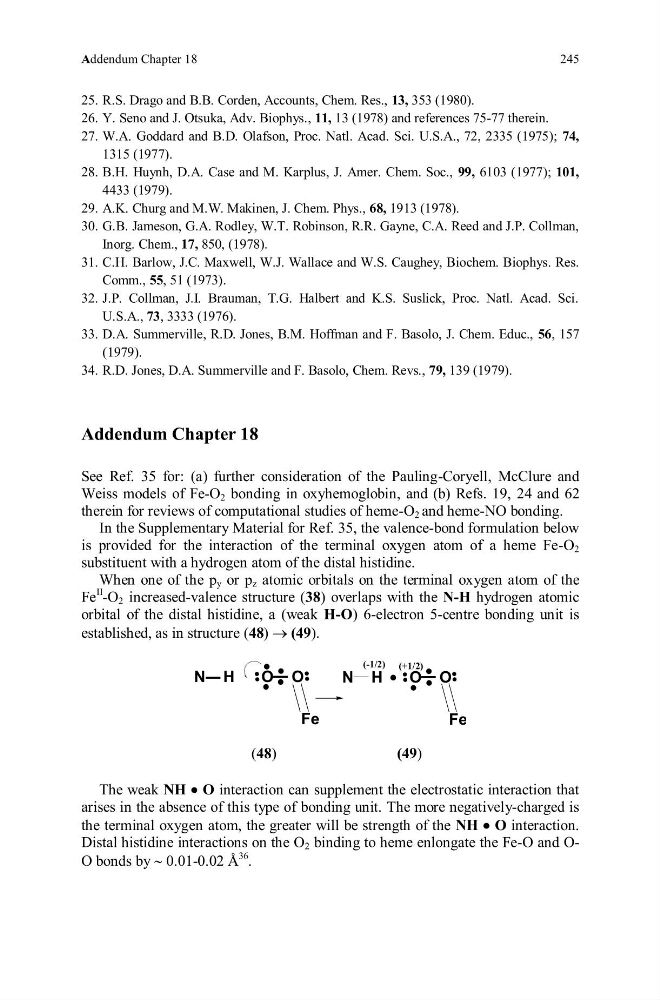
In the Supplementary Material for Ref. 35, the valence-bond formulation below
is provided for the interaction of the terminal oxygen atom of a heme Fe-O 2
substituent with a hydrogen atom of the distal histidine.
When one of the p y or p z atomic orbitals on the terminal oxygen atom of the
Fe
II
-O 2 increased-valence structure (38) overlaps with the N-H hydrogen atomic
orbital of the distal histidine, a (weak H-O) 6-electron 5-centre bonding unit is
established, as in structure (48) (49).
N H
O O
Fe
N H
O O
Fe
(+1/2)
(-1/2)
(48)
(49)
The weak NH O interaction can supplement the electrostatic interaction that
arises in the absence of this type of bonding unit. The more negatively-charged is
the terminal oxygen atom, the greater will be strength of the NH O interaction.
Distal histidine interactions on the O 2 binding to heme enlongate the Fe-O and OO bonds by 0.01-0.02 Å
36
.
245
25. R.S. Drago and B.B. Corden, Accounts, Chem. Res., 13, 353 (1980).
26. Y. Seno and J. Otsuka, Adv. Biophys., 11, 13 (1978) and references 75-77 therein.
27. W.A. Goddard and B.D. Olafson, Proc. Natl. Acad. Sci. U.S.A., 72, 2335 (1975); 74,
1315 (1977).
28. B.H. Huynh, D.A. Case and M. Karplus, J. Amer. Chem. Soc., 99, 6103 (1977); 101,
4433 (1979).
29. A.K. Churg and M.W. Makinen, J. Chem. Phys., 68, 1913 (1978).
30. G.B. Jameson, G.A. Rodley, W.T. Robinson, R.R. Gayne, C.A. Reed and J.P. Collman,
Inorg. Chem., 17, 850, (1978).
31. C.H. Barlow, J.C. Maxwell, W.J. Wallace and W.S. Caughey, Biochem. Biophys. Res.
Comm., 55, 51 (1973).
32. J.P. Collman, J.I. Brauman, T.G. Halbert and K.S. Suslick, Proc. Natl. Acad. Sci.
U.S.A., 73, 3333 (1976).
33. D.A. Summerville, R.D. Jones, B.M. Hoffman and F. Basolo, J. Chem. Educ., 56, 157
(1979).
34. R.D. Jones, D.A. Summerville and F. Basolo, Chem. Revs., 79, 139 (1979).
Addendum Chapter 18
See Ref. 35 for: (a) further consideration of the Pauling-Coryell, McClure and
Weiss models of Fe-O 2 bonding in oxyhemoglobin, and (b) Refs. 19, 24 and 62
therein for reviews of computational studies of heme-O 2 and heme-NO bonding.
In the Supplementary Material for Ref. 35, the valence-bond formulation below
is provided for the interaction of the terminal oxygen atom of a heme Fe-O 2
substituent with a hydrogen atom of the distal histidine.
When one of the p y or p z atomic orbitals on the terminal oxygen atom of the
Fe
II
-O 2 increased-valence structure (38) overlaps with the N-H hydrogen atomic
orbital of the distal histidine, a (weak H-O) 6-electron 5-centre bonding unit is
established, as in structure (48) (49).
N H
O O
Fe
N H
O O
Fe
(+1/2)
(-1/2)
(48)
(49)
The weak NH O interaction can supplement the electrostatic interaction that
arises in the absence of this type of bonding unit. The more negatively-charged is
the terminal oxygen atom, the greater will be strength of the NH O interaction.
Distal histidine interactions on the O 2 binding to heme enlongate the Fe-O and OO bonds by 0.01-0.02 Å
36
.