

18-4
Dioxygenyl Adducts
243
The
2
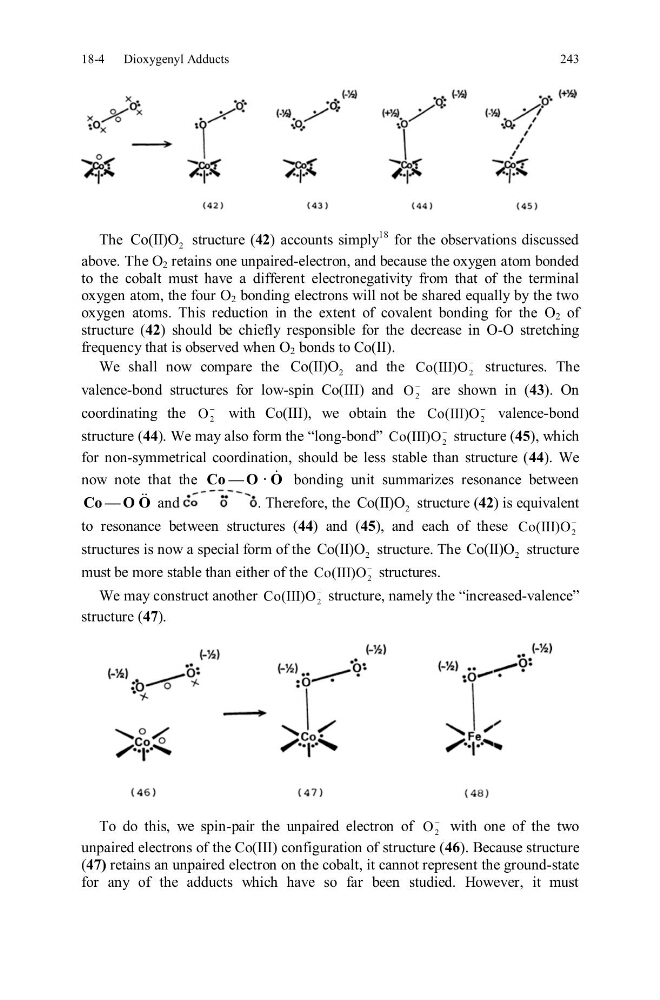
Co(II)O structure (42) accounts simply
18 for the observations discussed
above. The O 2 retains one unpaired-electron, and because the oxygen atom bonded
to the cobalt must have a different electronegativity from that of the terminal
oxygen atom, the four O 2 bonding electrons will not be shared equally by the two
oxygen atoms. This reduction in the extent of covalent bonding for the O 2 of
structure (42) should be chiefly responsible for the decrease in O-O stretching
frequency that is observed when O 2 bonds to Co(II).
We shall now compare the
2
Co(II)O and the
2
Co(III)O
structures. The
valence-bond structures for low-spin Co(III) and 2
O
are shown in (43). On
coordinating the
2
O
with Co(III), we obtain the
2
Co(III)O
valence-bond
structure (44). We may also form the “long-bond”
2
Co(III)O
structure (45), which
for non-symmetrical coordination, should be less stable than structure (44). We
now note that the
Co — O · O bonding unit summarizes resonance between
Co — O O and
. Therefore, the
2
Co(II)O structure (42) is equivalent
to resonance between structures (44) and (45), and each of these
2
Co(III)O
structures is now a special form of the
2
Co(II)O structure. The
2
Co(II)O structure
must be more stable than either of the
2
Co(III)O
structures.
We may construct another
2
Co(III)O
structure, namely the “increased-valence”
structure (47).
To do this, we spin-pair the unpaired electron of 2
O
with one of the two
unpaired electrons of the Co(III) configuration of structure (46). Because structure
(47) retains an unpaired electron on the cobalt, it cannot represent the ground-state
for any of the adducts which have so far been studied. However, it must
Dioxygenyl Adducts
243
The
2
Co(II)O structure (42) accounts simply
18 for the observations discussed
above. The O 2 retains one unpaired-electron, and because the oxygen atom bonded
to the cobalt must have a different electronegativity from that of the terminal
oxygen atom, the four O 2 bonding electrons will not be shared equally by the two
oxygen atoms. This reduction in the extent of covalent bonding for the O 2 of
structure (42) should be chiefly responsible for the decrease in O-O stretching
frequency that is observed when O 2 bonds to Co(II).
We shall now compare the
2
Co(II)O and the
2
Co(III)O
structures. The
valence-bond structures for low-spin Co(III) and 2
O
are shown in (43). On
coordinating the
2
O
with Co(III), we obtain the
2
Co(III)O
valence-bond
structure (44). We may also form the “long-bond”
2
Co(III)O
structure (45), which
for non-symmetrical coordination, should be less stable than structure (44). We
now note that the
Co — O · O bonding unit summarizes resonance between
Co — O O and
. Therefore, the
2
Co(II)O structure (42) is equivalent
to resonance between structures (44) and (45), and each of these
2
Co(III)O
structures is now a special form of the
2
Co(II)O structure. The
2
Co(II)O structure
must be more stable than either of the
2
Co(III)O
structures.
We may construct another
2
Co(III)O
structure, namely the “increased-valence”
structure (47).
To do this, we spin-pair the unpaired electron of 2
O
with one of the two
unpaired electrons of the Co(III) configuration of structure (46). Because structure
(47) retains an unpaired electron on the cobalt, it cannot represent the ground-state
for any of the adducts which have so far been studied. However, it must