

6
Chapter 1 Atomic Orbitals, Electron Spin, Linear Combinations
momentum generates a magnetic moment of
( 2)
n n
Bohr magneton for which
n ≡ 2S is the number of unpaired-electron spins.
1-3 Linear Combinations of Wave Functions
If 1
and 2
are two (real) wave-functions, then linear combinations of the form
1 1
2 2
c
c
(or
1
2
k
) may be constructed, in which the coefficients
1
c and 2
c (or k) are constants. If the coefficients 1
c and 2
c are determined so that
the energy of ψ (i.e.
ˆ
/
2
1
2
Ε
H d
d
with ˆ Hamiltonian operator
H
) is
a minimum, then provided that 1
and 2
interact (i.e. H 12
12
1
2
ˆ
H
d 0
H
),
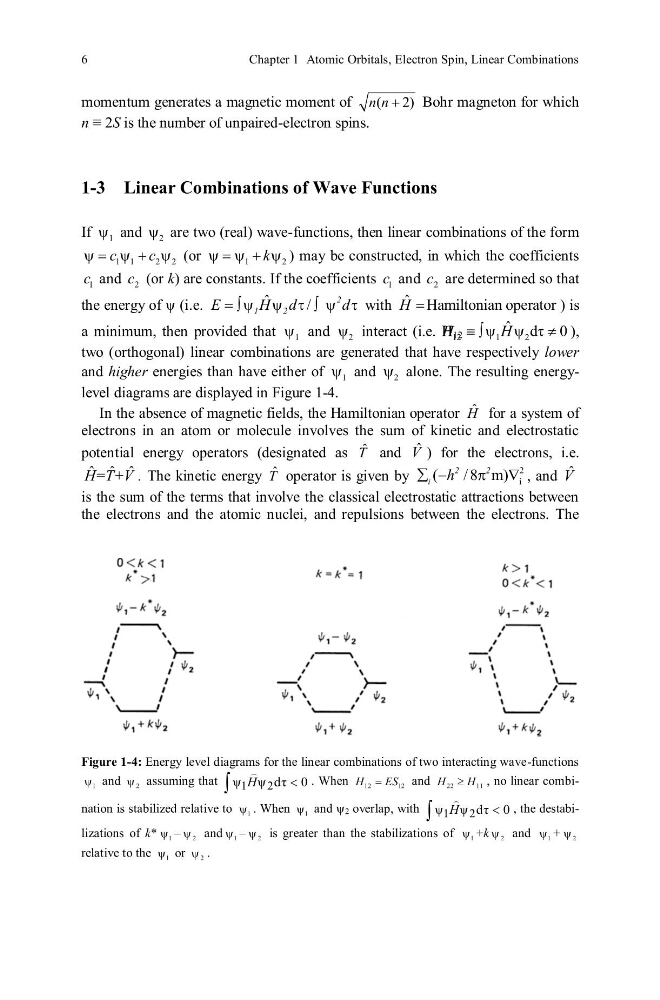
two (orthogonal) linear combinations are generated that have respectively lower
and higher energies than have either of 1
and 2
alone. The resulting energylevel diagrams are displayed in Figure 1-4.
In the absence of magnetic fields, the Hamiltonian operator ˆ
H for a system of
electrons in an atom or molecule involves the sum of kinetic and electrostatic
potential energy operators (designated as ˆ
T and ˆ
V ) for the electrons, i.e.
ˆ ˆ ˆ
H=Τ+V . The kinetic energy ˆ
T operator is given by
2
i
(
/ 8 m)
2
2
i
h
, and ˆ
V
is the sum of the terms that involve the classical electrostatic attractions between
the electrons and the atomic nuclei, and repulsions between the electrons. The
Figure 1-4: Energy level diagrams for the linear combinations of two interacting wave-functions
1
and 2
assuming that
0
dτ
ψ
ψ
2
1 H
. When 12
12
H
ES and 22
11
H
H , no linear combination is stabilized relative to 1
. When 1
and 2 overlap, with
0
dτ
ψ
ψ
2
1 H
, the destabilizations of k* 1
– 2
and 1
– 2
is greater than the stabilizations of 1
+k 2
and 1
+ 2
relative to the 1
or 2
.
Chapter 1 Atomic Orbitals, Electron Spin, Linear Combinations
momentum generates a magnetic moment of
( 2)
n n
Bohr magneton for which
n ≡ 2S is the number of unpaired-electron spins.
1-3 Linear Combinations of Wave Functions
If 1
and 2
are two (real) wave-functions, then linear combinations of the form
1 1
2 2
c
c
(or
1
2
k
) may be constructed, in which the coefficients
1
c and 2
c (or k) are constants. If the coefficients 1
c and 2
c are determined so that
the energy of ψ (i.e.
ˆ
/
2
1
2
Ε
H d
d
with ˆ Hamiltonian operator
H
) is
a minimum, then provided that 1
and 2
interact (i.e. H 12
12
1
2
ˆ
H
d 0
H
),
two (orthogonal) linear combinations are generated that have respectively lower
and higher energies than have either of 1
and 2
alone. The resulting energylevel diagrams are displayed in Figure 1-4.
In the absence of magnetic fields, the Hamiltonian operator ˆ
H for a system of
electrons in an atom or molecule involves the sum of kinetic and electrostatic
potential energy operators (designated as ˆ
T and ˆ
V ) for the electrons, i.e.
ˆ ˆ ˆ
H=Τ+V . The kinetic energy ˆ
T operator is given by
2
i
(
/ 8 m)
2
2
i
h
, and ˆ
V
is the sum of the terms that involve the classical electrostatic attractions between
the electrons and the atomic nuclei, and repulsions between the electrons. The
Figure 1-4: Energy level diagrams for the linear combinations of two interacting wave-functions
1
and 2
assuming that
0
dτ
ψ
ψ
2
1 H
. When 12
12
H
ES and 22
11
H
H , no linear combination is stabilized relative to 1
. When 1
and 2 overlap, with
0
dτ
ψ
ψ
2
1 H
, the destabilizations of k* 1
– 2
and 1
– 2
is greater than the stabilizations of 1
+k 2
and 1
+ 2
relative to the 1
or 2
.