

206
Chapter 15 Slater Determinants and Wave-Functions for “Increased-Valence” Structures
(1)
(2)
for which the identities of Eqs. (3-36) and (3-35) have been used.
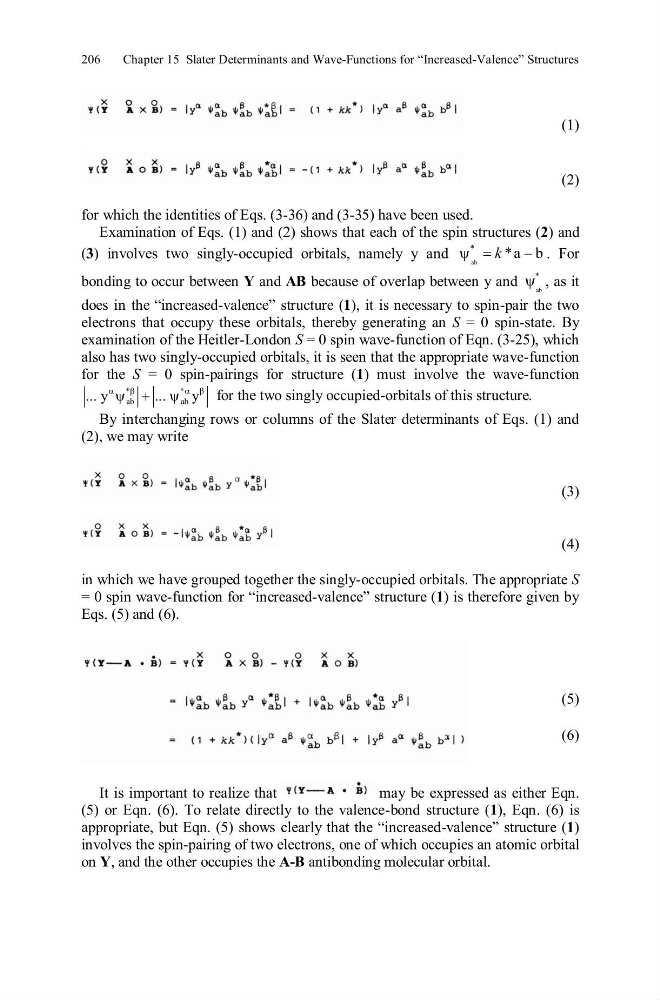
Examination of Eqs. (1) and (2) shows that each of the spin structures (2) and
(3) involves two singly-occupied orbitals, namely y and
ab
*
*a – b
k
. For
bonding to occur between Y and AB because of overlap between y and
ab
*
, as it
does in the “increased-valence” structure (1), it is necessary to spin-pair the two
electrons that occupy these orbitals, thereby generating an S = 0 spin-state. By
examination of the Heitler-London S = 0 spin wave-function of Eqn. (3-25), which
also has two singly-occupied orbitals, it is seen that the appropriate wave-function
for the S = 0 spin-pairings for structure (1) must involve the wave-function
*
*
ab
ab
... y
...
y
for the two singly occupied-orbitals of this structure.
By interchanging rows or columns of the Slater determinants of Eqs. (1) and
(2), we may write
(3)
(4)
in which we have grouped together the singly-occupied orbitals. The appropriate S
= 0 spin wave-function for “increased-valence” structure (1) is therefore given by
Eqs. (5) and (6).
(5)
(6)
It is important to realize that
may be expressed as either Eqn.
(5) or Eqn. (6). To relate directly to the valence-bond structure (1), Eqn. (6) is
appropriate, but Eqn. (5) shows clearly that the “increased-valence” structure (1)
involves the spin-pairing of two electrons, one of which occupies an atomic orbital
on Y, and the other occupies the A-B antibonding molecular orbital.
Chapter 15 Slater Determinants and Wave-Functions for “Increased-Valence” Structures
(1)
(2)
for which the identities of Eqs. (3-36) and (3-35) have been used.
Examination of Eqs. (1) and (2) shows that each of the spin structures (2) and
(3) involves two singly-occupied orbitals, namely y and
ab
*
*a – b
k
. For
bonding to occur between Y and AB because of overlap between y and
ab
*
, as it
does in the “increased-valence” structure (1), it is necessary to spin-pair the two
electrons that occupy these orbitals, thereby generating an S = 0 spin-state. By
examination of the Heitler-London S = 0 spin wave-function of Eqn. (3-25), which
also has two singly-occupied orbitals, it is seen that the appropriate wave-function
for the S = 0 spin-pairings for structure (1) must involve the wave-function
*
*
ab
ab
... y
...
y
for the two singly occupied-orbitals of this structure.
By interchanging rows or columns of the Slater determinants of Eqs. (1) and
(2), we may write
(3)
(4)
in which we have grouped together the singly-occupied orbitals. The appropriate S
= 0 spin wave-function for “increased-valence” structure (1) is therefore given by
Eqs. (5) and (6).
(5)
(6)
It is important to realize that
may be expressed as either Eqn.
(5) or Eqn. (6). To relate directly to the valence-bond structure (1), Eqn. (6) is
appropriate, but Eqn. (5) shows clearly that the “increased-valence” structure (1)
involves the spin-pairing of two electrons, one of which occupies an atomic orbital
on Y, and the other occupies the A-B antibonding molecular orbital.