

References
187
and
3
2
2
NO O
NO O
reactions. “Increased-valence” mechanisms for these
reactions are described in Chapter 22. The general “increased-valence” structures
for 5-electron 4-centre and 7-electron 5-centre bonding units are of types (79) and
(80) respectively. They may be constructed by bonding the “increased-valence”
structure
Y—A · B to either an atom C with one unpaired electron, or to the
diatomic Pauling “3-electron bond” structure C · D
, as is shown. Electron spin
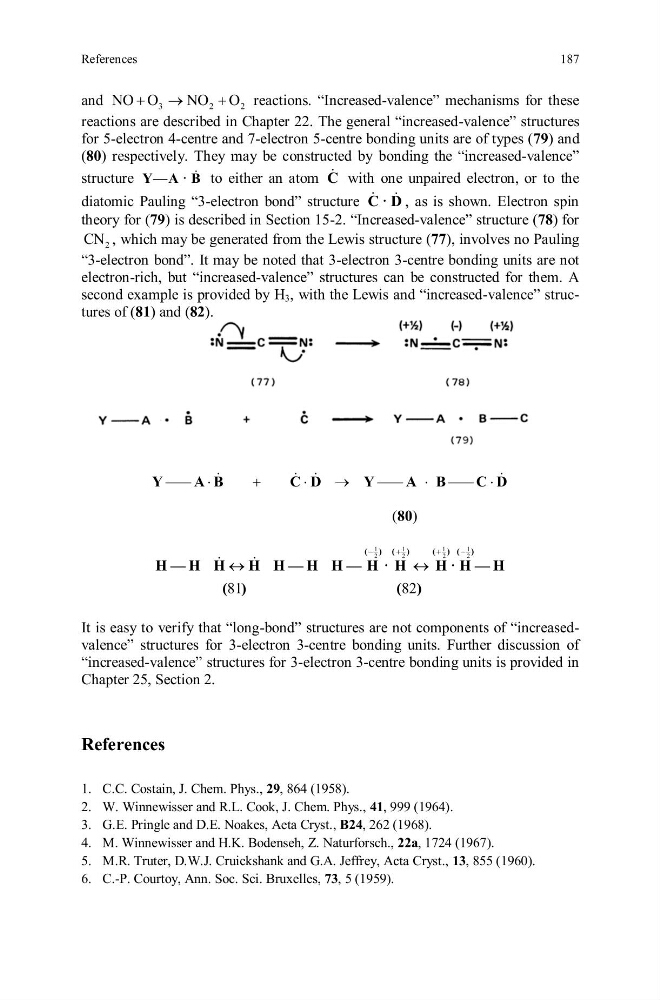
theory for (79) is described in Section 15-2. “Increased-valence” structure (78) for
2
CN , which may be generated from the Lewis structure (77), involves no Pauling
“3-electron bond”. It may be noted that 3-electron 3-centre bonding units are not
electron-rich, but “increased-valence” structures can be constructed for them. A
second example is provided by H 3 , with the Lewis and “increased-valence” structures of (81) and (82).
D
C
B
A
Y
D
C
B
A
Y
(80)
1
1
1
1
2
2
2
2
81
82
( ) ( )
( ) ( )
H — H H
H H — H H — H · H
H · H — H
( )
( )
It is easy to verify that “long-bond” structures are not components of “increasedvalence” structures for 3-electron 3-centre bonding units. Further discussion of
“increased-valence” structures for 3-electron 3-centre bonding units is provided in
Chapter 25, Section 2.
References
1. C.C. Costain, J. Chem. Phys., 29, 864 (1958).
2. W. Winnewisser and R.L. Cook, J. Chem. Phys., 41, 999 (1964).
3. G.E. Pringle and D.E. Noakes, Aeta Cryst., B24, 262 (1968).
4. M. Winnewisser and H.K. Bodenseh, Z. Naturforsch., 22a, 1724 (1967).
5. M.R. Truter, D.W.J. Cruickshank and G.A. Jeffrey, Acta Cryst., 13, 855 (1960).
6. C.-P. Courtoy, Ann. Soc. Sci. Bruxelles, 73, 5 (1959).
187
and
3
2
2
NO O
NO O
reactions. “Increased-valence” mechanisms for these
reactions are described in Chapter 22. The general “increased-valence” structures
for 5-electron 4-centre and 7-electron 5-centre bonding units are of types (79) and
(80) respectively. They may be constructed by bonding the “increased-valence”
structure
Y—A · B to either an atom C with one unpaired electron, or to the
diatomic Pauling “3-electron bond” structure C · D
, as is shown. Electron spin
theory for (79) is described in Section 15-2. “Increased-valence” structure (78) for
2
CN , which may be generated from the Lewis structure (77), involves no Pauling
“3-electron bond”. It may be noted that 3-electron 3-centre bonding units are not
electron-rich, but “increased-valence” structures can be constructed for them. A
second example is provided by H 3 , with the Lewis and “increased-valence” structures of (81) and (82).
D
C
B
A
Y
D
C
B
A
Y
(80)
1
1
1
1
2
2
2
2
81
82
( ) ( )
( ) ( )
H — H H
H H — H H — H · H
H · H — H
( )
( )
It is easy to verify that “long-bond” structures are not components of “increasedvalence” structures for 3-electron 3-centre bonding units. Further discussion of
“increased-valence” structures for 3-electron 3-centre bonding units is provided in
Chapter 25, Section 2.
References
1. C.C. Costain, J. Chem. Phys., 29, 864 (1958).
2. W. Winnewisser and R.L. Cook, J. Chem. Phys., 41, 999 (1964).
3. G.E. Pringle and D.E. Noakes, Aeta Cryst., B24, 262 (1968).
4. M. Winnewisser and H.K. Bodenseh, Z. Naturforsch., 22a, 1724 (1967).
5. M.R. Truter, D.W.J. Cruickshank and G.A. Jeffrey, Acta Cryst., 13, 855 (1960).
6. C.-P. Courtoy, Ann. Soc. Sci. Bruxelles, 73, 5 (1959).