

13-8
“Increased-Valence” Structures for Longer N-Centre Bonding Units
183
13-8 (a) 4 3
S N
: 10-electron 7-centre bonding
The 4 3
S N
cation is planar and cyclic with the geometry
33, 34 of (66). Planar 4 3
S N
has ten π-electrons distributed amongst seven overlapping pπ-atomic orbitals. The
S-N bond-lengths are all shorter than the estimate of 1.67 Å for the length of an SN single-bond
35
. From the standard Lewis structure (67), we may generate
“increased-valence” structure (68), which involves a 10-electron 7-centre
“increased-valence” bonding unit of type (69), and indicates the presence of
partial double-bond character for all of the S-N bonds. If only the standard Lewis
structures are used to represent the electronic structure of 4 3
S N
, it is necessary to
invoke resonance between structure (67) and four other Lewis structures that
differ in the positions of the two S-N π-bonds. Therefore, the main qualitative
features of the electronic structure may be described more economically by using
the “increased-valence” structure (68) for 4 3
S N
. This “increased-valence” structure associates partial double-bond character with each of the S-N bonds, thereby
accounting for the observed shortening of these bonds relative to the single-bond
length. Partial double-bond character for the S-S bond is also present in structure
(68), but the length of this bond (2.070, 2.088 Å) is longer rather than shorter than
the standard single-bond length of 2.06 Å for H 2 S 2 . This lengthening may be a
consequence of a combination of the following factors:
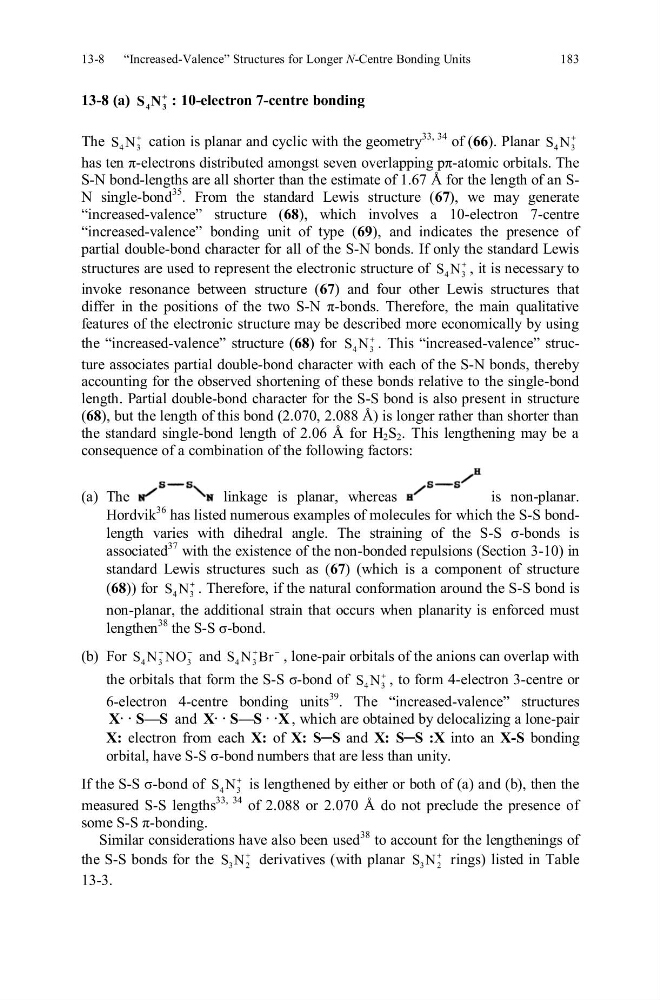
(a) The
linkage is planar, whereas
is non-planar.
Hordvik
36 has listed numerous examples of molecules for which the S-S bondlength varies with dihedral angle. The straining of the S-S σ-bonds is
associated
37 with the existence of the non-bonded repulsions (Section 3-10) in
standard Lewis structures such as (67) (which is a component of structure
(68)) for 4 3
S N
. Therefore, if the natural conformation around the S-S bond is
non-planar, the additional strain that occurs when planarity is enforced must
lengthen
38 the S-S σ-bond.
(b) For 4 3
3
S N NO
and 4 3
S N Br
, lone-pair orbitals of the anions can overlap with
the orbitals that form the S-S σ-bond of 4 3
S N
, to form 4-electron 3-centre or
6-electron 4-centre bonding units
39 . The “increased-valence” structures
X· · S—S and X· · S—S · ·X , which are obtained by delocalizing a lone-pair
X: electron from each X: of X: S─S and X: S─S :X into an X-S bonding
orbital, have S-S σ-bond numbers that are less than unity.
If the S-S σ-bond of 4 3
S N
is lengthened by either or both of (a) and (b), then the
measured S-S lengths
33, 34 of 2.088 or 2.070 Å do not preclude the presence of
some S-S π-bonding.
Similar considerations have also been used
38 to account for the lengthenings of
the S-S bonds for the 3 2
S N
derivatives (with planar 3 2
S N
rings) listed in Table
13-3.
“Increased-Valence” Structures for Longer N-Centre Bonding Units
183
13-8 (a) 4 3
S N
: 10-electron 7-centre bonding
The 4 3
S N
cation is planar and cyclic with the geometry
33, 34 of (66). Planar 4 3
S N
has ten π-electrons distributed amongst seven overlapping pπ-atomic orbitals. The
S-N bond-lengths are all shorter than the estimate of 1.67 Å for the length of an SN single-bond
35
. From the standard Lewis structure (67), we may generate
“increased-valence” structure (68), which involves a 10-electron 7-centre
“increased-valence” bonding unit of type (69), and indicates the presence of
partial double-bond character for all of the S-N bonds. If only the standard Lewis
structures are used to represent the electronic structure of 4 3
S N
, it is necessary to
invoke resonance between structure (67) and four other Lewis structures that
differ in the positions of the two S-N π-bonds. Therefore, the main qualitative
features of the electronic structure may be described more economically by using
the “increased-valence” structure (68) for 4 3
S N
. This “increased-valence” structure associates partial double-bond character with each of the S-N bonds, thereby
accounting for the observed shortening of these bonds relative to the single-bond
length. Partial double-bond character for the S-S bond is also present in structure
(68), but the length of this bond (2.070, 2.088 Å) is longer rather than shorter than
the standard single-bond length of 2.06 Å for H 2 S 2 . This lengthening may be a
consequence of a combination of the following factors:
(a) The
linkage is planar, whereas
is non-planar.
Hordvik
36 has listed numerous examples of molecules for which the S-S bondlength varies with dihedral angle. The straining of the S-S σ-bonds is
associated
37 with the existence of the non-bonded repulsions (Section 3-10) in
standard Lewis structures such as (67) (which is a component of structure
(68)) for 4 3
S N
. Therefore, if the natural conformation around the S-S bond is
non-planar, the additional strain that occurs when planarity is enforced must
lengthen
38 the S-S σ-bond.
(b) For 4 3
3
S N NO
and 4 3
S N Br
, lone-pair orbitals of the anions can overlap with
the orbitals that form the S-S σ-bond of 4 3
S N
, to form 4-electron 3-centre or
6-electron 4-centre bonding units
39 . The “increased-valence” structures
X· · S—S and X· · S—S · ·X , which are obtained by delocalizing a lone-pair
X: electron from each X: of X: S─S and X: S─S :X into an X-S bonding
orbital, have S-S σ-bond numbers that are less than unity.
If the S-S σ-bond of 4 3
S N
is lengthened by either or both of (a) and (b), then the
measured S-S lengths
33, 34 of 2.088 or 2.070 Å do not preclude the presence of
some S-S π-bonding.
Similar considerations have also been used
38 to account for the lengthenings of
the S-S bonds for the 3 2
S N
derivatives (with planar 3 2
S N
rings) listed in Table
13-3.