

172
Chapter 13 “Increased-Valence” Structures for N-Centre Bonding Units
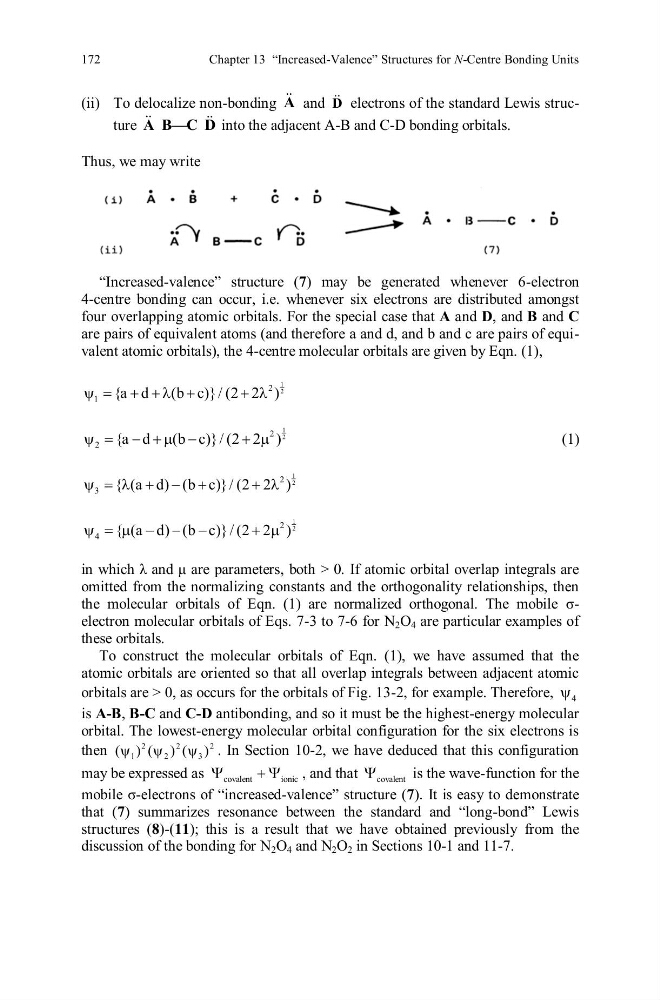
(ii) To delocalize non-bonding A and D electrons of the standard Lewis structure A B—C D
into the adjacent A-B and C-D bonding orbitals.
Thus, we may write
“Increased-valence” structure (7) may be generated whenever 6-electron
4-centre bonding can occur, i.e. whenever six electrons are distributed amongst
four overlapping atomic orbitals. For the special case that A and D, and B and C
are pairs of equivalent atoms (and therefore a and d, and b and c are pairs of equivalent atomic orbitals), the 4-centre molecular orbitals are given by Eqn. (1),
1
2
2
1
{a d (b c)} / (2 2 )
1
2
2
2
{a d (b c)} / (2 2 )
(1)
1
2
2
3
{ (a d) (b c)} / (2 2 )
1
2
2
4
{ (a d) (b c)} / (2 2 )
in which λ and μ are parameters, both > 0. If atomic orbital overlap integrals are
omitted from the normalizing constants and the orthogonality relationships, then
the molecular orbitals of Eqn. (1) are normalized orthogonal. The mobile σelectron molecular orbitals of Eqs. 7-3 to 7-6 for N 2 O 4 are particular examples of
these orbitals.
To construct the molecular orbitals of Eqn. (1), we have assumed that the
atomic orbitals are oriented so that all overlap integrals between adjacent atomic
orbitals are > 0, as occurs for the orbitals of Fig. 13-2, for example. Therefore, 4
is A-B, B-C and C-D antibonding, and so it must be the highest-energy molecular
orbital. The lowest-energy molecular orbital configuration for the six electrons is
then
2
2
2
1
2
3
( ) ( ) ( )
. In Section 10-2, we have deduced that this configuration
may be expressed as covalent
ionic
, and that covalent
is the wave-function for the
mobile σ-electrons of “increased-valence” structure (7). It is easy to demonstrate
that (7) summarizes resonance between the standard and “long-bond” Lewis
structures (8)-(11); this is a result that we have obtained previously from the
discussion of the bonding for N 2 O 4 and N 2 O 2 in Sections 10-1 and 11-7.
Chapter 13 “Increased-Valence” Structures for N-Centre Bonding Units
(ii) To delocalize non-bonding A and D electrons of the standard Lewis structure A B—C D
into the adjacent A-B and C-D bonding orbitals.
Thus, we may write
“Increased-valence” structure (7) may be generated whenever 6-electron
4-centre bonding can occur, i.e. whenever six electrons are distributed amongst
four overlapping atomic orbitals. For the special case that A and D, and B and C
are pairs of equivalent atoms (and therefore a and d, and b and c are pairs of equivalent atomic orbitals), the 4-centre molecular orbitals are given by Eqn. (1),
1
2
2
1
{a d (b c)} / (2 2 )
1
2
2
2
{a d (b c)} / (2 2 )
(1)
1
2
2
3
{ (a d) (b c)} / (2 2 )
1
2
2
4
{ (a d) (b c)} / (2 2 )
in which λ and μ are parameters, both > 0. If atomic orbital overlap integrals are
omitted from the normalizing constants and the orthogonality relationships, then
the molecular orbitals of Eqn. (1) are normalized orthogonal. The mobile σelectron molecular orbitals of Eqs. 7-3 to 7-6 for N 2 O 4 are particular examples of
these orbitals.
To construct the molecular orbitals of Eqn. (1), we have assumed that the
atomic orbitals are oriented so that all overlap integrals between adjacent atomic
orbitals are > 0, as occurs for the orbitals of Fig. 13-2, for example. Therefore, 4
is A-B, B-C and C-D antibonding, and so it must be the highest-energy molecular
orbital. The lowest-energy molecular orbital configuration for the six electrons is
then
2
2
2
1
2
3
( ) ( ) ( )
. In Section 10-2, we have deduced that this configuration
may be expressed as covalent
ionic
, and that covalent
is the wave-function for the
mobile σ-electrons of “increased-valence” structure (7). It is easy to demonstrate
that (7) summarizes resonance between the standard and “long-bond” Lewis
structures (8)-(11); this is a result that we have obtained previously from the
discussion of the bonding for N 2 O 4 and N 2 O 2 in Sections 10-1 and 11-7.