

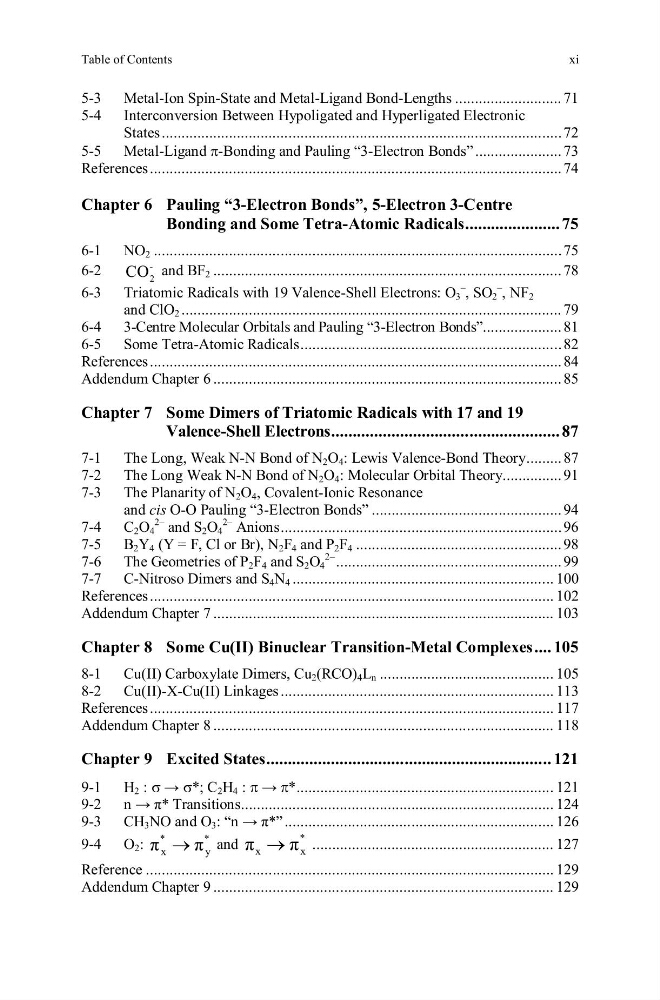
Table of Contents
xi
5-3 Metal-Ion Spin-State and Metal-Ligand Bond-Lengths ........................... 71
5-4 Interconversion Between Hypoligated and Hyperligated Electronic
States ..................................................................................................... 72
5-5 Metal-Ligand -Bonding and Pauling “3-Electron Bonds” ...................... 73
References ........................................................................................................ 74
Chapter 6 Pauling “3-Electron Bonds”, 5-Electron 3-Centre
Bonding and Some Tetra-Atomic Radicals ...................... 75
6-1 NO 2 ....................................................................................................... 75
6-2
-
2
CO and BF 2 ........................................................................................ 78
6-3 Triatomic Radicals with 19 Valence-Shell Electrons: O 3
–
, SO 2
–
, NF 2
and ClO 2 ................................................................................................ 79
6-4 3-Centre Molecular Orbitals and Pauling “3-Electron Bonds”.................... 81
6-5 Some Tetra-Atomic Radicals .................................................................. 82
References ........................................................................................................ 84
Addendum Chapter 6 ........................................................................................ 85
Chapter 7 Some Dimers of Triatomic Radicals with 17 and 19
Valence-Shell Electrons ..................................................... 87
7-1 The Long, Weak N-N Bond of N 2 O 4 : Lewis Valence-Bond Theory ......... 87
7-2 The Long Weak N-N Bond of N 2 O 4 : Molecular Orbital Theory............... 91
7-3 The Planarity of N 2 O 4 , Covalent-Ionic Resonance
and cis O-O Pauling “3-Electron Bonds” ................................................ 94
7-4 C 2 O 4
2– and S 2 O 4
2– Anions ....................................................................... 96
7-5 B 2 Y 4 (Y = F, Cl or Br), N 2 F 4 and P 2 F 4 .................................................... 98
7-6 The Geometries of P 2 F 4 and S 2 O 4
2– ......................................................... 99
7-7 C-Nitroso Dimers and S 4 N 4 .................................................................. 100
References ...................................................................................................... 102
Addendum Chapter 7 ...................................................................................... 103
Chapter 8 Some Cu(II) Binuclear Transition-Metal Complexes .... 105
8-1 Cu(II) Carboxylate Dimers, Cu 2 (RCO) 4 L n ............................................ 105
8-2 Cu(II)-X-Cu(II) Linkages ..................................................................... 113
References ...................................................................................................... 117
Addendum Chapter 8 ...................................................................................... 118
Chapter 9 Excited States .................................................................. 121
9-1 H 2 : → *; C 2 H 4 : → * ................................................................. 121
9-2 n → π* Transitions ............................................................................... 124
9-3 CH 3 NO and O 3 : “n → π*” .................................................................... 126
9-4 O 2 :
*
*
x
y
π
π
and
*
x
x
π
π
............................................................. 127
Reference ....................................................................................................... 129
Addendum Chapter 9 ...................................................................................... 129
xi
5-3 Metal-Ion Spin-State and Metal-Ligand Bond-Lengths ........................... 71
5-4 Interconversion Between Hypoligated and Hyperligated Electronic
States ..................................................................................................... 72
5-5 Metal-Ligand -Bonding and Pauling “3-Electron Bonds” ...................... 73
References ........................................................................................................ 74
Chapter 6 Pauling “3-Electron Bonds”, 5-Electron 3-Centre
Bonding and Some Tetra-Atomic Radicals ...................... 75
6-1 NO 2 ....................................................................................................... 75
6-2
-
2
CO and BF 2 ........................................................................................ 78
6-3 Triatomic Radicals with 19 Valence-Shell Electrons: O 3
–
, SO 2
–
, NF 2
and ClO 2 ................................................................................................ 79
6-4 3-Centre Molecular Orbitals and Pauling “3-Electron Bonds”.................... 81
6-5 Some Tetra-Atomic Radicals .................................................................. 82
References ........................................................................................................ 84
Addendum Chapter 6 ........................................................................................ 85
Chapter 7 Some Dimers of Triatomic Radicals with 17 and 19
Valence-Shell Electrons ..................................................... 87
7-1 The Long, Weak N-N Bond of N 2 O 4 : Lewis Valence-Bond Theory ......... 87
7-2 The Long Weak N-N Bond of N 2 O 4 : Molecular Orbital Theory............... 91
7-3 The Planarity of N 2 O 4 , Covalent-Ionic Resonance
and cis O-O Pauling “3-Electron Bonds” ................................................ 94
7-4 C 2 O 4
2– and S 2 O 4
2– Anions ....................................................................... 96
7-5 B 2 Y 4 (Y = F, Cl or Br), N 2 F 4 and P 2 F 4 .................................................... 98
7-6 The Geometries of P 2 F 4 and S 2 O 4
2– ......................................................... 99
7-7 C-Nitroso Dimers and S 4 N 4 .................................................................. 100
References ...................................................................................................... 102
Addendum Chapter 7 ...................................................................................... 103
Chapter 8 Some Cu(II) Binuclear Transition-Metal Complexes .... 105
8-1 Cu(II) Carboxylate Dimers, Cu 2 (RCO) 4 L n ............................................ 105
8-2 Cu(II)-X-Cu(II) Linkages ..................................................................... 113
References ...................................................................................................... 117
Addendum Chapter 8 ...................................................................................... 118
Chapter 9 Excited States .................................................................. 121
9-1 H 2 : → *; C 2 H 4 : → * ................................................................. 121
9-2 n → π* Transitions ............................................................................... 124
9-3 CH 3 NO and O 3 : “n → π*” .................................................................... 126
9-4 O 2 :
*
*
x
y
π
π
and
*
x
x
π
π
............................................................. 127
Reference ....................................................................................................... 129
Addendum Chapter 9 ...................................................................................... 129