

In summary, preliminary investigations show the potential of the eigenvalues of
the LDM extracted from the matrices using the principal component analysis
method as “pruned” descriptors of the electron densities contained within the LDM.
When compared to the full LDM or DM matrices, the distances of molecules
calculated using a combination of PCA and multidimensional scaling produce a
simple exponential model between the Euclidian distance separating the molecules
of the set and their experimental pK a . Furthermore, for a more extended group of
carboxylic acids, the same set of eigenvalues (Table 3.4) have been used to build
physical property models for pK a , LogP, LD50 (oral:rat), Henry’s Law Constants,
melting point, boiling point, vapor pressure and the Atmospheric OH rate constant.
For each set of these physical properties, models having both high regression
coefficients (r
2 > 0.95) and high cross validation scores (q
2 > 0.90) could be
produced.
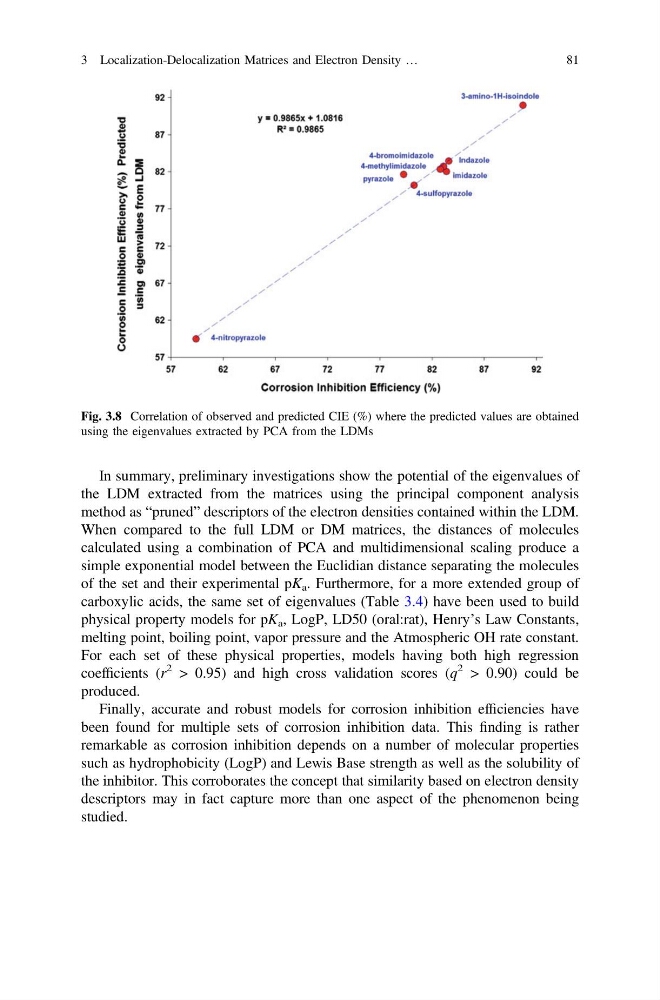
Finally, accurate and robust models for corrosion inhibition efficiencies have
been found for multiple sets of corrosion inhibition data. This finding is rather
remarkable as corrosion inhibition depends on a number of molecular properties
such as hydrophobicity (LogP) and Lewis Base strength as well as the solubility of
the inhibitor. This corroborates the concept that similarity based on electron density
descriptors may in fact capture more than one aspect of the phenomenon being
studied.
Fig. 3.8 Correlation of observed and predicted CIE (%) where the predicted values are obtained
using the eigenvalues extracted by PCA from the LDMs
3 Localization-Delocalization Matrices and Electron Density …
81
the LDM extracted from the matrices using the principal component analysis
method as “pruned” descriptors of the electron densities contained within the LDM.
When compared to the full LDM or DM matrices, the distances of molecules
calculated using a combination of PCA and multidimensional scaling produce a
simple exponential model between the Euclidian distance separating the molecules
of the set and their experimental pK a . Furthermore, for a more extended group of
carboxylic acids, the same set of eigenvalues (Table 3.4) have been used to build
physical property models for pK a , LogP, LD50 (oral:rat), Henry’s Law Constants,
melting point, boiling point, vapor pressure and the Atmospheric OH rate constant.
For each set of these physical properties, models having both high regression
coefficients (r
2 > 0.95) and high cross validation scores (q
2 > 0.90) could be
produced.
Finally, accurate and robust models for corrosion inhibition efficiencies have
been found for multiple sets of corrosion inhibition data. This finding is rather
remarkable as corrosion inhibition depends on a number of molecular properties
such as hydrophobicity (LogP) and Lewis Base strength as well as the solubility of
the inhibitor. This corroborates the concept that similarity based on electron density
descriptors may in fact capture more than one aspect of the phenomenon being
studied.
Fig. 3.8 Correlation of observed and predicted CIE (%) where the predicted values are obtained
using the eigenvalues extracted by PCA from the LDMs
3 Localization-Delocalization Matrices and Electron Density …
81