

these six carbon atoms within the molecule. This observation reflects the fact that
atoms in molecules are open quantum sub-systems exchanging electrons and energy
with their neighbours.
If one constructs ring matrices in the same order as that chosen to construct the
matrix of the reference, namely, benzene, then the similarity distance measured by
the Frobenius distance becomes invariable to the atomic labelling. For example if
we choose to construct the benzene reference sub-matrix by listing an ortho-carbon
atom as the second atom immediately following the ipso-carbon atom, the metacarbon attached to it as the third, the para- as the fourth, the second meta- as the
fifth, and the second ortho- as the sixth, then the Frobenius distance will be
insensitive to what atom we pick as the first in the ring of interest as long as we
stick to a nearest neighbour listing of the atoms (whether taken clockwise or
anticlockwise is unimportant).
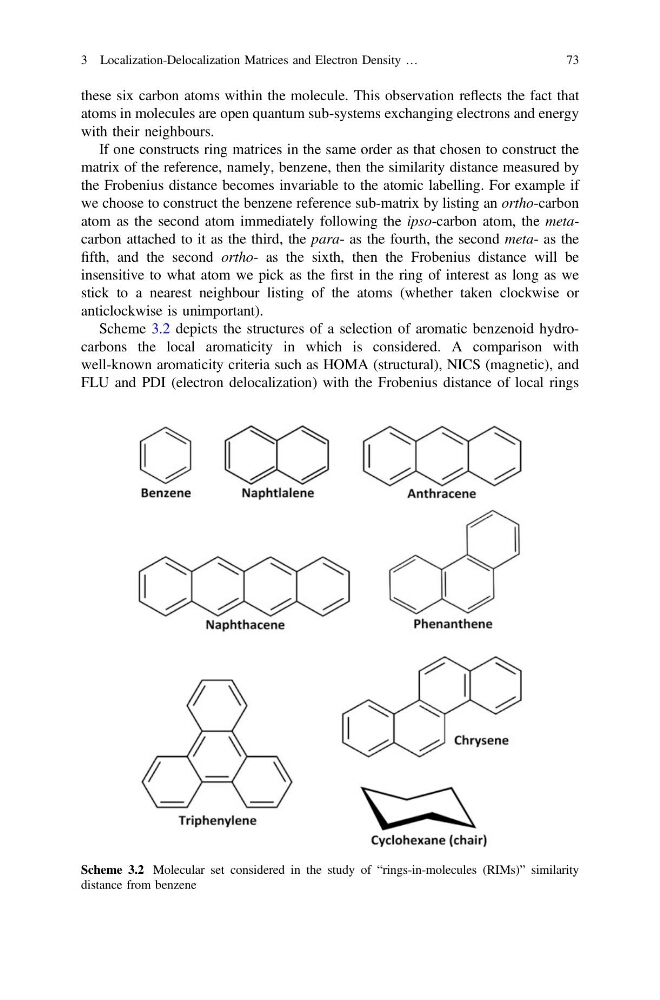
Scheme 3.2 depicts the structures of a selection of aromatic benzenoid hydrocarbons the local aromaticity in which is considered. A comparison with
well-known aromaticity criteria such as HOMA (structural), NICS (magnetic), and
FLU and PDI (electron delocalization) with the Frobenius distance of local rings
Scheme 3.2 Molecular set considered in the study of “rings-in-molecules (RIMs)” similarity
distance from benzene
3 Localization-Delocalization Matrices and Electron Density …
73
atoms in molecules are open quantum sub-systems exchanging electrons and energy
with their neighbours.
If one constructs ring matrices in the same order as that chosen to construct the
matrix of the reference, namely, benzene, then the similarity distance measured by
the Frobenius distance becomes invariable to the atomic labelling. For example if
we choose to construct the benzene reference sub-matrix by listing an ortho-carbon
atom as the second atom immediately following the ipso-carbon atom, the metacarbon attached to it as the third, the para- as the fourth, the second meta- as the
fifth, and the second ortho- as the sixth, then the Frobenius distance will be
insensitive to what atom we pick as the first in the ring of interest as long as we
stick to a nearest neighbour listing of the atoms (whether taken clockwise or
anticlockwise is unimportant).
Scheme 3.2 depicts the structures of a selection of aromatic benzenoid hydrocarbons the local aromaticity in which is considered. A comparison with
well-known aromaticity criteria such as HOMA (structural), NICS (magnetic), and
FLU and PDI (electron delocalization) with the Frobenius distance of local rings
Scheme 3.2 Molecular set considered in the study of “rings-in-molecules (RIMs)” similarity
distance from benzene
3 Localization-Delocalization Matrices and Electron Density …
73