

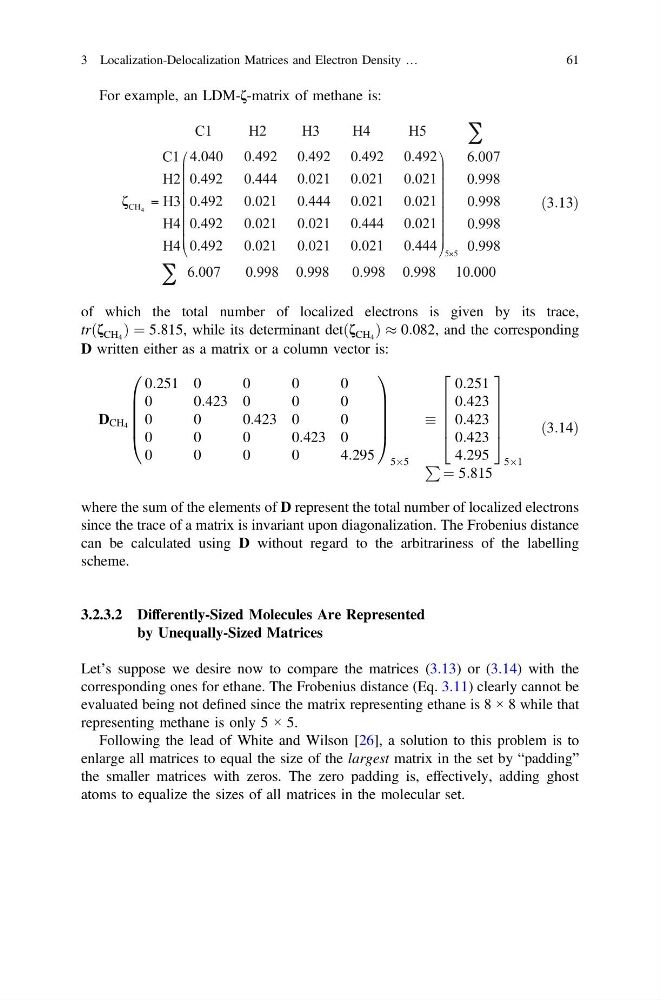
For example, an LDM-ζ-matrix of methane is:
ð3:13Þ
of which the total number of localized electrons is given by its trace,
trðf CH 4 Þ ¼ 5:815, while its determinant detðf CH 4 Þ % 0:082, and the corresponding
D written either as a matrix or a column vector is:
D CH 4
0:251 0
0
0
0
0
0:423 0
0
0
0
0
0:423 0
0
0
0
0
0:423 0
0
0
0
0
4:295
0
B
B
B
B
@
1
C
C
C
C
A
5Â5
0:251
0:423
0:423
0:423
4:295
2
6
6
6
6
4
3
7
7
7
7
5
5Â1
P ¼ 5:815
ð3:14Þ
where the sum of the elements of D represent the total number of localized electrons
since the trace of a matrix is invariant upon diagonalization. The Frobenius distance
can be calculated using D without regard to the arbitrariness of the labelling
scheme.
3.2.3.2 Differently-Sized Molecules Are Represented
by Unequally-Sized Matrices
Let’s suppose we desire now to compare the matrices (3.13) or (3.14) with the
corresponding ones for ethane. The Frobenius distance (Eq. 3.11) clearly cannot be
evaluated being not defined since the matrix representing ethane is 8 × 8 while that
representing methane is only 5 × 5.
Following the lead of White and Wilson [26], a solution to this problem is to
enlarge all matrices to equal the size of the largest matrix in the set by “padding”
the smaller matrices with zeros. The zero padding is, effectively, adding ghost
atoms to equalize the sizes of all matrices in the molecular set.
3 Localization-Delocalization Matrices and Electron Density …
61
ð3:13Þ
of which the total number of localized electrons is given by its trace,
trðf CH 4 Þ ¼ 5:815, while its determinant detðf CH 4 Þ % 0:082, and the corresponding
D written either as a matrix or a column vector is:
D CH 4
0:251 0
0
0
0
0
0:423 0
0
0
0
0
0:423 0
0
0
0
0
0:423 0
0
0
0
0
4:295
0
B
B
B
B
@
1
C
C
C
C
A
5Â5
0:251
0:423
0:423
0:423
4:295
2
6
6
6
6
4
3
7
7
7
7
5
5Â1
P ¼ 5:815
ð3:14Þ
where the sum of the elements of D represent the total number of localized electrons
since the trace of a matrix is invariant upon diagonalization. The Frobenius distance
can be calculated using D without regard to the arbitrariness of the labelling
scheme.
3.2.3.2 Differently-Sized Molecules Are Represented
by Unequally-Sized Matrices
Let’s suppose we desire now to compare the matrices (3.13) or (3.14) with the
corresponding ones for ethane. The Frobenius distance (Eq. 3.11) clearly cannot be
evaluated being not defined since the matrix representing ethane is 8 × 8 while that
representing methane is only 5 × 5.
Following the lead of White and Wilson [26], a solution to this problem is to
enlarge all matrices to equal the size of the largest matrix in the set by “padding”
the smaller matrices with zeros. The zero padding is, effectively, adding ghost
atoms to equalize the sizes of all matrices in the molecular set.
3 Localization-Delocalization Matrices and Electron Density …
61