

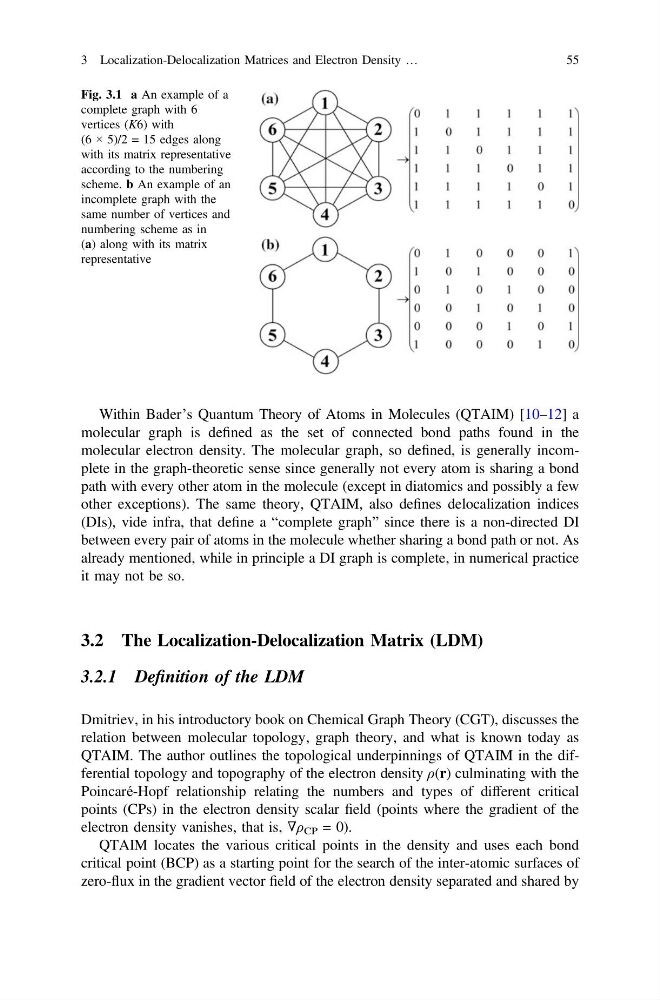
Within Bader’s Quantum Theory of Atoms in Molecules (QTAIM) [10–12] a
molecular graph is defined as the set of connected bond paths found in the
molecular electron density. The molecular graph, so defined, is generally incomplete in the graph-theoretic sense since generally not every atom is sharing a bond
path with every other atom in the molecule (except in diatomics and possibly a few
other exceptions). The same theory, QTAIM, also defines delocalization indices
(DIs), vide infra, that define a “complete graph” since there is a non-directed DI
between every pair of atoms in the molecule whether sharing a bond path or not. As
already mentioned, while in principle a DI graph is complete, in numerical practice
it may not be so.
3.2 The Localization-Delocalization Matrix (LDM)
3.2.1 Definition of the LDM
Dmitriev, in his introductory book on Chemical Graph Theory (CGT), discusses the
relation between molecular topology, graph theory, and what is known today as
QTAIM. The author outlines the topological underpinnings of QTAIM in the differential topology and topography of the electron density ρ(r) culminating with the
Poincaré-Hopf relationship relating the numbers and types of different critical
points (CPs) in the electron density scalar field (points where the gradient of the
electron density vanishes, that is, ∇ρ CP = 0).
QTAIM locates the various critical points in the density and uses each bond
critical point (BCP) as a starting point for the search of the inter-atomic surfaces of
zero-flux in the gradient vector field of the electron density separated and shared by
Fig. 3.1 a An example of a
complete graph with 6
vertices (K6) with
(6 × 5)/2 = 15 edges along
with its matrix representative
according to the numbering
scheme. b An example of an
incomplete graph with the
same number of vertices and
numbering scheme as in
(a) along with its matrix
representative
3 Localization-Delocalization Matrices and Electron Density …
55
molecular graph is defined as the set of connected bond paths found in the
molecular electron density. The molecular graph, so defined, is generally incomplete in the graph-theoretic sense since generally not every atom is sharing a bond
path with every other atom in the molecule (except in diatomics and possibly a few
other exceptions). The same theory, QTAIM, also defines delocalization indices
(DIs), vide infra, that define a “complete graph” since there is a non-directed DI
between every pair of atoms in the molecule whether sharing a bond path or not. As
already mentioned, while in principle a DI graph is complete, in numerical practice
it may not be so.
3.2 The Localization-Delocalization Matrix (LDM)
3.2.1 Definition of the LDM
Dmitriev, in his introductory book on Chemical Graph Theory (CGT), discusses the
relation between molecular topology, graph theory, and what is known today as
QTAIM. The author outlines the topological underpinnings of QTAIM in the differential topology and topography of the electron density ρ(r) culminating with the
Poincaré-Hopf relationship relating the numbers and types of different critical
points (CPs) in the electron density scalar field (points where the gradient of the
electron density vanishes, that is, ∇ρ CP = 0).
QTAIM locates the various critical points in the density and uses each bond
critical point (BCP) as a starting point for the search of the inter-atomic surfaces of
zero-flux in the gradient vector field of the electron density separated and shared by
Fig. 3.1 a An example of a
complete graph with 6
vertices (K6) with
(6 × 5)/2 = 15 edges along
with its matrix representative
according to the numbering
scheme. b An example of an
incomplete graph with the
same number of vertices and
numbering scheme as in
(a) along with its matrix
representative
3 Localization-Delocalization Matrices and Electron Density …
55