

20.1 Introduction
Since chemists began to draw formulas of chemical compounds where atoms are
linked by electron pairs [1, 2], simple concepts such as single and multiple bonds or
covalent and ionic bonds, appear as the cornerstone of the molecular structure
understanding. They notably have demonstrated their indisputable utility for
helping chemists in the rational design of systems with desired properties.
However, the bonding in many systems containing heavy atoms is still unclear to
chemists, especially because of relativistic effects and in particular the spin-orbit
coupling (SOC). One may distinguish electron spin-independent (scalar) effects
from spin-dependent relativistic effects. The scalar effects are associated with the
relativistic mass increase of electrons, resulting essentially from their high speed in
the vicinity of heavy nuclei. The main spin-dependent effect is the coupling
between electron spin and electron orbital momentum (SOC). The latter complicates the possibility of imagining a bridge between the complex electronic structure
of systems containing heavy atoms (e.g. actinides and heavy p-elements) and
simple concepts, which can be used by chemists to understand the outcomes of
experimental observations as well as the results of state-of-the-art electronic
structure calculations. Indeed, a proper description of systems containing actinides
or heavy p-elements requires including SOC in the quantum mechanical calculations. While computational chemists have been developing tools to bridge quantum
mechanical calculations to chemist’s views for decades [3–8], this has only been
done thoroughly in the framework of non-relativistic or scalar-relativistic methods,
since scalar-relativistic effects can be incorporated into existing non-relativistic
programs with minimum extra code developments. The situation is deeply contrasting when looking at available tools for scrutinizing SOC effects on traditional
pictures of the chemical bond. A fundamental problem is that chemists are not
familiar with spinors which are single-particle functions usually used to expand
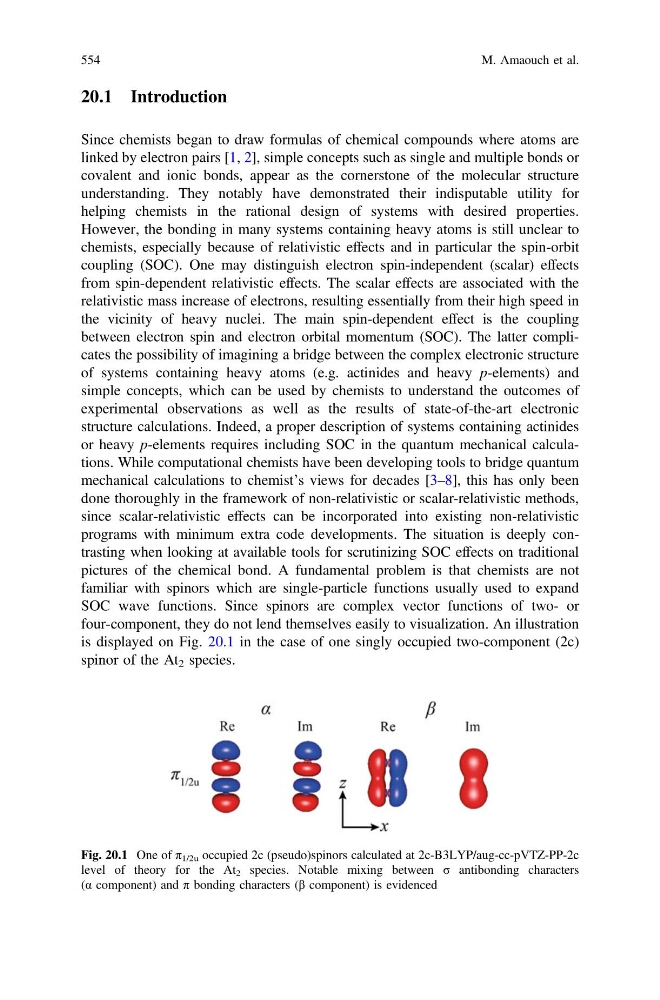
SOC wave functions. Since spinors are complex vector functions of two- or
four-component, they do not lend themselves easily to visualization. An illustration
is displayed on Fig. 20.1 in the case of one singly occupied two-component (2c)
spinor of the At 2 species.
Fig. 20.1 One of π 1/2u occupied 2c (pseudo)spinors calculated at 2c-B3LYP/aug-cc-pVTZ-PP-2c
level of theory for the At 2 species. Notable mixing between σ antibonding characters
(α component) and π bonding characters (β component) is evidenced
554
M. Amaouch et al.
Since chemists began to draw formulas of chemical compounds where atoms are
linked by electron pairs [1, 2], simple concepts such as single and multiple bonds or
covalent and ionic bonds, appear as the cornerstone of the molecular structure
understanding. They notably have demonstrated their indisputable utility for
helping chemists in the rational design of systems with desired properties.
However, the bonding in many systems containing heavy atoms is still unclear to
chemists, especially because of relativistic effects and in particular the spin-orbit
coupling (SOC). One may distinguish electron spin-independent (scalar) effects
from spin-dependent relativistic effects. The scalar effects are associated with the
relativistic mass increase of electrons, resulting essentially from their high speed in
the vicinity of heavy nuclei. The main spin-dependent effect is the coupling
between electron spin and electron orbital momentum (SOC). The latter complicates the possibility of imagining a bridge between the complex electronic structure
of systems containing heavy atoms (e.g. actinides and heavy p-elements) and
simple concepts, which can be used by chemists to understand the outcomes of
experimental observations as well as the results of state-of-the-art electronic
structure calculations. Indeed, a proper description of systems containing actinides
or heavy p-elements requires including SOC in the quantum mechanical calculations. While computational chemists have been developing tools to bridge quantum
mechanical calculations to chemist’s views for decades [3–8], this has only been
done thoroughly in the framework of non-relativistic or scalar-relativistic methods,
since scalar-relativistic effects can be incorporated into existing non-relativistic
programs with minimum extra code developments. The situation is deeply contrasting when looking at available tools for scrutinizing SOC effects on traditional
pictures of the chemical bond. A fundamental problem is that chemists are not
familiar with spinors which are single-particle functions usually used to expand
SOC wave functions. Since spinors are complex vector functions of two- or
four-component, they do not lend themselves easily to visualization. An illustration
is displayed on Fig. 20.1 in the case of one singly occupied two-component (2c)
spinor of the At 2 species.
Fig. 20.1 One of π 1/2u occupied 2c (pseudo)spinors calculated at 2c-B3LYP/aug-cc-pVTZ-PP-2c
level of theory for the At 2 species. Notable mixing between σ antibonding characters
(α component) and π bonding characters (β component) is evidenced
554
M. Amaouch et al.