

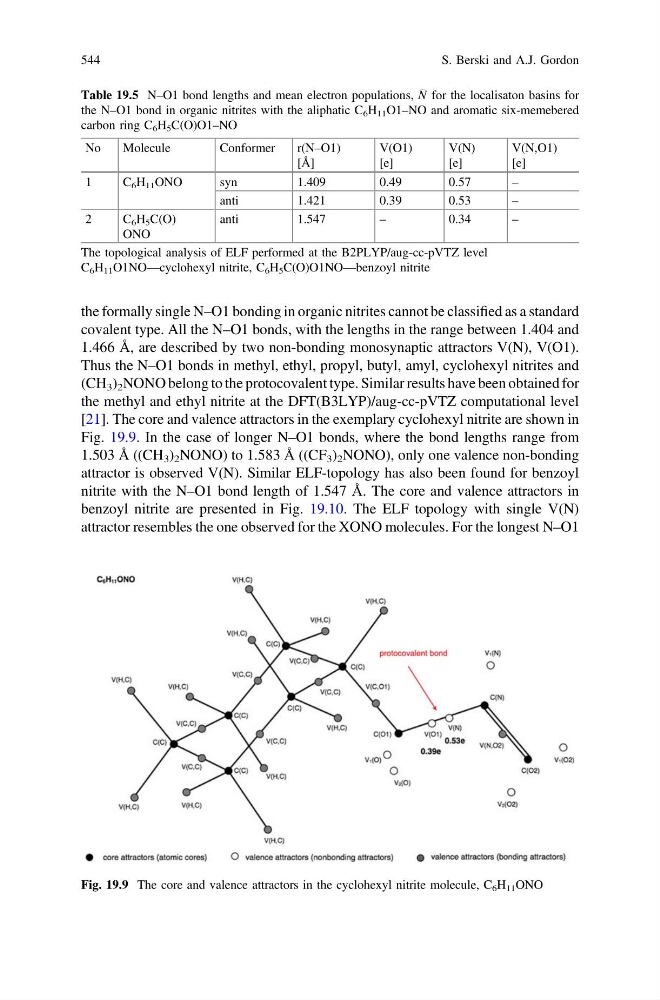
the formally single N–O1 bonding in organic nitrites cannot be classified as a standard
covalent type. All the N–O1 bonds, with the lengths in the range between 1.404 and
1.466 Å, are described by two non-bonding monosynaptic attractors V(N), V(O1).
Thus the N–O1 bonds in methyl, ethyl, propyl, butyl, amyl, cyclohexyl nitrites and
(CH 3 ) 2 NONO belong to the protocovalent type. Similar results have been obtained for
the methyl and ethyl nitrite at the DFT(B3LYP)/aug-cc-pVTZ computational level
[21]. The core and valence attractors in the exemplary cyclohexyl nitrite are shown in
Fig. 19.9. In the case of longer N–O1 bonds, where the bond lengths range from
1.503 Å ((CH 3 ) 2 NONO) to 1.583 Å ((CF 3 ) 2 NONO), only one valence non-bonding
attractor is observed V(N). Similar ELF-topology has also been found for benzoyl
nitrite with the N–O1 bond length of 1.547 Å. The core and valence attractors in
benzoyl nitrite are presented in Fig. 19.10. The ELF topology with single V(N)
attractor resembles the one observed for the XONO molecules. For the longest N–O1
Table 19.5 N–O1 bond lengths and mean electron populations,
N for the localisaton basins for
the N–O1 bond in organic nitrites with the aliphatic C 6 H 11 O1–NO and aromatic six-memebered
carbon ring C 6 H 5 C(O)O1–NO
No
Molecule
Conformer
r(N–O1)
[Å]
V(O1)
[e]
V(N)
[e]
V(N,O1)
[e]
1
C 6 H 11 ONO
syn
1.409
0.49
0.57
–
anti
1.421
0.39
0.53
–
2
C 6 H 5 C(O)
ONO
anti
1.547
–
0.34
–
The topological analysis of ELF performed at the B2PLYP/aug-cc-pVTZ level
C 6 H 11 O1NO—cyclohexyl nitrite, C 6 H 5 C(O)O1NO—benzoyl nitrite
Fig. 19.9 The core and valence attractors in the cyclohexyl nitrite molecule, C 6 H 11 ONO
544
S. Berski and A.J. Gordon
covalent type. All the N–O1 bonds, with the lengths in the range between 1.404 and
1.466 Å, are described by two non-bonding monosynaptic attractors V(N), V(O1).
Thus the N–O1 bonds in methyl, ethyl, propyl, butyl, amyl, cyclohexyl nitrites and
(CH 3 ) 2 NONO belong to the protocovalent type. Similar results have been obtained for
the methyl and ethyl nitrite at the DFT(B3LYP)/aug-cc-pVTZ computational level
[21]. The core and valence attractors in the exemplary cyclohexyl nitrite are shown in
Fig. 19.9. In the case of longer N–O1 bonds, where the bond lengths range from
1.503 Å ((CH 3 ) 2 NONO) to 1.583 Å ((CF 3 ) 2 NONO), only one valence non-bonding
attractor is observed V(N). Similar ELF-topology has also been found for benzoyl
nitrite with the N–O1 bond length of 1.547 Å. The core and valence attractors in
benzoyl nitrite are presented in Fig. 19.10. The ELF topology with single V(N)
attractor resembles the one observed for the XONO molecules. For the longest N–O1
Table 19.5 N–O1 bond lengths and mean electron populations,
N for the localisaton basins for
the N–O1 bond in organic nitrites with the aliphatic C 6 H 11 O1–NO and aromatic six-memebered
carbon ring C 6 H 5 C(O)O1–NO
No
Molecule
Conformer
r(N–O1)
[Å]
V(O1)
[e]
V(N)
[e]
V(N,O1)
[e]
1
C 6 H 11 ONO
syn
1.409
0.49
0.57
–
anti
1.421
0.39
0.53
–
2
C 6 H 5 C(O)
ONO
anti
1.547
–
0.34
–
The topological analysis of ELF performed at the B2PLYP/aug-cc-pVTZ level
C 6 H 11 O1NO—cyclohexyl nitrite, C 6 H 5 C(O)O1NO—benzoyl nitrite
Fig. 19.9 The core and valence attractors in the cyclohexyl nitrite molecule, C 6 H 11 ONO
544
S. Berski and A.J. Gordon