

0.1 kJmol
−1 . This quantitative information reveals where to draw the lines in a
Lewis diagram.
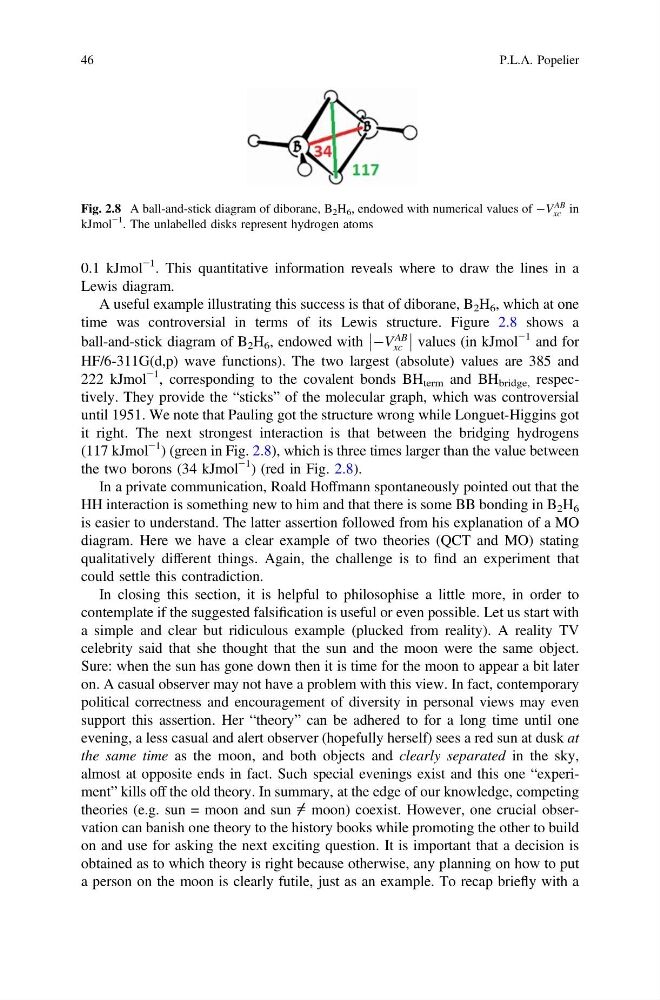
A useful example illustrating this success is that of diborane, B 2 H 6 , which at one
time was controversial in terms of its Lewis structure. Figure 2.8 shows a
ball-and-stick diagram of B 2 H 6 , endowed with ÀV
AB
xc
values (in kJmol
−1 and for
HF/6-311G(d,p) wave functions). The two largest (absolute) values are 385 and
222 kJmol
−1 , corresponding to the covalent bonds BH term and BH bridge, respectively. They provide the “sticks” of the molecular graph, which was controversial
until 1951. We note that Pauling got the structure wrong while Longuet-Higgins got
it right. The next strongest interaction is that between the bridging hydrogens
(117 kJmol
−1 ) (green in Fig. 2.8), which is three times larger than the value between
the two borons (34 kJmol
−1 ) (red in Fig. 2.8).
In a private communication, Roald Hoffmann spontaneously pointed out that the
HH interaction is something new to him and that there is some BB bonding in B 2 H 6
is easier to understand. The latter assertion followed from his explanation of a MO
diagram. Here we have a clear example of two theories (QCT and MO) stating
qualitatively different things. Again, the challenge is to find an experiment that
could settle this contradiction.
In closing this section, it is helpful to philosophise a little more, in order to
contemplate if the suggested falsification is useful or even possible. Let us start with
a simple and clear but ridiculous example (plucked from reality). A reality TV
celebrity said that she thought that the sun and the moon were the same object.
Sure: when the sun has gone down then it is time for the moon to appear a bit later
on. A casual observer may not have a problem with this view. In fact, contemporary
political correctness and encouragement of diversity in personal views may even
support this assertion. Her “theory” can be adhered to for a long time until one
evening, a less casual and alert observer (hopefully herself) sees a red sun at dusk at
the same time as the moon, and both objects and clearly separated in the sky,
almost at opposite ends in fact. Such special evenings exist and this one “experiment” kills off the old theory. In summary, at the edge of our knowledge, competing
theories (e.g. sun = moon and sun ≠ moon) coexist. However, one crucial observation can banish one theory to the history books while promoting the other to build
on and use for asking the next exciting question. It is important that a decision is
obtained as to which theory is right because otherwise, any planning on how to put
a person on the moon is clearly futile, just as an example. To recap briefly with a
Fig. 2.8 A ball-and-stick diagram of diborane, B 2 H 6 , endowed with numerical values of ÀV
AB
xc in
kJmol
−1
. The unlabelled disks represent hydrogen atoms
46
P.L.A. Popelier
−1 . This quantitative information reveals where to draw the lines in a
Lewis diagram.
A useful example illustrating this success is that of diborane, B 2 H 6 , which at one
time was controversial in terms of its Lewis structure. Figure 2.8 shows a
ball-and-stick diagram of B 2 H 6 , endowed with ÀV
AB
xc
values (in kJmol
−1 and for
HF/6-311G(d,p) wave functions). The two largest (absolute) values are 385 and
222 kJmol
−1 , corresponding to the covalent bonds BH term and BH bridge, respectively. They provide the “sticks” of the molecular graph, which was controversial
until 1951. We note that Pauling got the structure wrong while Longuet-Higgins got
it right. The next strongest interaction is that between the bridging hydrogens
(117 kJmol
−1 ) (green in Fig. 2.8), which is three times larger than the value between
the two borons (34 kJmol
−1 ) (red in Fig. 2.8).
In a private communication, Roald Hoffmann spontaneously pointed out that the
HH interaction is something new to him and that there is some BB bonding in B 2 H 6
is easier to understand. The latter assertion followed from his explanation of a MO
diagram. Here we have a clear example of two theories (QCT and MO) stating
qualitatively different things. Again, the challenge is to find an experiment that
could settle this contradiction.
In closing this section, it is helpful to philosophise a little more, in order to
contemplate if the suggested falsification is useful or even possible. Let us start with
a simple and clear but ridiculous example (plucked from reality). A reality TV
celebrity said that she thought that the sun and the moon were the same object.
Sure: when the sun has gone down then it is time for the moon to appear a bit later
on. A casual observer may not have a problem with this view. In fact, contemporary
political correctness and encouragement of diversity in personal views may even
support this assertion. Her “theory” can be adhered to for a long time until one
evening, a less casual and alert observer (hopefully herself) sees a red sun at dusk at
the same time as the moon, and both objects and clearly separated in the sky,
almost at opposite ends in fact. Such special evenings exist and this one “experiment” kills off the old theory. In summary, at the edge of our knowledge, competing
theories (e.g. sun = moon and sun ≠ moon) coexist. However, one crucial observation can banish one theory to the history books while promoting the other to build
on and use for asking the next exciting question. It is important that a decision is
obtained as to which theory is right because otherwise, any planning on how to put
a person on the moon is clearly futile, just as an example. To recap briefly with a
Fig. 2.8 A ball-and-stick diagram of diborane, B 2 H 6 , endowed with numerical values of ÀV
AB
xc in
kJmol
−1
. The unlabelled disks represent hydrogen atoms
46
P.L.A. Popelier