

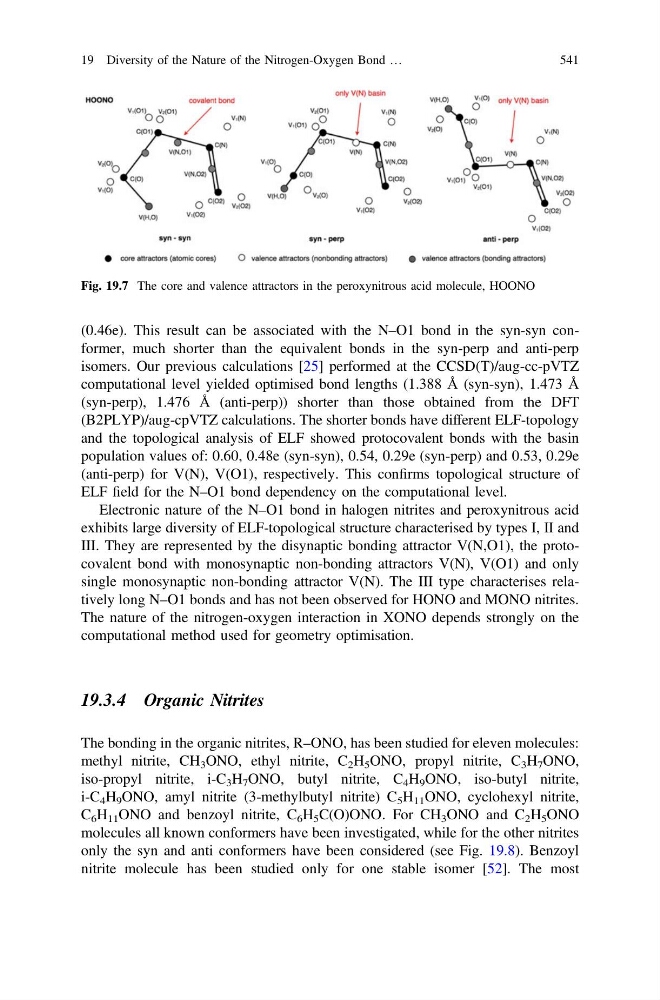
(0.46e). This result can be associated with the N–O1 bond in the syn-syn conformer, much shorter than the equivalent bonds in the syn-perp and anti-perp
isomers. Our previous calculations [25] performed at the CCSD(T)/aug-cc-pVTZ
computational level yielded optimised bond lengths (1.388 Å (syn-syn), 1.473 Å
(syn-perp), 1.476 Å (anti-perp)) shorter than those obtained from the DFT
(B2PLYP)/aug-cpVTZ calculations. The shorter bonds have different ELF-topology
and the topological analysis of ELF showed protocovalent bonds with the basin
population values of: 0.60, 0.48e (syn-syn), 0.54, 0.29e (syn-perp) and 0.53, 0.29e
(anti-perp) for V(N), V(O1), respectively. This confirms topological structure of
ELF field for the N–O1 bond dependency on the computational level.
Electronic nature of the N–O1 bond in halogen nitrites and peroxynitrous acid
exhibits large diversity of ELF-topological structure characterised by types I, II and
III. They are represented by the disynaptic bonding attractor V(N,O1), the protocovalent bond with monosynaptic non-bonding attractors V(N), V(O1) and only
single monosynaptic non-bonding attractor V(N). The III type characterises relatively long N–O1 bonds and has not been observed for HONO and MONO nitrites.
The nature of the nitrogen-oxygen interaction in XONO depends strongly on the
computational method used for geometry optimisation.
19.3.4 Organic Nitrites
The bonding in the organic nitrites, R–ONO, has been studied for eleven molecules:
methyl nitrite, CH 3 ONO, ethyl nitrite, C 2 H 5 ONO, propyl nitrite, C 3 H 7 ONO,
iso-propyl nitrite, i-C 3 H 7 ONO, butyl nitrite, C 4 H 9 ONO, iso-butyl nitrite,
i-C 4 H 9 ONO, amyl nitrite (3-methylbutyl nitrite) C 5 H 11 ONO, cyclohexyl nitrite,
C 6 H 11 ONO and benzoyl nitrite, C 6 H 5 C(O)ONO. For CH 3 ONO and C 2 H 5 ONO
molecules all known conformers have been investigated, while for the other nitrites
only the syn and anti conformers have been considered (see Fig. 19.8). Benzoyl
nitrite molecule has been studied only for one stable isomer [52]. The most
Fig. 19.7 The core and valence attractors in the peroxynitrous acid molecule, HOONO
19 Diversity of the Nature of the Nitrogen-Oxygen Bond …
541
isomers. Our previous calculations [25] performed at the CCSD(T)/aug-cc-pVTZ
computational level yielded optimised bond lengths (1.388 Å (syn-syn), 1.473 Å
(syn-perp), 1.476 Å (anti-perp)) shorter than those obtained from the DFT
(B2PLYP)/aug-cpVTZ calculations. The shorter bonds have different ELF-topology
and the topological analysis of ELF showed protocovalent bonds with the basin
population values of: 0.60, 0.48e (syn-syn), 0.54, 0.29e (syn-perp) and 0.53, 0.29e
(anti-perp) for V(N), V(O1), respectively. This confirms topological structure of
ELF field for the N–O1 bond dependency on the computational level.
Electronic nature of the N–O1 bond in halogen nitrites and peroxynitrous acid
exhibits large diversity of ELF-topological structure characterised by types I, II and
III. They are represented by the disynaptic bonding attractor V(N,O1), the protocovalent bond with monosynaptic non-bonding attractors V(N), V(O1) and only
single monosynaptic non-bonding attractor V(N). The III type characterises relatively long N–O1 bonds and has not been observed for HONO and MONO nitrites.
The nature of the nitrogen-oxygen interaction in XONO depends strongly on the
computational method used for geometry optimisation.
19.3.4 Organic Nitrites
The bonding in the organic nitrites, R–ONO, has been studied for eleven molecules:
methyl nitrite, CH 3 ONO, ethyl nitrite, C 2 H 5 ONO, propyl nitrite, C 3 H 7 ONO,
iso-propyl nitrite, i-C 3 H 7 ONO, butyl nitrite, C 4 H 9 ONO, iso-butyl nitrite,
i-C 4 H 9 ONO, amyl nitrite (3-methylbutyl nitrite) C 5 H 11 ONO, cyclohexyl nitrite,
C 6 H 11 ONO and benzoyl nitrite, C 6 H 5 C(O)ONO. For CH 3 ONO and C 2 H 5 ONO
molecules all known conformers have been investigated, while for the other nitrites
only the syn and anti conformers have been considered (see Fig. 19.8). Benzoyl
nitrite molecule has been studied only for one stable isomer [52]. The most
Fig. 19.7 The core and valence attractors in the peroxynitrous acid molecule, HOONO
19 Diversity of the Nature of the Nitrogen-Oxygen Bond …
541