

Fig. 19.4 (both for syn and anti conformers of LiONO). The electronic structure of
MONO molecules is relatively simple, because it consists only of four core basins,
C(M), C(O1), C(N), C(O2), corresponding to core electron densities of the alkali
metal, oxygen and nitrogen; two bonding disynaptic basins V(N,O1), V(N,O2) in
the valence space corresponding to the NO1 and NO2 bonds and five nonbonding
basins corresponding to non-bonding electrons of oxygen V 1 (O1), V 2 (O1), V 1 (O2),
V 2 (O2) and nitrogen V 1 (N). In the region between the metal atom and the ONO
group no valence bonding attractor can be found, thus the metal-oxygen interaction
has no covalent character. The ELF analysis supports the M
δ+ [ONO]
δ− representation of studied molecules. Very similar result has been obtained previously for
LiONO, NaONO and KONO using the DFT(B3LYP) optimised wave function and
topological analysis of Electron Localizability Indicator (ELI-D) with the CASSCF
(12,10)//MP2/aug-cc-pVTZ wave function and various basis sets [19].
The mean electron populations for the V(N,O1), V(N,O2) basins are collected in
Table 19.2. All values are smaller than 1.9e thus the electronic structure of the
bonds can be attributed to the delocalisation between structures containing formal
N–O bonds and those where the N
+
O
− , N
−
O
+ bonds are present. As can be seen
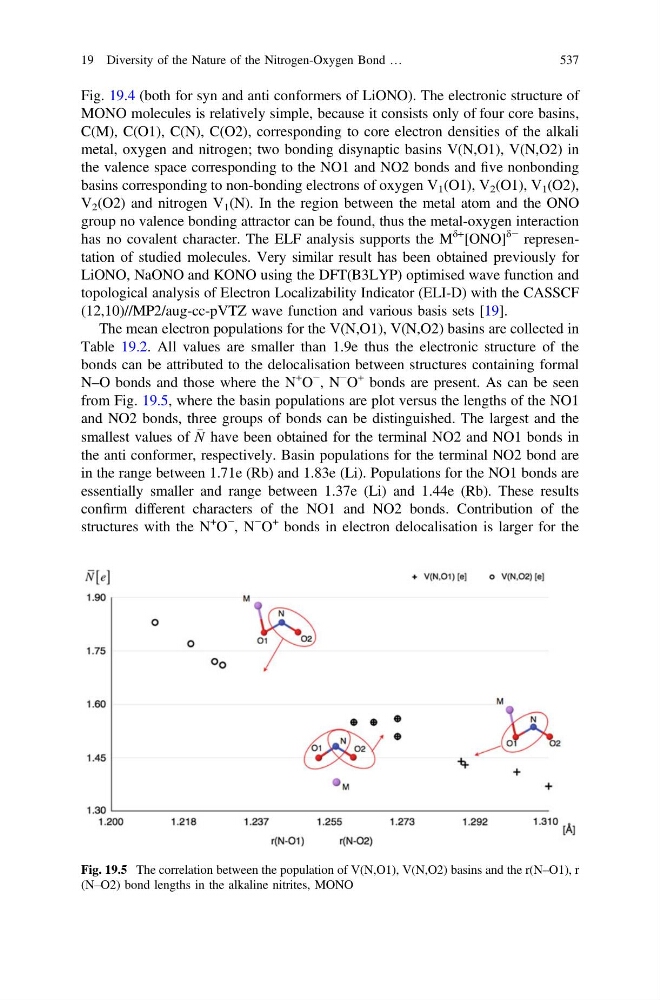
from Fig. 19.5, where the basin populations are plot versus the lengths of the NO1
and NO2 bonds, three groups of bonds can be distinguished. The largest and the
smallest values of
N have been obtained for the terminal NO2 and NO1 bonds in
the anti conformer, respectively. Basin populations for the terminal NO2 bond are
in the range between 1.71e (Rb) and 1.83e (Li). Populations for the NO1 bonds are
essentially smaller and range between 1.37e (Li) and 1.44e (Rb). These results
confirm different characters of the NO1 and NO2 bonds. Contribution of the
structures with the N
+
O
−
, N
− O
+ bonds in electron delocalisation is larger for the
Fig. 19.5 The correlation between the population of V(N,O1), V(N,O2) basins and the r(N–O1), r
(N–O2) bond lengths in the alkaline nitrites, MONO
19 Diversity of the Nature of the Nitrogen-Oxygen Bond …
537
MONO molecules is relatively simple, because it consists only of four core basins,
C(M), C(O1), C(N), C(O2), corresponding to core electron densities of the alkali
metal, oxygen and nitrogen; two bonding disynaptic basins V(N,O1), V(N,O2) in
the valence space corresponding to the NO1 and NO2 bonds and five nonbonding
basins corresponding to non-bonding electrons of oxygen V 1 (O1), V 2 (O1), V 1 (O2),
V 2 (O2) and nitrogen V 1 (N). In the region between the metal atom and the ONO
group no valence bonding attractor can be found, thus the metal-oxygen interaction
has no covalent character. The ELF analysis supports the M
δ+ [ONO]
δ− representation of studied molecules. Very similar result has been obtained previously for
LiONO, NaONO and KONO using the DFT(B3LYP) optimised wave function and
topological analysis of Electron Localizability Indicator (ELI-D) with the CASSCF
(12,10)//MP2/aug-cc-pVTZ wave function and various basis sets [19].
The mean electron populations for the V(N,O1), V(N,O2) basins are collected in
Table 19.2. All values are smaller than 1.9e thus the electronic structure of the
bonds can be attributed to the delocalisation between structures containing formal
N–O bonds and those where the N
+
O
− , N
−
O
+ bonds are present. As can be seen
from Fig. 19.5, where the basin populations are plot versus the lengths of the NO1
and NO2 bonds, three groups of bonds can be distinguished. The largest and the
smallest values of
N have been obtained for the terminal NO2 and NO1 bonds in
the anti conformer, respectively. Basin populations for the terminal NO2 bond are
in the range between 1.71e (Rb) and 1.83e (Li). Populations for the NO1 bonds are
essentially smaller and range between 1.37e (Li) and 1.44e (Rb). These results
confirm different characters of the NO1 and NO2 bonds. Contribution of the
structures with the N
+
O
−
, N
− O
+ bonds in electron delocalisation is larger for the
Fig. 19.5 The correlation between the population of V(N,O1), V(N,O2) basins and the r(N–O1), r
(N–O2) bond lengths in the alkaline nitrites, MONO
19 Diversity of the Nature of the Nitrogen-Oxygen Bond …
537