

functional and variety of basis sets, ranging from 6-311G(d,p) to aug-cc-pVQZ also
concluded the protocovalent N–O1 bond [18]. This result has been confirmed by a
topological analysis for the ELI-D scalar field with the correlated wave function
obtained from the CASSCF(12,10)/6-311++G(2d,2p)//B3LYP/6-311++G(2d,2p)
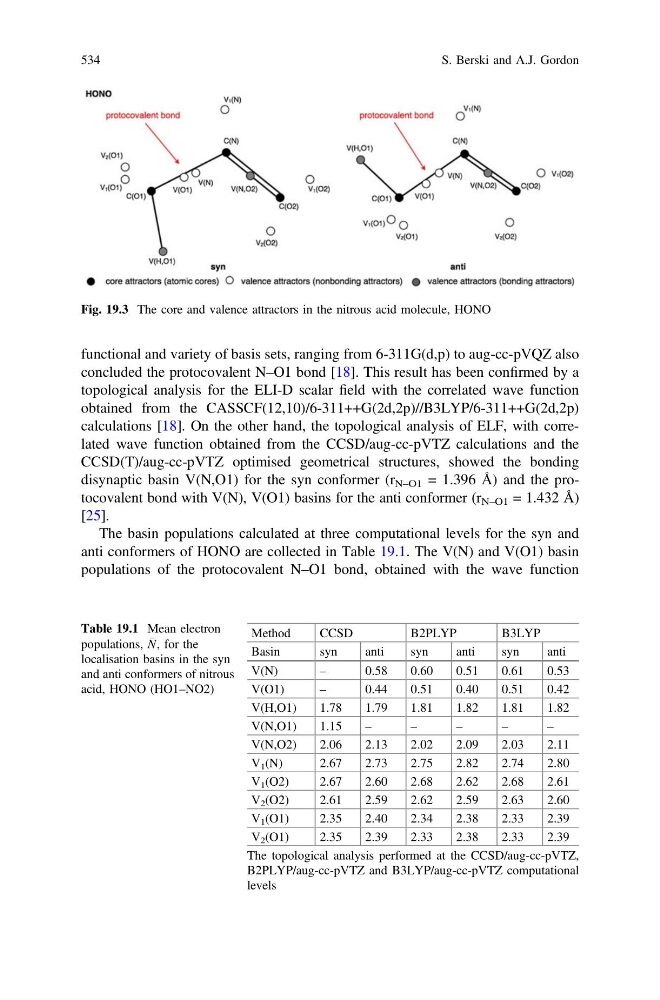
calculations [18]. On the other hand, the topological analysis of ELF, with correlated wave function obtained from the CCSD/aug-cc-pVTZ calculations and the
CCSD(T)/aug-cc-pVTZ optimised geometrical structures, showed the bonding
disynaptic basin V(N,O1) for the syn conformer (r N–O1 = 1.396 Å) and the protocovalent bond with V(N), V(O1) basins for the anti conformer (r N–O1 = 1.432 Å)
[25].
The basin populations calculated at three computational levels for the syn and
anti conformers of HONO are collected in Table 19.1. The V(N) and V(O1) basin
populations of the protocovalent N–O1 bond, obtained with the wave function
Fig. 19.3 The core and valence attractors in the nitrous acid molecule, HONO
Table 19.1 Mean electron
populations,
N, for the
localisation basins in the syn
and anti conformers of nitrous
acid, HONO (HO1–NO2)
Method
CCSD
B2PLYP
B3LYP
Basin
syn
anti
syn
anti
syn
anti
V(N)
–
0.58
0.60
0.51
0.61
0.53
V(O1)
–
0.44
0.51
0.40
0.51
0.42
V(H,O1)
1.78
1.79
1.81
1.82
1.81
1.82
V(N,O1)
1.15
–
–
–
–
–
V(N,O2)
2.06
2.13
2.02
2.09
2.03
2.11
V 1 (N)
2.67
2.73
2.75
2.82
2.74
2.80
V 1 (O2)
2.67
2.60
2.68
2.62
2.68
2.61
V 2 (O2)
2.61
2.59
2.62
2.59
2.63
2.60
V 1 (O1)
2.35
2.40
2.34
2.38
2.33
2.39
V 2 (O1)
2.35
2.39
2.33
2.38
2.33
2.39
The topological analysis performed at the CCSD/aug-cc-pVTZ,
B2PLYP/aug-cc-pVTZ and B3LYP/aug-cc-pVTZ computational
levels
534
S. Berski and A.J. Gordon
concluded the protocovalent N–O1 bond [18]. This result has been confirmed by a
topological analysis for the ELI-D scalar field with the correlated wave function
obtained from the CASSCF(12,10)/6-311++G(2d,2p)//B3LYP/6-311++G(2d,2p)
calculations [18]. On the other hand, the topological analysis of ELF, with correlated wave function obtained from the CCSD/aug-cc-pVTZ calculations and the
CCSD(T)/aug-cc-pVTZ optimised geometrical structures, showed the bonding
disynaptic basin V(N,O1) for the syn conformer (r N–O1 = 1.396 Å) and the protocovalent bond with V(N), V(O1) basins for the anti conformer (r N–O1 = 1.432 Å)
[25].
The basin populations calculated at three computational levels for the syn and
anti conformers of HONO are collected in Table 19.1. The V(N) and V(O1) basin
populations of the protocovalent N–O1 bond, obtained with the wave function
Fig. 19.3 The core and valence attractors in the nitrous acid molecule, HONO
Table 19.1 Mean electron
populations,
N, for the
localisation basins in the syn
and anti conformers of nitrous
acid, HONO (HO1–NO2)
Method
CCSD
B2PLYP
B3LYP
Basin
syn
anti
syn
anti
syn
anti
V(N)
–
0.58
0.60
0.51
0.61
0.53
V(O1)
–
0.44
0.51
0.40
0.51
0.42
V(H,O1)
1.78
1.79
1.81
1.82
1.81
1.82
V(N,O1)
1.15
–
–
–
–
–
V(N,O2)
2.06
2.13
2.02
2.09
2.03
2.11
V 1 (N)
2.67
2.73
2.75
2.82
2.74
2.80
V 1 (O2)
2.67
2.60
2.68
2.62
2.68
2.61
V 2 (O2)
2.61
2.59
2.62
2.59
2.63
2.60
V 1 (O1)
2.35
2.40
2.34
2.38
2.33
2.39
V 2 (O1)
2.35
2.39
2.33
2.38
2.33
2.39
The topological analysis performed at the CCSD/aug-cc-pVTZ,
B2PLYP/aug-cc-pVTZ and B3LYP/aug-cc-pVTZ computational
levels
534
S. Berski and A.J. Gordon