

Hessian eigenvalue is used to give the type of interaction, and its strength can be
derived from the density on the non-covalent interaction surface.
NCI provides a rapid and rich representation of van der Waals interactions,
hydrogen bonds, and steric clashes. For large systems, such as proteins or DNA,
NCI can be approximated from atomic densities.
Since it is based in the electron density, it is applicable to all types of chemical
bonds. We have reviewed here several such examples along the periodic table:
halogen bonds, pnictogenic bonds, di-hydrogen bonds. We have even gone to
higher densities to show that NCI is also able to reveal and characterize interactions
in organometallic systems. Finally, we have also looked at the change of chemical
interactions along a reaction path, reformulating orbital rules in the
torquoselectivity.
In summary, we have shown that the electron density and its derivatives contain
all the information to characterize all chemical bonds and their change, making NCI
a holistic tool in the analysis of weak interactions.
Acknowledgments This work undertaken (partially) in the framework of CALSIMLAB is
supported by the public grant ANR-11-LABX-0037-01 overseen by the French National Research
Agency (ANR) as part of the “Investissements d’Avenir” program (reference:
ANR-11-IDEX-0004-02).
Behavior of Model Densities
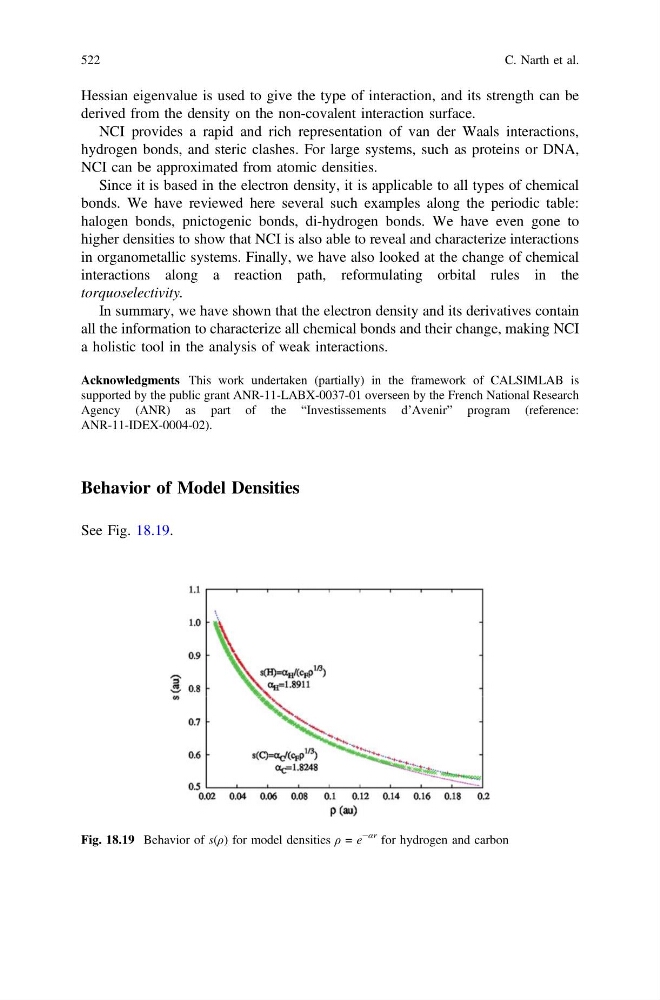
See Fig. 18.19.
Fig. 18.19 Behavior of s(ρ) for model densities ρ = e
−αr for hydrogen and carbon
522
C. Narth et al.
derived from the density on the non-covalent interaction surface.
NCI provides a rapid and rich representation of van der Waals interactions,
hydrogen bonds, and steric clashes. For large systems, such as proteins or DNA,
NCI can be approximated from atomic densities.
Since it is based in the electron density, it is applicable to all types of chemical
bonds. We have reviewed here several such examples along the periodic table:
halogen bonds, pnictogenic bonds, di-hydrogen bonds. We have even gone to
higher densities to show that NCI is also able to reveal and characterize interactions
in organometallic systems. Finally, we have also looked at the change of chemical
interactions along a reaction path, reformulating orbital rules in the
torquoselectivity.
In summary, we have shown that the electron density and its derivatives contain
all the information to characterize all chemical bonds and their change, making NCI
a holistic tool in the analysis of weak interactions.
Acknowledgments This work undertaken (partially) in the framework of CALSIMLAB is
supported by the public grant ANR-11-LABX-0037-01 overseen by the French National Research
Agency (ANR) as part of the “Investissements d’Avenir” program (reference:
ANR-11-IDEX-0004-02).
Behavior of Model Densities
See Fig. 18.19.
Fig. 18.19 Behavior of s(ρ) for model densities ρ = e
−αr for hydrogen and carbon
522
C. Narth et al.