

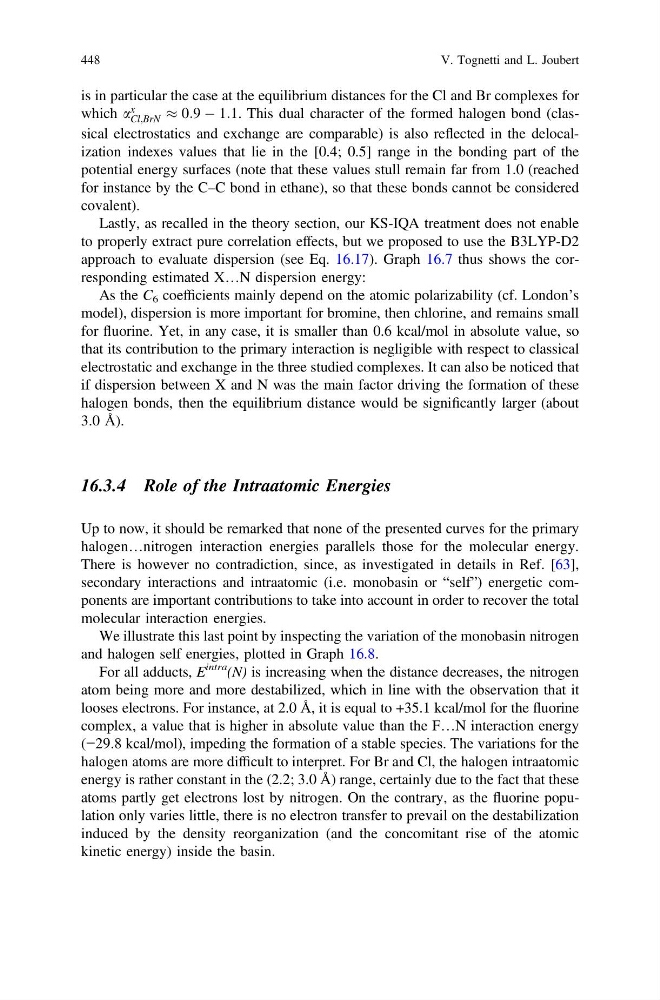
is in particular the case at the equilibrium distances for the Cl and Br complexes for
which a
x
Cl;BrN % 0:9 À 1:1. This dual character of the formed halogen bond (classical electrostatics and exchange are comparable) is also reflected in the delocalization indexes values that lie in the [0.4; 0.5] range in the bonding part of the
potential energy surfaces (note that these values stull remain far from 1.0 (reached
for instance by the C–C bond in ethane), so that these bonds cannot be considered
covalent).
Lastly, as recalled in the theory section, our KS-IQA treatment does not enable
to properly extract pure correlation effects, but we proposed to use the B3LYP-D2
approach to evaluate dispersion (see Eq. 16.17). Graph 16.7 thus shows the corresponding estimated X…N dispersion energy:
As the C 6 coefficients mainly depend on the atomic polarizability (cf. London’s
model), dispersion is more important for bromine, then chlorine, and remains small
for fluorine. Yet, in any case, it is smaller than 0.6 kcal/mol in absolute value, so
that its contribution to the primary interaction is negligible with respect to classical
electrostatic and exchange in the three studied complexes. It can also be noticed that
if dispersion between X and N was the main factor driving the formation of these
halogen bonds, then the equilibrium distance would be significantly larger (about
3.0 Å).
16.3.4 Role of the Intraatomic Energies
Up to now, it should be remarked that none of the presented curves for the primary
halogen…nitrogen interaction energies parallels those for the molecular energy.
There is however no contradiction, since, as investigated in details in Ref. [63],
secondary interactions and intraatomic (i.e. monobasin or “self”) energetic components are important contributions to take into account in order to recover the total
molecular interaction energies.
We illustrate this last point by inspecting the variation of the monobasin nitrogen
and halogen self energies, plotted in Graph 16.8.
For all adducts, E
intra (N) is increasing when the distance decreases, the nitrogen
atom being more and more destabilized, which in line with the observation that it
looses electrons. For instance, at 2.0 Å, it is equal to +35.1 kcal/mol for the fluorine
complex, a value that is higher in absolute value than the F…N interaction energy
(−29.8 kcal/mol), impeding the formation of a stable species. The variations for the
halogen atoms are more difficult to interpret. For Br and Cl, the halogen intraatomic
energy is rather constant in the (2.2; 3.0 Å) range, certainly due to the fact that these
atoms partly get electrons lost by nitrogen. On the contrary, as the fluorine population only varies little, there is no electron transfer to prevail on the destabilization
induced by the density reorganization (and the concomitant rise of the atomic
kinetic energy) inside the basin.
448
V. Tognetti and L. Joubert
which a
x
Cl;BrN % 0:9 À 1:1. This dual character of the formed halogen bond (classical electrostatics and exchange are comparable) is also reflected in the delocalization indexes values that lie in the [0.4; 0.5] range in the bonding part of the
potential energy surfaces (note that these values stull remain far from 1.0 (reached
for instance by the C–C bond in ethane), so that these bonds cannot be considered
covalent).
Lastly, as recalled in the theory section, our KS-IQA treatment does not enable
to properly extract pure correlation effects, but we proposed to use the B3LYP-D2
approach to evaluate dispersion (see Eq. 16.17). Graph 16.7 thus shows the corresponding estimated X…N dispersion energy:
As the C 6 coefficients mainly depend on the atomic polarizability (cf. London’s
model), dispersion is more important for bromine, then chlorine, and remains small
for fluorine. Yet, in any case, it is smaller than 0.6 kcal/mol in absolute value, so
that its contribution to the primary interaction is negligible with respect to classical
electrostatic and exchange in the three studied complexes. It can also be noticed that
if dispersion between X and N was the main factor driving the formation of these
halogen bonds, then the equilibrium distance would be significantly larger (about
3.0 Å).
16.3.4 Role of the Intraatomic Energies
Up to now, it should be remarked that none of the presented curves for the primary
halogen…nitrogen interaction energies parallels those for the molecular energy.
There is however no contradiction, since, as investigated in details in Ref. [63],
secondary interactions and intraatomic (i.e. monobasin or “self”) energetic components are important contributions to take into account in order to recover the total
molecular interaction energies.
We illustrate this last point by inspecting the variation of the monobasin nitrogen
and halogen self energies, plotted in Graph 16.8.
For all adducts, E
intra (N) is increasing when the distance decreases, the nitrogen
atom being more and more destabilized, which in line with the observation that it
looses electrons. For instance, at 2.0 Å, it is equal to +35.1 kcal/mol for the fluorine
complex, a value that is higher in absolute value than the F…N interaction energy
(−29.8 kcal/mol), impeding the formation of a stable species. The variations for the
halogen atoms are more difficult to interpret. For Br and Cl, the halogen intraatomic
energy is rather constant in the (2.2; 3.0 Å) range, certainly due to the fact that these
atoms partly get electrons lost by nitrogen. On the contrary, as the fluorine population only varies little, there is no electron transfer to prevail on the destabilization
induced by the density reorganization (and the concomitant rise of the atomic
kinetic energy) inside the basin.
448
V. Tognetti and L. Joubert