

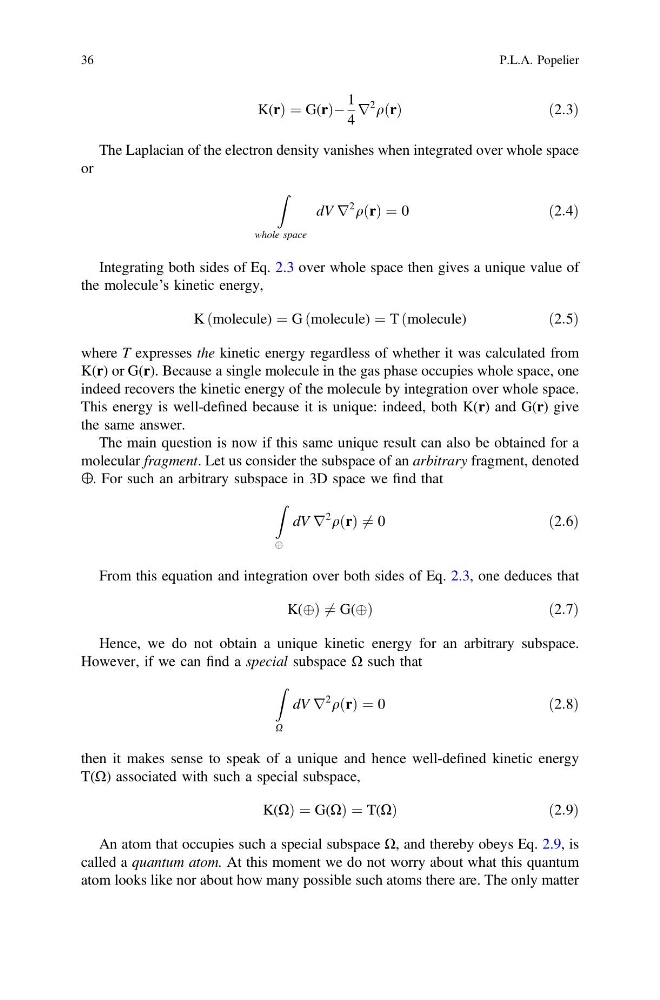
K(rÞ ¼ G(rÞÀ
1
4
r
2
qðrÞ
ð 2:3Þ
The Laplacian of the electron density vanishes when integrated over whole space
or
Z
whole space
dV r
2
qðrÞ ¼ 0
ð2:4Þ
Integrating both sides of Eq. 2.3 over whole space then gives a unique value of
the molecule’s kinetic energy,
K ðmolecule) ¼ G ðmolecule) ¼ T ðmolecule)
ð2:5Þ
where T expresses the kinetic energy regardless of whether it was calculated from
K(r) or G(r). Because a single molecule in the gas phase occupies whole space, one
indeed recovers the kinetic energy of the molecule by integration over whole space.
This energy is well-defined because it is unique: indeed, both K(r) and G(r) give
the same answer.
The main question is now if this same unique result can also be obtained for a
molecular fragment. Let us consider the subspace of an arbitrary fragment, denoted
⨁. For such an arbitrary subspace in 3D space we find that
Z
È
dV r
2
qðrÞ 6 ¼ 0
ð2:6Þ
From this equation and integration over both sides of Eq. 2.3, one deduces that
K(ÈÞ 6 ¼ G(ÈÞ
ð2:7Þ
Hence, we do not obtain a unique kinetic energy for an arbitrary subspace.
However, if we can find a special subspace Ω such that
Z
X
dV r
2
qðrÞ ¼ 0
ð2:8Þ
then it makes sense to speak of a unique and hence well-defined kinetic energy
T(Ω) associated with such a special subspace,
K(XÞ ¼ G(XÞ ¼ T(XÞ
ð 2:9Þ
An atom that occupies such a special subspace Ω, and thereby obeys Eq. 2.9, is
called a quantum atom. At this moment we do not worry about what this quantum
atom looks like nor about how many possible such atoms there are. The only matter
36
P.L.A. Popelier
1
4
r
2
qðrÞ
ð 2:3Þ
The Laplacian of the electron density vanishes when integrated over whole space
or
Z
whole space
dV r
2
qðrÞ ¼ 0
ð2:4Þ
Integrating both sides of Eq. 2.3 over whole space then gives a unique value of
the molecule’s kinetic energy,
K ðmolecule) ¼ G ðmolecule) ¼ T ðmolecule)
ð2:5Þ
where T expresses the kinetic energy regardless of whether it was calculated from
K(r) or G(r). Because a single molecule in the gas phase occupies whole space, one
indeed recovers the kinetic energy of the molecule by integration over whole space.
This energy is well-defined because it is unique: indeed, both K(r) and G(r) give
the same answer.
The main question is now if this same unique result can also be obtained for a
molecular fragment. Let us consider the subspace of an arbitrary fragment, denoted
⨁. For such an arbitrary subspace in 3D space we find that
Z
È
dV r
2
qðrÞ 6 ¼ 0
ð2:6Þ
From this equation and integration over both sides of Eq. 2.3, one deduces that
K(ÈÞ 6 ¼ G(ÈÞ
ð2:7Þ
Hence, we do not obtain a unique kinetic energy for an arbitrary subspace.
However, if we can find a special subspace Ω such that
Z
X
dV r
2
qðrÞ ¼ 0
ð2:8Þ
then it makes sense to speak of a unique and hence well-defined kinetic energy
T(Ω) associated with such a special subspace,
K(XÞ ¼ G(XÞ ¼ T(XÞ
ð 2:9Þ
An atom that occupies such a special subspace Ω, and thereby obeys Eq. 2.9, is
called a quantum atom. At this moment we do not worry about what this quantum
atom looks like nor about how many possible such atoms there are. The only matter
36
P.L.A. Popelier