

ratios between the spin densities on the ring atoms of the series 1a, 2a, 3a are very
close to those predicted from the topology. The local character of the SOMO in 2c
and 3c, predicted by this Hamiltonian, is confirmed at this level. These tables also
report the values obtained from Unrestricted DFT (UDFT) calculations. The spin
polarization does not change significantly the ratios between the spin densities of
the atoms which bear large positive spin densities at the RODFT level, but it
introduces large values on atoms which are far from the extra-cyclic CH 2
group. The spin polarization introduces long range effects, especially in the acene
series (Cf. 3a in Table 14.2), as previously commented. The effect is much less
pronounced in 2c and 3c, due to the localization of the SOMO. One sees that
despite the neglect of the spin polarization important information can be obtained
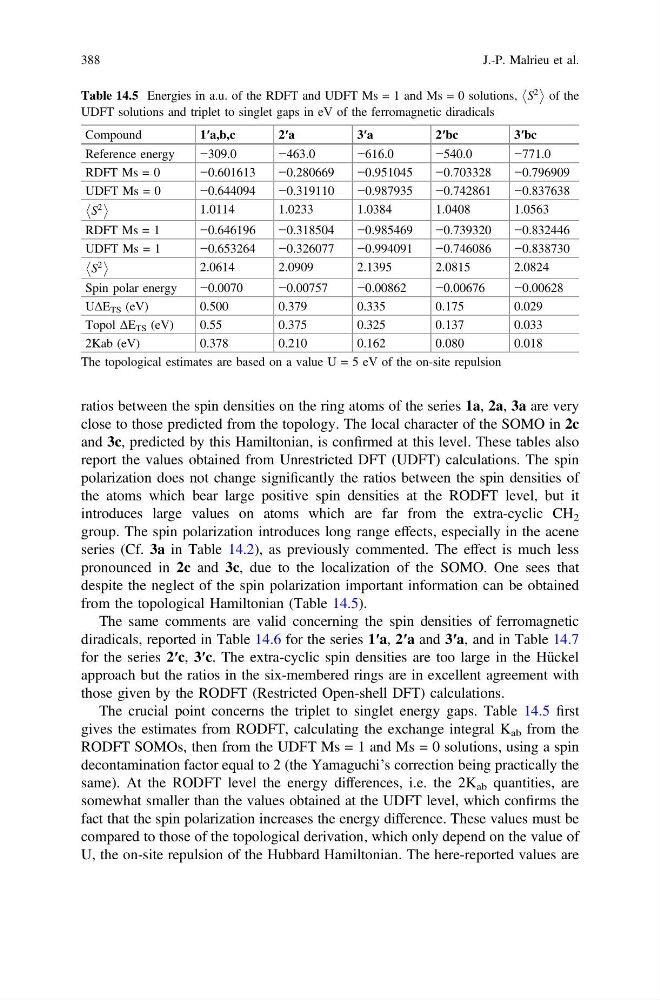
from the topological Hamiltonian (Table 14.5).
The same comments are valid concerning the spin densities of ferromagnetic
diradicals, reported in Table 14.6 for the series 1′a, 2′a and 3′a, and in Table 14.7
for the series 2′c, 3′c. The extra-cyclic spin densities are too large in the Hückel
approach but the ratios in the six-membered rings are in excellent agreement with
those given by the RODFT (Restricted Open-shell DFT) calculations.
The crucial point concerns the triplet to singlet energy gaps. Table 14.5 first
gives the estimates from RODFT, calculating the exchange integral K ab from the
RODFT SOMOs, then from the UDFT Ms = 1 and Ms = 0 solutions, using a spin
decontamination factor equal to 2 (the Yamaguchi’s correction being practically the
same). At the RODFT level the energy differences, i.e. the 2K ab quantities, are
somewhat smaller than the values obtained at the UDFT level, which confirms the
fact that the spin polarization increases the energy difference. These values must be
compared to those of the topological derivation, which only depend on the value of
U, the on-site repulsion of the Hubbard Hamiltonian. The here-reported values are
Table 14.5 Energies in a.u. of the RDFT and UDFT Ms = 1 and Ms = 0 solutions, S
2
of the
UDFT solutions and triplet to singlet gaps in eV of the ferromagnetic diradicals
Compound
1′a,b,c
2′a
3 ′a
2 ′bc
3′bc
Reference energy
−309.0
−463.0
−616.0
−540.0
−771.0
RDFT Ms = 0
−0.601613
−0.280669
−0.951045
−0.703328
−0.796909
UDFT Ms = 0
−0.644094
−0.319110
−0.987935
−0.742861
−0.837638
S
2
1.0114
1.0233
1.0384
1.0408
1.0563
RDFT Ms = 1
−0.646196
−0.318504
−0.985469
−0.739320
−0.832446
UDFT Ms = 1
−0.653264
−0.326077
−0.994091
−0.746086
−0.838730
S
2
2.0614
2.0909
2.1395
2.0815
2.0824
Spin polar energy
−0.0070
−0.00757
−0.00862
−0.00676
−0.00628
UΔE TS (eV)
0.500
0.379
0.335
0.175
0.029
Topol ΔE TS (eV)
0.55
0.375
0.325
0.137
0.033
2Kab (eV)
0.378
0.210
0.162
0.080
0.018
The topological estimates are based on a value U = 5 eV of the on-site repulsion
388
J.-P. Malrieu et al.
close to those predicted from the topology. The local character of the SOMO in 2c
and 3c, predicted by this Hamiltonian, is confirmed at this level. These tables also
report the values obtained from Unrestricted DFT (UDFT) calculations. The spin
polarization does not change significantly the ratios between the spin densities of
the atoms which bear large positive spin densities at the RODFT level, but it
introduces large values on atoms which are far from the extra-cyclic CH 2
group. The spin polarization introduces long range effects, especially in the acene
series (Cf. 3a in Table 14.2), as previously commented. The effect is much less
pronounced in 2c and 3c, due to the localization of the SOMO. One sees that
despite the neglect of the spin polarization important information can be obtained
from the topological Hamiltonian (Table 14.5).
The same comments are valid concerning the spin densities of ferromagnetic
diradicals, reported in Table 14.6 for the series 1′a, 2′a and 3′a, and in Table 14.7
for the series 2′c, 3′c. The extra-cyclic spin densities are too large in the Hückel
approach but the ratios in the six-membered rings are in excellent agreement with
those given by the RODFT (Restricted Open-shell DFT) calculations.
The crucial point concerns the triplet to singlet energy gaps. Table 14.5 first
gives the estimates from RODFT, calculating the exchange integral K ab from the
RODFT SOMOs, then from the UDFT Ms = 1 and Ms = 0 solutions, using a spin
decontamination factor equal to 2 (the Yamaguchi’s correction being practically the
same). At the RODFT level the energy differences, i.e. the 2K ab quantities, are
somewhat smaller than the values obtained at the UDFT level, which confirms the
fact that the spin polarization increases the energy difference. These values must be
compared to those of the topological derivation, which only depend on the value of
U, the on-site repulsion of the Hubbard Hamiltonian. The here-reported values are
Table 14.5 Energies in a.u. of the RDFT and UDFT Ms = 1 and Ms = 0 solutions, S
2
of the
UDFT solutions and triplet to singlet gaps in eV of the ferromagnetic diradicals
Compound
1′a,b,c
2′a
3 ′a
2 ′bc
3′bc
Reference energy
−309.0
−463.0
−616.0
−540.0
−771.0
RDFT Ms = 0
−0.601613
−0.280669
−0.951045
−0.703328
−0.796909
UDFT Ms = 0
−0.644094
−0.319110
−0.987935
−0.742861
−0.837638
S
2
1.0114
1.0233
1.0384
1.0408
1.0563
RDFT Ms = 1
−0.646196
−0.318504
−0.985469
−0.739320
−0.832446
UDFT Ms = 1
−0.653264
−0.326077
−0.994091
−0.746086
−0.838730
S
2
2.0614
2.0909
2.1395
2.0815
2.0824
Spin polar energy
−0.0070
−0.00757
−0.00862
−0.00676
−0.00628
UΔE TS (eV)
0.500
0.379
0.335
0.175
0.029
Topol ΔE TS (eV)
0.55
0.375
0.325
0.137
0.033
2Kab (eV)
0.378
0.210
0.162
0.080
0.018
The topological estimates are based on a value U = 5 eV of the on-site repulsion
388
J.-P. Malrieu et al.