

density and this minimality obeys Occam’s razor. This principle of parsimony in
assumptions is a quality gauge while assessing theories and models. The fewer
parameters a model or theory possesses, while explaining the same number of
observed phenomena, the more powerful it is. As a result, the more minimal models
are preferable to the more elaborate ones. If experiment does not come to the aid of
ranking theoretical proposals by their merit, then Occam’s razor does.
After this philosophical but also strategic interlude we are ready to inspect the
electron density of a simple pilot system, the HCN molecule, which is linear.
However, we first ask why the electron density is a good starting point to look for
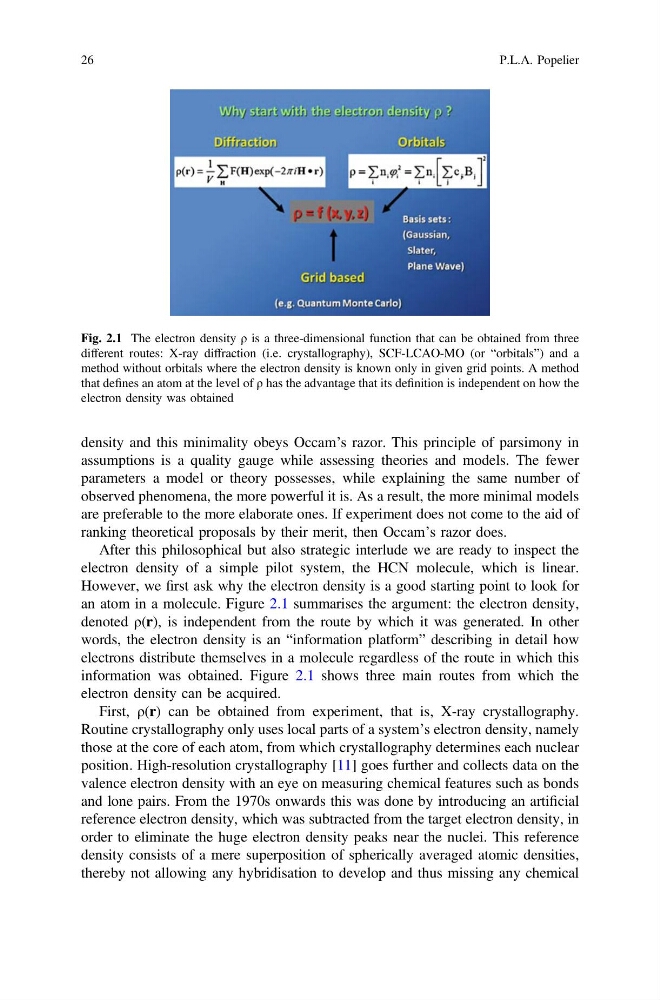
an atom in a molecule. Figure 2.1 summarises the argument: the electron density,
denoted ρ(r), is independent from the route by which it was generated. In other
words, the electron density is an “information platform” describing in detail how
electrons distribute themselves in a molecule regardless of the route in which this
information was obtained. Figure 2.1 shows three main routes from which the
electron density can be acquired.
First, ρ(r) can be obtained from experiment, that is, X-ray crystallography.
Routine crystallography only uses local parts of a system’s electron density, namely
those at the core of each atom, from which crystallography determines each nuclear
position. High-resolution crystallography [11] goes further and collects data on the
valence electron density with an eye on measuring chemical features such as bonds
and lone pairs. From the 1970s onwards this was done by introducing an artificial
reference electron density, which was subtracted from the target electron density, in
order to eliminate the huge electron density peaks near the nuclei. This reference
density consists of a mere superposition of spherically averaged atomic densities,
thereby not allowing any hybridisation to develop and thus missing any chemical
Fig. 2.1 The electron density ρ is a three-dimensional function that can be obtained from three
different routes: X-ray diffraction (i.e. crystallography), SCF-LCAO-MO (or “orbitals”) and a
method without orbitals where the electron density is known only in given grid points. A method
that defines an atom at the level of ρ has the advantage that its definition is independent on how the
electron density was obtained
26
P.L.A. Popelier
assumptions is a quality gauge while assessing theories and models. The fewer
parameters a model or theory possesses, while explaining the same number of
observed phenomena, the more powerful it is. As a result, the more minimal models
are preferable to the more elaborate ones. If experiment does not come to the aid of
ranking theoretical proposals by their merit, then Occam’s razor does.
After this philosophical but also strategic interlude we are ready to inspect the
electron density of a simple pilot system, the HCN molecule, which is linear.
However, we first ask why the electron density is a good starting point to look for
an atom in a molecule. Figure 2.1 summarises the argument: the electron density,
denoted ρ(r), is independent from the route by which it was generated. In other
words, the electron density is an “information platform” describing in detail how
electrons distribute themselves in a molecule regardless of the route in which this
information was obtained. Figure 2.1 shows three main routes from which the
electron density can be acquired.
First, ρ(r) can be obtained from experiment, that is, X-ray crystallography.
Routine crystallography only uses local parts of a system’s electron density, namely
those at the core of each atom, from which crystallography determines each nuclear
position. High-resolution crystallography [11] goes further and collects data on the
valence electron density with an eye on measuring chemical features such as bonds
and lone pairs. From the 1970s onwards this was done by introducing an artificial
reference electron density, which was subtracted from the target electron density, in
order to eliminate the huge electron density peaks near the nuclei. This reference
density consists of a mere superposition of spherically averaged atomic densities,
thereby not allowing any hybridisation to develop and thus missing any chemical
Fig. 2.1 The electron density ρ is a three-dimensional function that can be obtained from three
different routes: X-ray diffraction (i.e. crystallography), SCF-LCAO-MO (or “orbitals”) and a
method without orbitals where the electron density is known only in given grid points. A method
that defines an atom at the level of ρ has the advantage that its definition is independent on how the
electron density was obtained
26
P.L.A. Popelier