

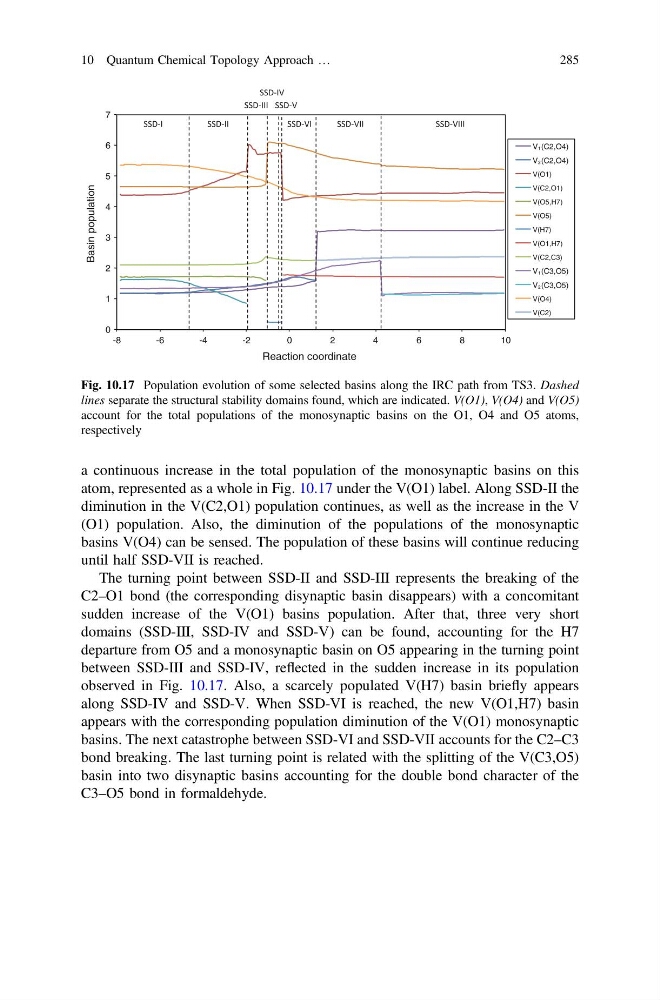
a continuous increase in the total population of the monosynaptic basins on this
atom, represented as a whole in Fig. 10.17 under the V(O1) label. Along SSD-II the
diminution in the V(C2,O1) population continues, as well as the increase in the V
(O1) population. Also, the diminution of the populations of the monosynaptic
basins V(O4) can be sensed. The population of these basins will continue reducing
until half SSD-VII is reached.
The turning point between SSD-II and SSD-III represents the breaking of the
C2–O1 bond (the corresponding disynaptic basin disappears) with a concomitant
sudden increase of the V(O1) basins population. After that, three very short
domains (SSD-III, SSD-IV and SSD-V) can be found, accounting for the H7
departure from O5 and a monosynaptic basin on O5 appearing in the turning point
between SSD-III and SSD-IV, reflected in the sudden increase in its population
observed in Fig. 10.17. Also, a scarcely populated V(H7) basin briefly appears
along SSD-IV and SSD-V. When SSD-VI is reached, the new V(O1,H7) basin
appears with the corresponding population diminution of the V(O1) monosynaptic
basins. The next catastrophe between SSD-VI and SSD-VII accounts for the C2–C3
bond breaking. The last turning point is related with the splitting of the V(C3,O5)
basin into two disynaptic basins accounting for the double bond character of the
C3–O5 bond in formaldehyde.
0
1
2
3
4
5
6
7
-8
-6
-4
-2
0
2
4
6
8
10
Basin population
Reaction coordinate
V(O1)
V(C2,O1)
V(O5,H7)
V(O5)
V(H7)
V(O1,H7)
V(C2,C3)
V(O4)
V(C2)
V1(C2,O4)
V2(C2,O4)
V1(C3,O5)
V2(C3,O5)
Fig. 10.17 Population evolution of some selected basins along the IRC path from TS3. Dashed
lines separate the structural stability domains found, which are indicated. V(O1), V(O4) and V(O5)
account for the total populations of the monosynaptic basins on the O1, O4 and O5 atoms,
respectively
10 Quantum Chemical Topology Approach …
285
atom, represented as a whole in Fig. 10.17 under the V(O1) label. Along SSD-II the
diminution in the V(C2,O1) population continues, as well as the increase in the V
(O1) population. Also, the diminution of the populations of the monosynaptic
basins V(O4) can be sensed. The population of these basins will continue reducing
until half SSD-VII is reached.
The turning point between SSD-II and SSD-III represents the breaking of the
C2–O1 bond (the corresponding disynaptic basin disappears) with a concomitant
sudden increase of the V(O1) basins population. After that, three very short
domains (SSD-III, SSD-IV and SSD-V) can be found, accounting for the H7
departure from O5 and a monosynaptic basin on O5 appearing in the turning point
between SSD-III and SSD-IV, reflected in the sudden increase in its population
observed in Fig. 10.17. Also, a scarcely populated V(H7) basin briefly appears
along SSD-IV and SSD-V. When SSD-VI is reached, the new V(O1,H7) basin
appears with the corresponding population diminution of the V(O1) monosynaptic
basins. The next catastrophe between SSD-VI and SSD-VII accounts for the C2–C3
bond breaking. The last turning point is related with the splitting of the V(C3,O5)
basin into two disynaptic basins accounting for the double bond character of the
C3–O5 bond in formaldehyde.
0
1
2
3
4
5
6
7
-8
-6
-4
-2
0
2
4
6
8
10
Basin population
Reaction coordinate
V(O1)
V(C2,O1)
V(O5,H7)
V(O5)
V(H7)
V(O1,H7)
V(C2,C3)
V(O4)
V(C2)
V1(C2,O4)
V2(C2,O4)
V1(C3,O5)
V2(C3,O5)
Fig. 10.17 Population evolution of some selected basins along the IRC path from TS3. Dashed
lines separate the structural stability domains found, which are indicated. V(O1), V(O4) and V(O5)
account for the total populations of the monosynaptic basins on the O1, O4 and O5 atoms,
respectively
10 Quantum Chemical Topology Approach …
285