

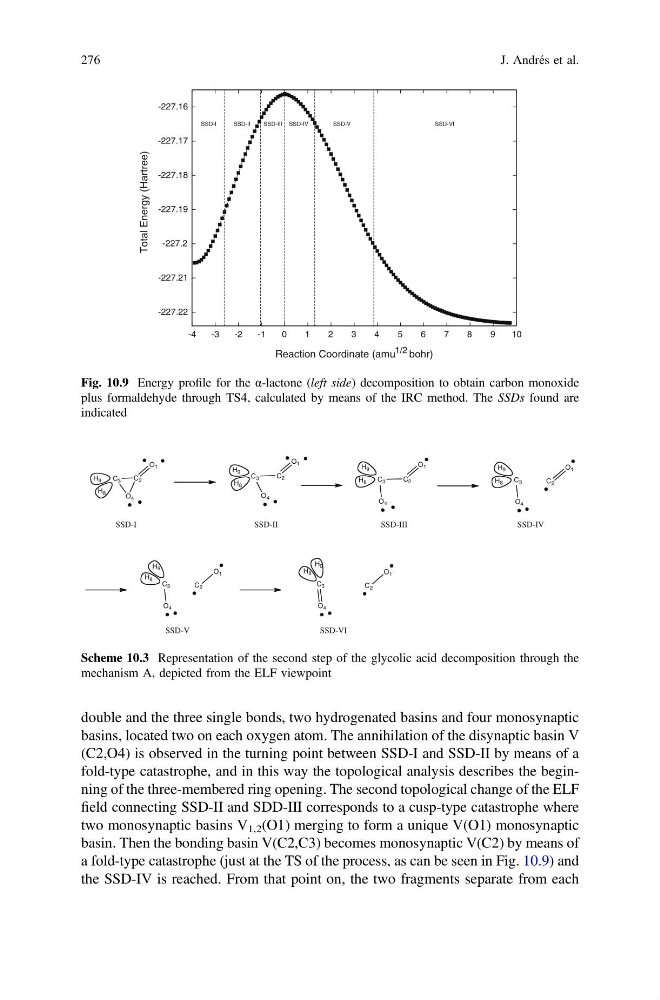
double and the three single bonds, two hydrogenated basins and four monosynaptic
basins, located two on each oxygen atom. The annihilation of the disynaptic basin V
(C2,O4) is observed in the turning point between SSD-I and SSD-II by means of a
fold-type catastrophe, and in this way the topological analysis describes the beginning of the three-membered ring opening. The second topological change of the ELF
field connecting SSD-II and SDD-III corresponds to a cusp-type catastrophe where
two monosynaptic basins V 1,2 (O1) merging to form a unique V(O1) monosynaptic
basin. Then the bonding basin V(C2,C3) becomes monosynaptic V(C2) by means of
a fold-type catastrophe (just at the TS of the process, as can be seen in Fig. 10.9) and
the SSD-IV is reached. From that point on, the two fragments separate from each
-227.22
-227.21
-227.2
-227.19
-227.18
-227.17
-227.16
-4
-3
-2
-1
0
1
2
3
4
5
6
7
8
9
10
Total Energy (Hartree)
Reaction Coordinate (amu 1/2 bohr)
SSD-I
SSD-II
SSD-III SSD-IV
SSD-V
SSD-VI
Fig. 10.9 Energy profile for the α-lactone (left side) decomposition to obtain carbon monoxide
plus formaldehyde through TS4, calculated by means of the IRC method. The SSDs found are
indicated
C 3
C 2
O 4
O 1
H 9
H 8
SSD-I
C 3
C 2
O 4
O 1
H 9
H 8
SSD-II
C 3
C 2
O 4
O 1
H 9
H 8
SSD-III
C 3
C 2
O 4
O 1
H 9
H 8
SSD-IV
C 3
C 2
O 4
O 1
H 9
H 8
SSD-V
C 3
C 2
O 4
O 1
H 9
H 8
SSD-VI
Scheme 10.3 Representation of the second step of the glycolic acid decomposition through the
mechanism A, depicted from the ELF viewpoint
276
J. Andrés et al.
basins, located two on each oxygen atom. The annihilation of the disynaptic basin V
(C2,O4) is observed in the turning point between SSD-I and SSD-II by means of a
fold-type catastrophe, and in this way the topological analysis describes the beginning of the three-membered ring opening. The second topological change of the ELF
field connecting SSD-II and SDD-III corresponds to a cusp-type catastrophe where
two monosynaptic basins V 1,2 (O1) merging to form a unique V(O1) monosynaptic
basin. Then the bonding basin V(C2,C3) becomes monosynaptic V(C2) by means of
a fold-type catastrophe (just at the TS of the process, as can be seen in Fig. 10.9) and
the SSD-IV is reached. From that point on, the two fragments separate from each
-227.22
-227.21
-227.2
-227.19
-227.18
-227.17
-227.16
-4
-3
-2
-1
0
1
2
3
4
5
6
7
8
9
10
Total Energy (Hartree)
Reaction Coordinate (amu 1/2 bohr)
SSD-I
SSD-II
SSD-III SSD-IV
SSD-V
SSD-VI
Fig. 10.9 Energy profile for the α-lactone (left side) decomposition to obtain carbon monoxide
plus formaldehyde through TS4, calculated by means of the IRC method. The SSDs found are
indicated
C 3
C 2
O 4
O 1
H 9
H 8
SSD-I
C 3
C 2
O 4
O 1
H 9
H 8
SSD-II
C 3
C 2
O 4
O 1
H 9
H 8
SSD-III
C 3
C 2
O 4
O 1
H 9
H 8
SSD-IV
C 3
C 2
O 4
O 1
H 9
H 8
SSD-V
C 3
C 2
O 4
O 1
H 9
H 8
SSD-VI
Scheme 10.3 Representation of the second step of the glycolic acid decomposition through the
mechanism A, depicted from the ELF viewpoint
276
J. Andrés et al.