

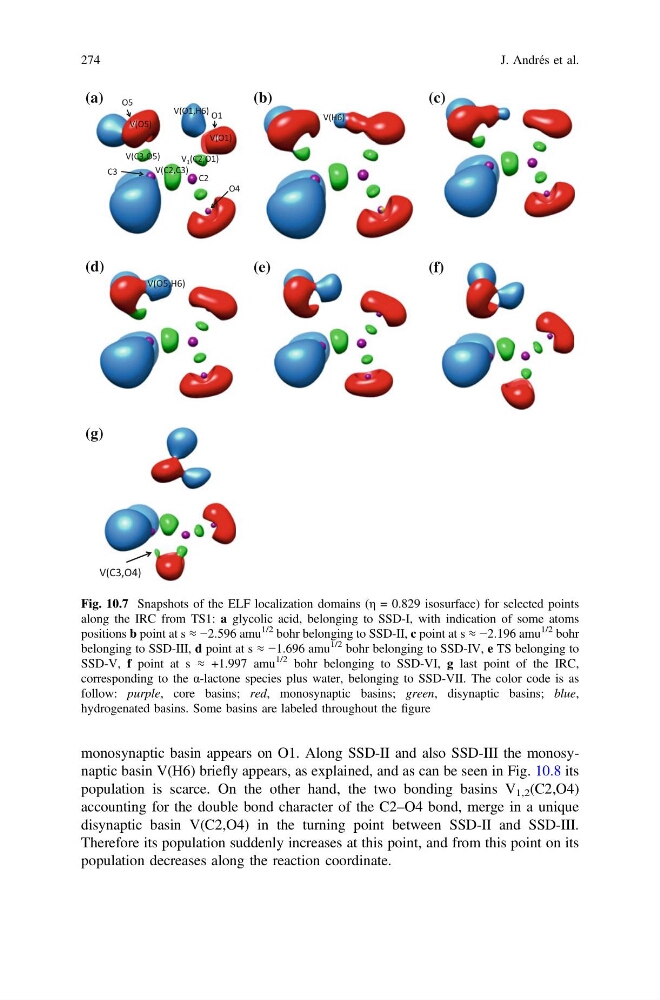
monosynaptic basin appears on O1. Along SSD-II and also SSD-III the monosynaptic basin V(H6) briefly appears, as explained, and as can be seen in Fig. 10.8 its
population is scarce. On the other hand, the two bonding basins V 1,2 (C2,O4)
accounting for the double bond character of the C2–O4 bond, merge in a unique
disynaptic basin V(C2,O4) in the turning point between SSD-II and SSD-III.
Therefore its population suddenly increases at this point, and from this point on its
population decreases along the reaction coordinate.
(a)
(b)
(c)
(d)
(e)
(f)
(g)
Fig. 10.7 Snapshots of the ELF localization domains (η = 0.829 isosurface) for selected points
along the IRC from TS1: a glycolic acid, belonging to SSD-I, with indication of some atoms
positions b point at s ≈ −2.596 amu
1/2 bohr belonging to SSD-II, c point at s ≈ −2.196 amu
1/2 bohr
belonging to SSD-III, d point at s ≈ −1.696 amu
1/2 bohr belonging to SSD-IV, e TS belonging to
SSD-V, f point at s ≈ +1.997 amu
1/2 bohr belonging to SSD-VI, g last point of the IRC,
corresponding to the α-lactone species plus water, belonging to SSD-VII. The color code is as
follow: purple, core basins; red, monosynaptic basins; green, disynaptic basins; blue,
hydrogenated basins. Some basins are labeled throughout the figure
274
J. Andrés et al.
population is scarce. On the other hand, the two bonding basins V 1,2 (C2,O4)
accounting for the double bond character of the C2–O4 bond, merge in a unique
disynaptic basin V(C2,O4) in the turning point between SSD-II and SSD-III.
Therefore its population suddenly increases at this point, and from this point on its
population decreases along the reaction coordinate.
(a)
(b)
(c)
(d)
(e)
(f)
(g)
Fig. 10.7 Snapshots of the ELF localization domains (η = 0.829 isosurface) for selected points
along the IRC from TS1: a glycolic acid, belonging to SSD-I, with indication of some atoms
positions b point at s ≈ −2.596 amu
1/2 bohr belonging to SSD-II, c point at s ≈ −2.196 amu
1/2 bohr
belonging to SSD-III, d point at s ≈ −1.696 amu
1/2 bohr belonging to SSD-IV, e TS belonging to
SSD-V, f point at s ≈ +1.997 amu
1/2 bohr belonging to SSD-VI, g last point of the IRC,
corresponding to the α-lactone species plus water, belonging to SSD-VII. The color code is as
follow: purple, core basins; red, monosynaptic basins; green, disynaptic basins; blue,
hydrogenated basins. Some basins are labeled throughout the figure
274
J. Andrés et al.