

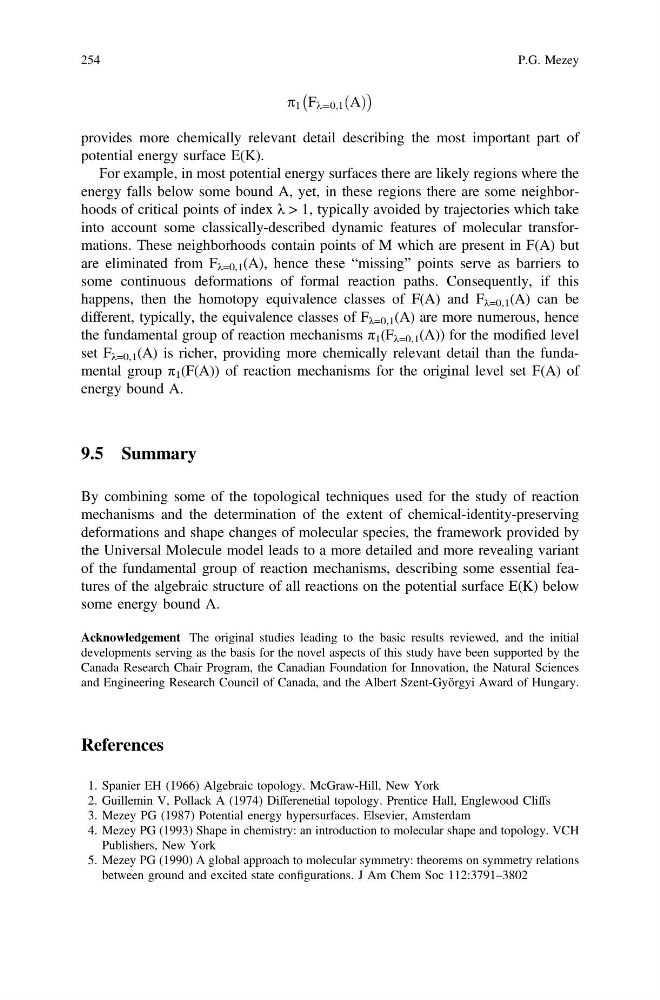
p 1 F k¼0;1 A
ð Þ
À
Á
provides more chemically relevant detail describing the most important part of
potential energy surface E(K).
For example, in most potential energy surfaces there are likely regions where the
energy falls below some bound A, yet, in these regions there are some neighborhoods of critical points of index λ > 1, typically avoided by trajectories which take
into account some classically-described dynamic features of molecular transformations. These neighborhoods contain points of M which are present in F(A) but
are eliminated from F λ=0,1 (A), hence these “missing” points serve as barriers to
some continuous deformations of formal reaction paths. Consequently, if this
happens, then the homotopy equivalence classes of F(A) and F λ=0,1 (A) can be
different, typically, the equivalence classes of F λ=0,1 (A) are more numerous, hence
the fundamental group of reaction mechanisms π 1 (F λ=0,1 (A)) for the modified level
set F λ=0,1 (A) is richer, providing more chemically relevant detail than the fundamental group π 1 (F(A)) of reaction mechanisms for the original level set F(A) of
energy bound A.
9.5 Summary
By combining some of the topological techniques used for the study of reaction
mechanisms and the determination of the extent of chemical-identity-preserving
deformations and shape changes of molecular species, the framework provided by
the Universal Molecule model leads to a more detailed and more revealing variant
of the fundamental group of reaction mechanisms, describing some essential features of the algebraic structure of all reactions on the potential surface E(K) below
some energy bound A.
Acknowledgement The original studies leading to the basic results reviewed, and the initial
developments serving as the basis for the novel aspects of this study have been supported by the
Canada Research Chair Program, the Canadian Foundation for Innovation, the Natural Sciences
and Engineering Research Council of Canada, and the Albert Szent-Györgyi Award of Hungary.
References
1. Spanier EH (1966) Algebraic topology. McGraw-Hill, New York
2. Guillemin V, Pollack A (1974) Differenetial topology. Prentice Hall, Englewood Cliffs
3. Mezey PG (1987) Potential energy hypersurfaces. Elsevier, Amsterdam
4. Mezey PG (1993) Shape in chemistry: an introduction to molecular shape and topology. VCH
Publishers, New York
5. Mezey PG (1990) A global approach to molecular symmetry: theorems on symmetry relations
between ground and excited state configurations. J Am Chem Soc 112:3791–3802
254
P.G. Mezey
ð Þ
À
Á
provides more chemically relevant detail describing the most important part of
potential energy surface E(K).
For example, in most potential energy surfaces there are likely regions where the
energy falls below some bound A, yet, in these regions there are some neighborhoods of critical points of index λ > 1, typically avoided by trajectories which take
into account some classically-described dynamic features of molecular transformations. These neighborhoods contain points of M which are present in F(A) but
are eliminated from F λ=0,1 (A), hence these “missing” points serve as barriers to
some continuous deformations of formal reaction paths. Consequently, if this
happens, then the homotopy equivalence classes of F(A) and F λ=0,1 (A) can be
different, typically, the equivalence classes of F λ=0,1 (A) are more numerous, hence
the fundamental group of reaction mechanisms π 1 (F λ=0,1 (A)) for the modified level
set F λ=0,1 (A) is richer, providing more chemically relevant detail than the fundamental group π 1 (F(A)) of reaction mechanisms for the original level set F(A) of
energy bound A.
9.5 Summary
By combining some of the topological techniques used for the study of reaction
mechanisms and the determination of the extent of chemical-identity-preserving
deformations and shape changes of molecular species, the framework provided by
the Universal Molecule model leads to a more detailed and more revealing variant
of the fundamental group of reaction mechanisms, describing some essential features of the algebraic structure of all reactions on the potential surface E(K) below
some energy bound A.
Acknowledgement The original studies leading to the basic results reviewed, and the initial
developments serving as the basis for the novel aspects of this study have been supported by the
Canada Research Chair Program, the Canadian Foundation for Innovation, the Natural Sciences
and Engineering Research Council of Canada, and the Albert Szent-Györgyi Award of Hungary.
References
1. Spanier EH (1966) Algebraic topology. McGraw-Hill, New York
2. Guillemin V, Pollack A (1974) Differenetial topology. Prentice Hall, Englewood Cliffs
3. Mezey PG (1987) Potential energy hypersurfaces. Elsevier, Amsterdam
4. Mezey PG (1993) Shape in chemistry: an introduction to molecular shape and topology. VCH
Publishers, New York
5. Mezey PG (1990) A global approach to molecular symmetry: theorems on symmetry relations
between ground and excited state configurations. J Am Chem Soc 112:3791–3802
254
P.G. Mezey