

plotting conventions of this figure, the anti-clockwise flow about the H1 nucleus is
supported by b-polarised electrons [16, 51, 52, 146]. Two clockwise whirlpools,
supported by opposite a polarisation, are observed in the H1–C1 bond and about the
C1 nucleus. The regime is reversed on the right of the r v plane, as required by the
C 2v magnetic symmetry. At the end of the coupling path, all over the H4 nucleus,
the circulation is clockwise, corresponding to local a-electron distribution. The
contour plots, (b) and (e), and the three-dimensional perspective views, (c) and (f),
show local maxima of modulus of the current density field about the nuclei.
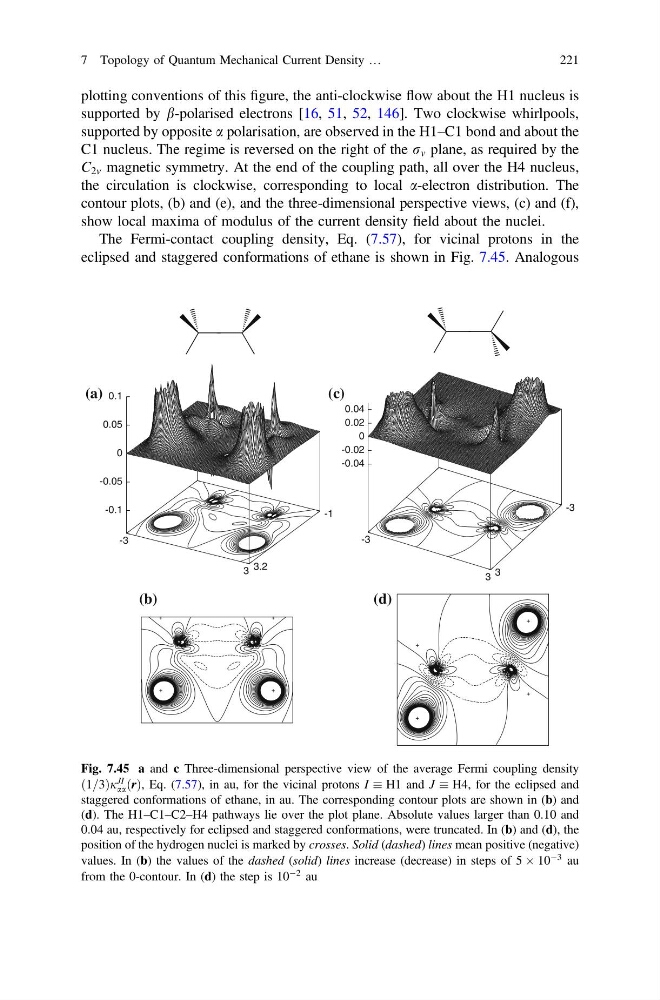
The Fermi-contact coupling density, Eq. (7.57), for vicinal protons in the
eclipsed and staggered conformations of ethane is shown in Fig. 7.45. Analogous
-1
3.2
-3
3
-0.1
-0.05
0
0.05
0.1
-3
3
-3
3
-0.04
-0.02
0
0.02
0.04
(a)
(c)
(b)
(d)
Fig. 7.45 a and c Three-dimensional perspective view of the average Fermi coupling density
ð1=3Þj
JI
aa ðrÞ, Eq. (7.57), in au, for the vicinal protons I H1 and J H4, for the eclipsed and
staggered conformations of ethane, in au. The corresponding contour plots are shown in (b) and
(d). The H1–C1–C2–H4 pathways lie over the plot plane. Absolute values larger than 0.10 and
0.04 au, respectively for eclipsed and staggered conformations, were truncated. In (b) and (d), the
position of the hydrogen nuclei is marked by crosses. Solid (dashed) lines mean positive (negative)
values. In (b) the values of the dashed (solid) lines increase (decrease) in steps of 5 Â 10
À3 au
from the 0-contour. In (d) the step is 10
À2 au
7 Topology of Quantum Mechanical Current Density …
221
supported by b-polarised electrons [16, 51, 52, 146]. Two clockwise whirlpools,
supported by opposite a polarisation, are observed in the H1–C1 bond and about the
C1 nucleus. The regime is reversed on the right of the r v plane, as required by the
C 2v magnetic symmetry. At the end of the coupling path, all over the H4 nucleus,
the circulation is clockwise, corresponding to local a-electron distribution. The
contour plots, (b) and (e), and the three-dimensional perspective views, (c) and (f),
show local maxima of modulus of the current density field about the nuclei.
The Fermi-contact coupling density, Eq. (7.57), for vicinal protons in the
eclipsed and staggered conformations of ethane is shown in Fig. 7.45. Analogous
-1
3.2
-3
3
-0.1
-0.05
0
0.05
0.1
-3
3
-3
3
-0.04
-0.02
0
0.02
0.04
(a)
(c)
(b)
(d)
Fig. 7.45 a and c Three-dimensional perspective view of the average Fermi coupling density
ð1=3Þj
JI
aa ðrÞ, Eq. (7.57), in au, for the vicinal protons I H1 and J H4, for the eclipsed and
staggered conformations of ethane, in au. The corresponding contour plots are shown in (b) and
(d). The H1–C1–C2–H4 pathways lie over the plot plane. Absolute values larger than 0.10 and
0.04 au, respectively for eclipsed and staggered conformations, were truncated. In (b) and (d), the
position of the hydrogen nuclei is marked by crosses. Solid (dashed) lines mean positive (negative)
values. In (b) the values of the dashed (solid) lines increase (decrease) in steps of 5 Â 10
À3 au
from the 0-contour. In (d) the step is 10
À2 au
7 Topology of Quantum Mechanical Current Density …
221