

7.6 Toroidal Flow and Associated Anapole Moment
As shown by Hirschfelder and coworkers, one is left with the possibility of either
AVs, rotating around nodal manifolds which extend to the boundaries of space, or
TVs flowing up through the centre and down around the sides of a closed nodal line
[37–40, 78, 118].
0.67
C plane
2.00
H plane
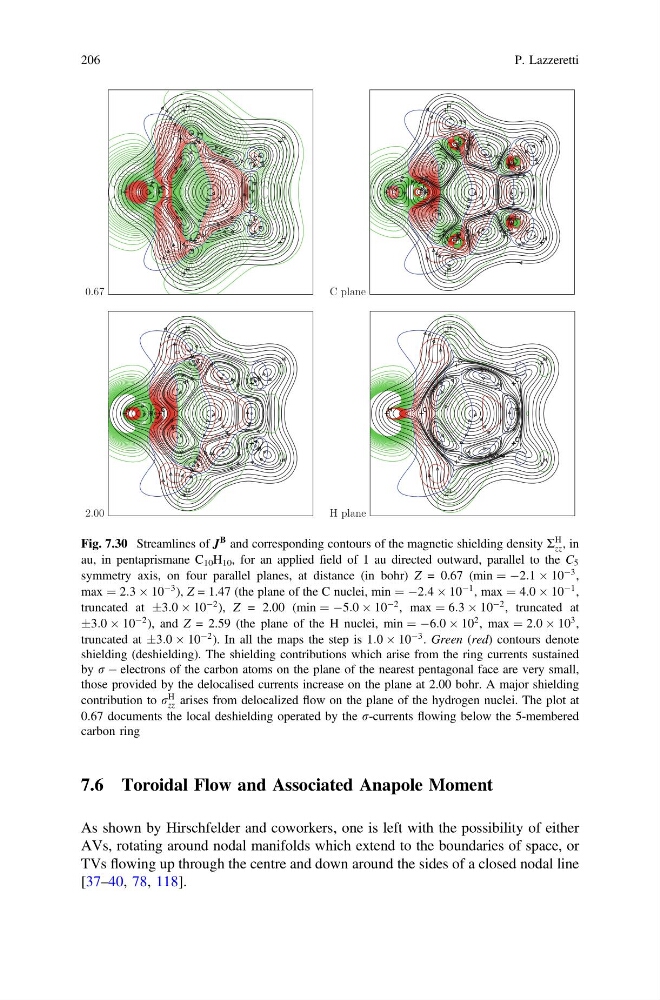
Fig. 7.30 Streamlines of J
B and corresponding contours of the magnetic shielding density R
H
zz , in
au, in pentaprismane C 10 H 10 , for an applied field of 1 au directed outward, parallel to the C 5
symmetry axis, on four parallel planes, at distance (in bohr) Z = 0.67 (min ¼ À2:1 Â 10
À3 ,
max ¼ 2:3 Â 10
À3 ), Z = 1.47 (the plane of the C nuclei, min ¼ À2:4 Â 10
À1 , max ¼ 4:0 Â 10
À1 ,
truncated at Æ3:0 Â 10
À2 ), Z = 2.00 (min ¼ À5:0 Â 10
À2 , max ¼ 6:3 Â 10
À2 , truncated at
Æ3:0 Â 10
À2 ), and Z = 2.59 (the plane of the H nuclei, min ¼ À6:0 Â 10
2 , max ¼ 2:0 Â 10
3 ,
truncated at Æ3:0 Â 10
À2 ). In all the maps the step is 1:0 Â 10
À3 . Green (red) contours denote
shielding (deshielding). The shielding contributions which arise from the ring currents sustained
by r À electrons of the carbon atoms on the plane of the nearest pentagonal face are very small,
those provided by the delocalised currents increase on the plane at 2.00 bohr. A major shielding
contribution to r
H
zz arises from delocalized flow on the plane of the hydrogen nuclei. The plot at
0.67 documents the local deshielding operated by the r-currents flowing below the 5-membered
carbon ring
206
P. Lazzeretti
As shown by Hirschfelder and coworkers, one is left with the possibility of either
AVs, rotating around nodal manifolds which extend to the boundaries of space, or
TVs flowing up through the centre and down around the sides of a closed nodal line
[37–40, 78, 118].
0.67
C plane
2.00
H plane
Fig. 7.30 Streamlines of J
B and corresponding contours of the magnetic shielding density R
H
zz , in
au, in pentaprismane C 10 H 10 , for an applied field of 1 au directed outward, parallel to the C 5
symmetry axis, on four parallel planes, at distance (in bohr) Z = 0.67 (min ¼ À2:1 Â 10
À3 ,
max ¼ 2:3 Â 10
À3 ), Z = 1.47 (the plane of the C nuclei, min ¼ À2:4 Â 10
À1 , max ¼ 4:0 Â 10
À1 ,
truncated at Æ3:0 Â 10
À2 ), Z = 2.00 (min ¼ À5:0 Â 10
À2 , max ¼ 6:3 Â 10
À2 , truncated at
Æ3:0 Â 10
À2 ), and Z = 2.59 (the plane of the H nuclei, min ¼ À6:0 Â 10
2 , max ¼ 2:0 Â 10
3 ,
truncated at Æ3:0 Â 10
À2 ). In all the maps the step is 1:0 Â 10
À3 . Green (red) contours denote
shielding (deshielding). The shielding contributions which arise from the ring currents sustained
by r À electrons of the carbon atoms on the plane of the nearest pentagonal face are very small,
those provided by the delocalised currents increase on the plane at 2.00 bohr. A major shielding
contribution to r
H
zz arises from delocalized flow on the plane of the hydrogen nuclei. The plot at
0.67 documents the local deshielding operated by the r-currents flowing below the 5-membered
carbon ring
206
P. Lazzeretti