

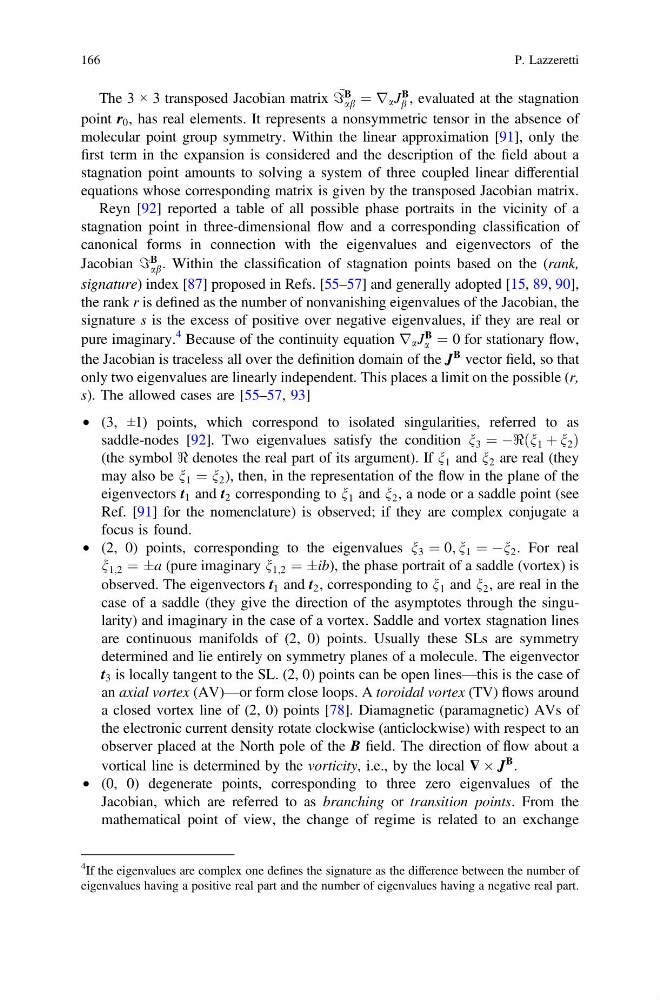
The 3 × 3 transposed Jacobian matrix ~
=
B
ab ¼ r a J
B
b , evaluated at the stagnation
point r 0 , has real elements. It represents a nonsymmetric tensor in the absence of
molecular point group symmetry. Within the linear approximation [91], only the
first term in the expansion is considered and the description of the field about a
stagnation point amounts to solving a system of three coupled linear differential
equations whose corresponding matrix is given by the transposed Jacobian matrix.
Reyn [92] reported a table of all possible phase portraits in the vicinity of a
stagnation point in three-dimensional flow and a corresponding classification of
canonical forms in connection with the eigenvalues and eigenvectors of the
Jacobian =
B
ab . Within the classification of stagnation points based on the (rank,
signature) index [87] proposed in Refs. [55–57] and generally adopted [15, 89, 90],
the rank r is defined as the number of nonvanishing eigenvalues of the Jacobian, the
signature s is the excess of positive over negative eigenvalues, if they are real or
pure imaginary.
4 Because of the continuity equation r a J
B
a ¼ 0 for stationary flow,
the Jacobian is traceless all over the definition domain of the J
B vector field, so that
only two eigenvalues are linearly independent. This places a limit on the possible (r,
s). The allowed cases are [55–57, 93]
• (3, ±1) points, which correspond to isolated singularities, referred to as
saddle-nodes [92]. Two eigenvalues satisfy the condition n 3 ¼ À<ðn 1 þ n 2 Þ
(the symbol < denotes the real part of its argument). If n 1 and n 2 are real (they
may also be n 1 ¼ n 2 ), then, in the representation of the flow in the plane of the
eigenvectors t 1 and t 2 corresponding to n 1 and n 2 , a node or a saddle point (see
Ref. [91] for the nomenclature) is observed; if they are complex conjugate a
focus is found.
• (2, 0) points, corresponding to the eigenvalues n 3 ¼ 0; n 1 ¼ Àn 2 . For real
n 1;2 ¼ Æa (pure imaginary n 1;2 ¼ Æib), the phase portrait of a saddle (vortex) is
observed. The eigenvectors t 1 and t 2 , corresponding to n 1 and n 2 , are real in the
case of a saddle (they give the direction of the asymptotes through the singularity) and imaginary in the case of a vortex. Saddle and vortex stagnation lines
are continuous manifolds of (2, 0) points. Usually these SLs are symmetry
determined and lie entirely on symmetry planes of a molecule. The eigenvector
t 3 is locally tangent to the SL. (2, 0) points can be open lines—this is the case of
an axial vortex (AV)—or form close loops. A toroidal vortex (TV) flows around
a closed vortex line of (2, 0) points [78]. Diamagnetic (paramagnetic) AVs of
the electronic current density rotate clockwise (anticlockwise) with respect to an
observer placed at the North pole of the B field. The direction of flow about a
vortical line is determined by the vorticity, i.e., by the local $ Â J
B .
• (0, 0) degenerate points, corresponding to three zero eigenvalues of the
Jacobian, which are referred to as branching or transition points. From the
mathematical point of view, the change of regime is related to an exchange
4
If the eigenvalues are complex one defines the signature as the difference between the number of
eigenvalues having a positive real part and the number of eigenvalues having a negative real part.
166
P. Lazzeretti
=
B
ab ¼ r a J
B
b , evaluated at the stagnation
point r 0 , has real elements. It represents a nonsymmetric tensor in the absence of
molecular point group symmetry. Within the linear approximation [91], only the
first term in the expansion is considered and the description of the field about a
stagnation point amounts to solving a system of three coupled linear differential
equations whose corresponding matrix is given by the transposed Jacobian matrix.
Reyn [92] reported a table of all possible phase portraits in the vicinity of a
stagnation point in three-dimensional flow and a corresponding classification of
canonical forms in connection with the eigenvalues and eigenvectors of the
Jacobian =
B
ab . Within the classification of stagnation points based on the (rank,
signature) index [87] proposed in Refs. [55–57] and generally adopted [15, 89, 90],
the rank r is defined as the number of nonvanishing eigenvalues of the Jacobian, the
signature s is the excess of positive over negative eigenvalues, if they are real or
pure imaginary.
4 Because of the continuity equation r a J
B
a ¼ 0 for stationary flow,
the Jacobian is traceless all over the definition domain of the J
B vector field, so that
only two eigenvalues are linearly independent. This places a limit on the possible (r,
s). The allowed cases are [55–57, 93]
• (3, ±1) points, which correspond to isolated singularities, referred to as
saddle-nodes [92]. Two eigenvalues satisfy the condition n 3 ¼ À<ðn 1 þ n 2 Þ
(the symbol < denotes the real part of its argument). If n 1 and n 2 are real (they
may also be n 1 ¼ n 2 ), then, in the representation of the flow in the plane of the
eigenvectors t 1 and t 2 corresponding to n 1 and n 2 , a node or a saddle point (see
Ref. [91] for the nomenclature) is observed; if they are complex conjugate a
focus is found.
• (2, 0) points, corresponding to the eigenvalues n 3 ¼ 0; n 1 ¼ Àn 2 . For real
n 1;2 ¼ Æa (pure imaginary n 1;2 ¼ Æib), the phase portrait of a saddle (vortex) is
observed. The eigenvectors t 1 and t 2 , corresponding to n 1 and n 2 , are real in the
case of a saddle (they give the direction of the asymptotes through the singularity) and imaginary in the case of a vortex. Saddle and vortex stagnation lines
are continuous manifolds of (2, 0) points. Usually these SLs are symmetry
determined and lie entirely on symmetry planes of a molecule. The eigenvector
t 3 is locally tangent to the SL. (2, 0) points can be open lines—this is the case of
an axial vortex (AV)—or form close loops. A toroidal vortex (TV) flows around
a closed vortex line of (2, 0) points [78]. Diamagnetic (paramagnetic) AVs of
the electronic current density rotate clockwise (anticlockwise) with respect to an
observer placed at the North pole of the B field. The direction of flow about a
vortical line is determined by the vorticity, i.e., by the local $ Â J
B .
• (0, 0) degenerate points, corresponding to three zero eigenvalues of the
Jacobian, which are referred to as branching or transition points. From the
mathematical point of view, the change of regime is related to an exchange
4
If the eigenvalues are complex one defines the signature as the difference between the number of
eigenvalues having a positive real part and the number of eigenvalues having a negative real part.
166
P. Lazzeretti