

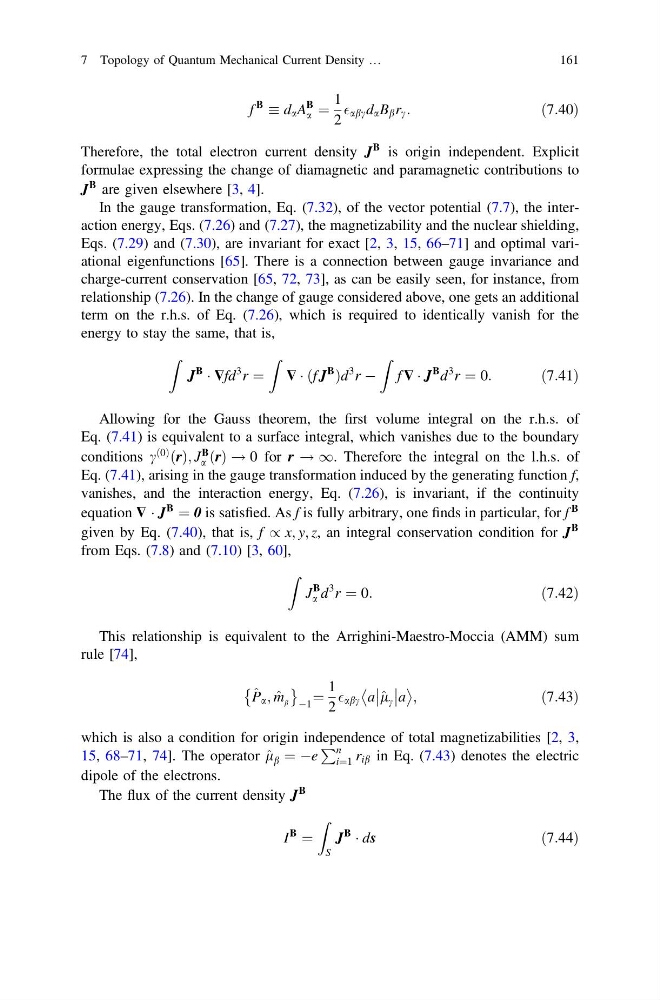
f
B
d a A
B
a ¼
1
2
abc d a B b r c :
ð7:40Þ
Therefore, the total electron current density J
B is origin independent. Explicit
formulae expressing the change of diamagnetic and paramagnetic contributions to
J
B are given elsewhere [3, 4].
In the gauge transformation, Eq. (7.32), of the vector potential (7.7), the interaction energy, Eqs. (7.26) and (7.27), the magnetizability and the nuclear shielding,
Eqs. (7.29) and (7.30), are invariant for exact [2, 3, 15, 66–71] and optimal variational eigenfunctions [65]. There is a connection between gauge invariance and
charge-current conservation [65, 72, 73], as can be easily seen, for instance, from
relationship (7.26). In the change of gauge considered above, one gets an additional
term on the r.h.s. of Eq. (7.26), which is required to identically vanish for the
energy to stay the same, that is,
Z
J
B
Á $fd
3 r ¼
Z
$ Á ðf J
B
Þd
3 r À
Z
f $ Á J
B d
3 r ¼ 0:
ð7:41Þ
Allowing for the Gauss theorem, the first volume integral on the r.h.s. of
Eq. (7.41) is equivalent to a surface integral, which vanishes due to the boundary
conditions c
ð0Þ
ðrÞ; J
B
a ðrÞ ! 0 for r ! 1. Therefore the integral on the l.h.s. of
Eq. (7.41), arising in the gauge transformation induced by the generating function f,
vanishes, and the interaction energy, Eq. (7.26), is invariant, if the continuity
equation $ Á J
B
¼ 0 is satisfied. As f is fully arbitrary, one finds in particular, for f
B
given by Eq. (7.40), that is, f / x; y; z, an integral conservation condition for J
B
from Eqs. (7.8) and (7.10) [3, 60],
Z
J
B
a d
3 r ¼ 0:
ð7:42Þ
This relationship is equivalent to the Arrighini-Maestro-Moccia (AMM) sum
rule [74],
^
P a ; ^
m b
È
É
À1
¼
1
2
abc a ^
l c
a
;
ð7:43Þ
which is also a condition for origin independence of total magnetizabilities [2, 3,
15, 68–71, 74]. The operator ^
l b ¼ Àe
P n
i¼1 r ib in Eq. (7.43) denotes the electric
dipole of the electrons.
The flux of the current density J
B
I
B
¼
Z
S
J
B
Á ds
ð7:44Þ
7 Topology of Quantum Mechanical Current Density …
161
B
d a A
B
a ¼
1
2
abc d a B b r c :
ð7:40Þ
Therefore, the total electron current density J
B is origin independent. Explicit
formulae expressing the change of diamagnetic and paramagnetic contributions to
J
B are given elsewhere [3, 4].
In the gauge transformation, Eq. (7.32), of the vector potential (7.7), the interaction energy, Eqs. (7.26) and (7.27), the magnetizability and the nuclear shielding,
Eqs. (7.29) and (7.30), are invariant for exact [2, 3, 15, 66–71] and optimal variational eigenfunctions [65]. There is a connection between gauge invariance and
charge-current conservation [65, 72, 73], as can be easily seen, for instance, from
relationship (7.26). In the change of gauge considered above, one gets an additional
term on the r.h.s. of Eq. (7.26), which is required to identically vanish for the
energy to stay the same, that is,
Z
J
B
Á $fd
3 r ¼
Z
$ Á ðf J
B
Þd
3 r À
Z
f $ Á J
B d
3 r ¼ 0:
ð7:41Þ
Allowing for the Gauss theorem, the first volume integral on the r.h.s. of
Eq. (7.41) is equivalent to a surface integral, which vanishes due to the boundary
conditions c
ð0Þ
ðrÞ; J
B
a ðrÞ ! 0 for r ! 1. Therefore the integral on the l.h.s. of
Eq. (7.41), arising in the gauge transformation induced by the generating function f,
vanishes, and the interaction energy, Eq. (7.26), is invariant, if the continuity
equation $ Á J
B
¼ 0 is satisfied. As f is fully arbitrary, one finds in particular, for f
B
given by Eq. (7.40), that is, f / x; y; z, an integral conservation condition for J
B
from Eqs. (7.8) and (7.10) [3, 60],
Z
J
B
a d
3 r ¼ 0:
ð7:42Þ
This relationship is equivalent to the Arrighini-Maestro-Moccia (AMM) sum
rule [74],
^
P a ; ^
m b
È
É
À1
¼
1
2
abc a ^
l c
a
;
ð7:43Þ
which is also a condition for origin independence of total magnetizabilities [2, 3,
15, 68–71, 74]. The operator ^
l b ¼ Àe
P n
i¼1 r ib in Eq. (7.43) denotes the electric
dipole of the electrons.
The flux of the current density J
B
I
B
¼
Z
S
J
B
Á ds
ð7:44Þ
7 Topology of Quantum Mechanical Current Density …
161