

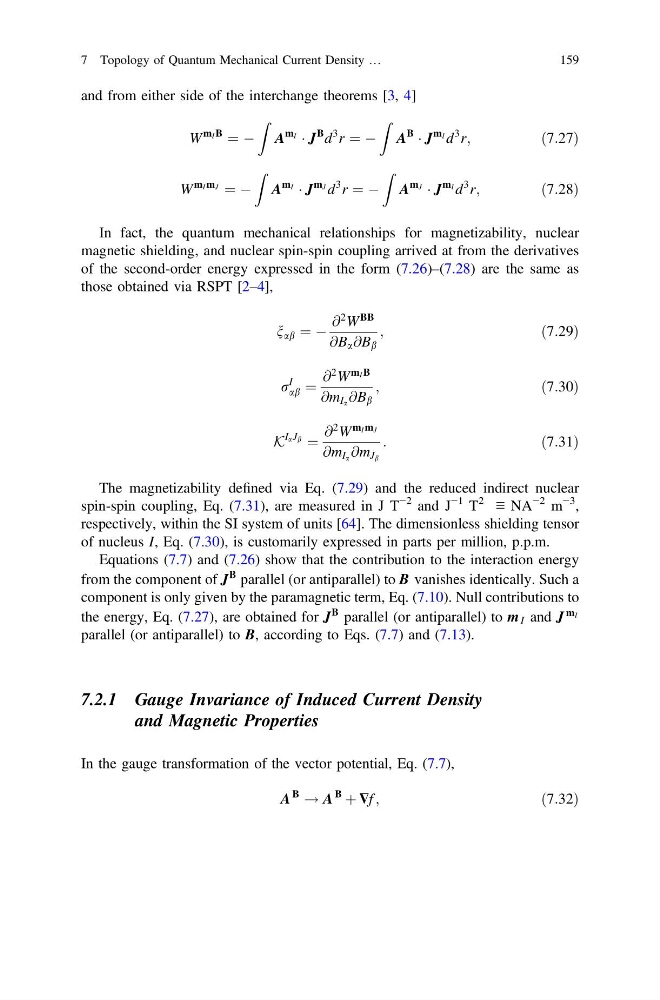
and from either side of the interchange theorems [3, 4]
W
m I B
¼ À
Z
A
m I Á J
B d
3 r ¼ À
Z
A
B
Á J
m I d
3 r;
ð7:27Þ
W
m I m J ¼ À
Z
A
m I Á J
m J d
3 r ¼ À
Z
A
m J Á J
m I d
3 r;
ð7:28Þ
In fact, the quantum mechanical relationships for magnetizability, nuclear
magnetic shielding, and nuclear spin-spin coupling arrived at from the derivatives
of the second-order energy expressed in the form (7.26)–(7.28) are the same as
those obtained via RSPT [2–4],
n ab ¼ À
@
2 W
BB
@B a @B b
;
ð7:29Þ
r
I
ab ¼
@
2 W
m I B
@m I a @B b
;
ð7:30Þ
K
I a J b ¼
@
2 W
m I m J
@m I a @m J b
:
ð7:31Þ
The magnetizability defined via Eq. (7.29) and the reduced indirect nuclear
spin-spin coupling, Eq. (7.31), are measured in J T
−2 and J
−1 T
2 ≡ NA
−2 m
−3 ,
respectively, within the SI system of units [64]. The dimensionless shielding tensor
of nucleus I, Eq. (7.30), is customarily expressed in parts per million, p.p.m.
Equations (7.7) and (7.26) show that the contribution to the interaction energy
from the component of J
B parallel (or antiparallel) to B vanishes identically. Such a
component is only given by the paramagnetic term, Eq. (7.10). Null contributions to
the energy, Eq. (7.27), are obtained for J
B parallel (or antiparallel) to m I and J
m I
parallel (or antiparallel) to B, according to Eqs. (7.7) and (7.13).
7.2.1 Gauge Invariance of Induced Current Density
and Magnetic Properties
In the gauge transformation of the vector potential, Eq. (7.7),
A
B
! A
B
þ $f ;
ð7:32Þ
7 Topology of Quantum Mechanical Current Density …
159
W
m I B
¼ À
Z
A
m I Á J
B d
3 r ¼ À
Z
A
B
Á J
m I d
3 r;
ð7:27Þ
W
m I m J ¼ À
Z
A
m I Á J
m J d
3 r ¼ À
Z
A
m J Á J
m I d
3 r;
ð7:28Þ
In fact, the quantum mechanical relationships for magnetizability, nuclear
magnetic shielding, and nuclear spin-spin coupling arrived at from the derivatives
of the second-order energy expressed in the form (7.26)–(7.28) are the same as
those obtained via RSPT [2–4],
n ab ¼ À
@
2 W
BB
@B a @B b
;
ð7:29Þ
r
I
ab ¼
@
2 W
m I B
@m I a @B b
;
ð7:30Þ
K
I a J b ¼
@
2 W
m I m J
@m I a @m J b
:
ð7:31Þ
The magnetizability defined via Eq. (7.29) and the reduced indirect nuclear
spin-spin coupling, Eq. (7.31), are measured in J T
−2 and J
−1 T
2 ≡ NA
−2 m
−3 ,
respectively, within the SI system of units [64]. The dimensionless shielding tensor
of nucleus I, Eq. (7.30), is customarily expressed in parts per million, p.p.m.
Equations (7.7) and (7.26) show that the contribution to the interaction energy
from the component of J
B parallel (or antiparallel) to B vanishes identically. Such a
component is only given by the paramagnetic term, Eq. (7.10). Null contributions to
the energy, Eq. (7.27), are obtained for J
B parallel (or antiparallel) to m I and J
m I
parallel (or antiparallel) to B, according to Eqs. (7.7) and (7.13).
7.2.1 Gauge Invariance of Induced Current Density
and Magnetic Properties
In the gauge transformation of the vector potential, Eq. (7.7),
A
B
! A
B
þ $f ;
ð7:32Þ
7 Topology of Quantum Mechanical Current Density …
159