

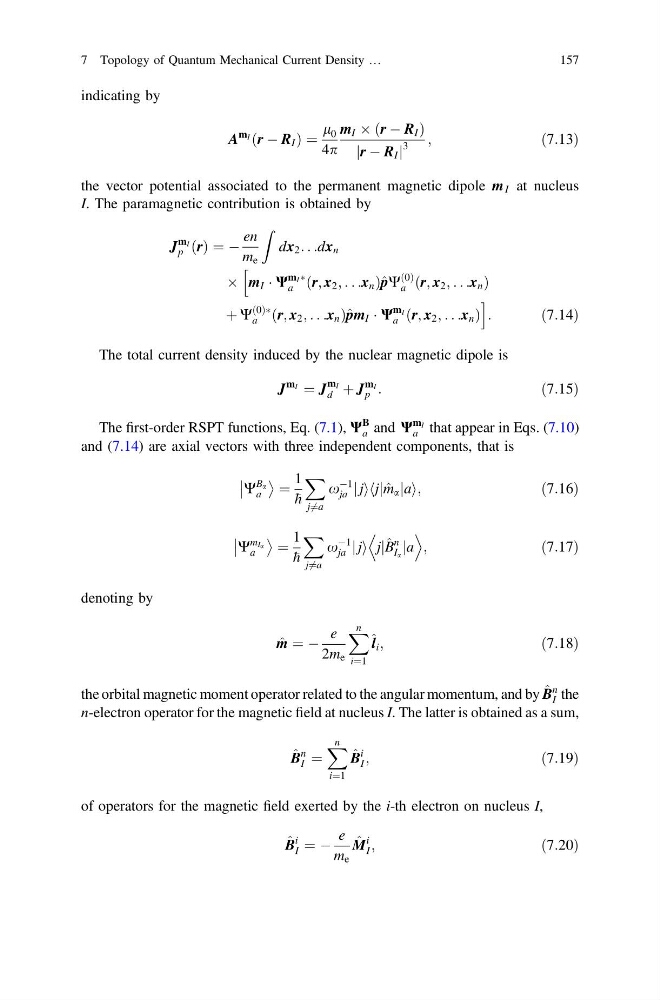
indicating by
A
m I ðr À R I Þ ¼
l 0
4p
m I Â ðr À R I Þ
r À R I
j
j
3
;
ð7:13Þ
the vector potential associated to the permanent magnetic dipole m I at nucleus
I. The paramagnetic contribution is obtained by
J
m I
p ðrÞ ¼ À
en
m e
Z
dx 2 . . .dx n
 m I Á W
m I Ã
a ðr; x 2 ; . . .x n Þ^ pW
ð0Þ
a ðr; x 2 ; . . .x n Þ
h
þ W
ð0ÞÃ
a ðr; x 2 ; . . .x n Þ^ pm I Á W
m I
a ðr; x 2 ; . . .x n Þ
i
:
ð7:14Þ
The total current density induced by the nuclear magnetic dipole is
J
m I ¼ J
m I
d þ J
m I
p :
ð7:15Þ
The first-order RSPT functions, Eq. (7.1), W
B
a and W
m I
a that appear in Eqs. (7.10)
and (7.14) are axial vectors with three independent components, that is
W
B a
a
¼
1
h
X
j6 ¼a
x
À1
ja j ji jj ^
m a ja
h
i;
ð7:16Þ
W
m Ia
a
¼
1
h
X
j6 ¼a
x
À1
ja j ji jj ^
B
n
I a
ja
D
E
;
ð7:17Þ
denoting by
^
m ¼ À
e
2m e
X n
i¼1
^ l i ;
ð7:18Þ
the orbital magnetic moment operator related to the angular momentum, and by ^
B
n
I the
n-electron operator for the magnetic field at nucleus I. The latter is obtained as a sum,
^
B
n
I ¼
X n
i¼1
^
B
i
I ;
ð7:19Þ
of operators for the magnetic field exerted by the i-th electron on nucleus I,
^
B
i
I ¼ À
e
m e
^
M
i
I ;
ð7:20Þ
7 Topology of Quantum Mechanical Current Density …
157
A
m I ðr À R I Þ ¼
l 0
4p
m I Â ðr À R I Þ
r À R I
j
j
3
;
ð7:13Þ
the vector potential associated to the permanent magnetic dipole m I at nucleus
I. The paramagnetic contribution is obtained by
J
m I
p ðrÞ ¼ À
en
m e
Z
dx 2 . . .dx n
 m I Á W
m I Ã
a ðr; x 2 ; . . .x n Þ^ pW
ð0Þ
a ðr; x 2 ; . . .x n Þ
h
þ W
ð0ÞÃ
a ðr; x 2 ; . . .x n Þ^ pm I Á W
m I
a ðr; x 2 ; . . .x n Þ
i
:
ð7:14Þ
The total current density induced by the nuclear magnetic dipole is
J
m I ¼ J
m I
d þ J
m I
p :
ð7:15Þ
The first-order RSPT functions, Eq. (7.1), W
B
a and W
m I
a that appear in Eqs. (7.10)
and (7.14) are axial vectors with three independent components, that is
W
B a
a
¼
1
h
X
j6 ¼a
x
À1
ja j ji jj ^
m a ja
h
i;
ð7:16Þ
W
m Ia
a
¼
1
h
X
j6 ¼a
x
À1
ja j ji jj ^
B
n
I a
ja
D
E
;
ð7:17Þ
denoting by
^
m ¼ À
e
2m e
X n
i¼1
^ l i ;
ð7:18Þ
the orbital magnetic moment operator related to the angular momentum, and by ^
B
n
I the
n-electron operator for the magnetic field at nucleus I. The latter is obtained as a sum,
^
B
n
I ¼
X n
i¼1
^
B
i
I ;
ð7:19Þ
of operators for the magnetic field exerted by the i-th electron on nucleus I,
^
B
i
I ¼ À
e
m e
^
M
i
I ;
ð7:20Þ
7 Topology of Quantum Mechanical Current Density …
157