

7.1.1 The Conventional Approach of Perturbation Theory
to Magnetic Properties
The magnetic response of atoms and molecules to external static electromagnetic
fields and internal perturbations, e.g., nuclear magnetic dipoles and nuclear electric
quadrupoles, is usually rationalized within the framework of time-independent
Rayleigh-Schrödinger perturbation theory (RSPT) [6, 7] by introducing tensors of
increasing rank which describe intrinsic electronic properties. For instance, RSPT is
the basic tool used by Van Vleck to study second-rank n ab magnetizability tensors
[8]. Ramsey implemented an analogous approach to the magnetic shielding [9–11]
r
I
ab of nucleus I and to the electron-mediated interaction between the spins of two
nuclei I and J in a molecule via J I a J b nuclear spin-spin coupling [12, 13]. These
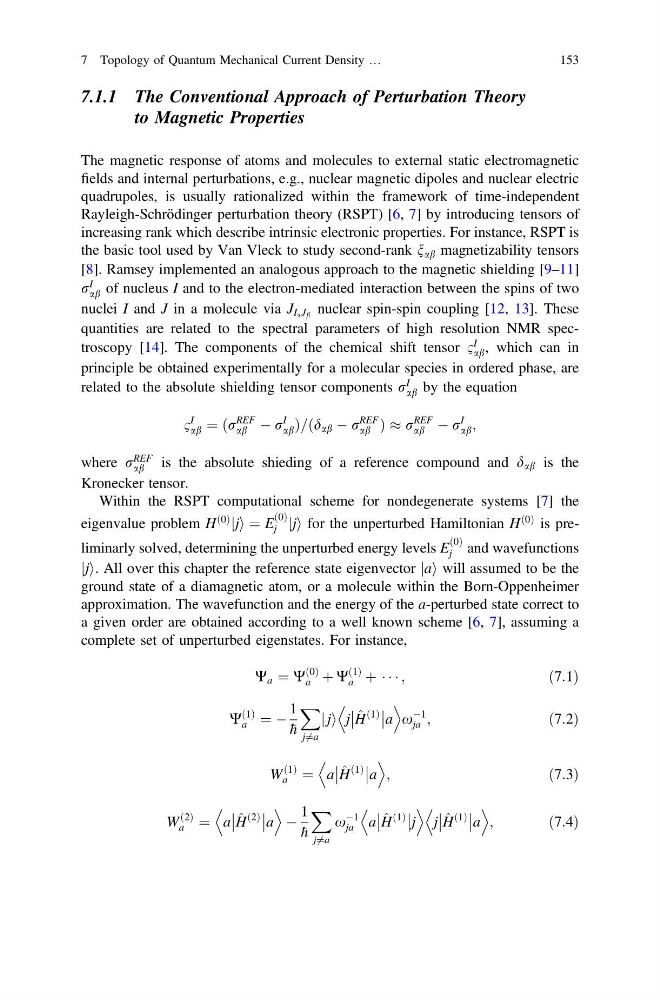
quantities are related to the spectral parameters of high resolution NMR spectroscopy [14]. The components of the chemical shift tensor 1
I
ab , which can in
principle be obtained experimentally for a molecular species in ordered phase, are
related to the absolute shielding tensor components r
I
ab by the equation
1
I
ab ¼ ðr
REF
ab À r
I
ab Þ=ðd ab À r
REF
ab Þ % r
REF
ab À r
I
ab ;
where r
REF
ab
is the absolute shieding of a reference compound and d ab is the
Kronecker tensor.
Within the RSPT computational scheme for nondegenerate systems [7] the
eigenvalue problem H
ð0Þ
jji ¼ E
ð0Þ
j jji for the unperturbed Hamiltonian H
ð0Þ is preliminarly solved, determining the unperturbed energy levels E
ð0Þ
j and wavefunctions
jji. All over this chapter the reference state eigenvector jai will assumed to be the
ground state of a diamagnetic atom, or a molecule within the Born-Oppenheimer
approximation. The wavefunction and the energy of the a-perturbed state correct to
a given order are obtained according to a well known scheme [6, 7], assuming a
complete set of unperturbed eigenstates. For instance,
W a ¼ W
ð0Þ
a þ W
ð1Þ
a þ Á Á Á ;
ð7:1Þ
W
ð1Þ
a ¼ À
1
h
X
j6 ¼a
j
j i j ^
H
ð1Þ
a
D
E
x
À1
ja ;
ð7:2Þ
W
ð1Þ
a ¼ a ^
H
ð1Þ
a
D
E
;
ð7:3Þ
W
ð2Þ
a ¼ a ^
H
ð2Þ
a
D
E
À
1
h
X
j6 ¼a
x
À1
ja a ^
H
ð1Þ
j
D
E
j ^
H
ð1Þ
a
D
E
;
ð7:4Þ
7 Topology of Quantum Mechanical Current Density …
153
to Magnetic Properties
The magnetic response of atoms and molecules to external static electromagnetic
fields and internal perturbations, e.g., nuclear magnetic dipoles and nuclear electric
quadrupoles, is usually rationalized within the framework of time-independent
Rayleigh-Schrödinger perturbation theory (RSPT) [6, 7] by introducing tensors of
increasing rank which describe intrinsic electronic properties. For instance, RSPT is
the basic tool used by Van Vleck to study second-rank n ab magnetizability tensors
[8]. Ramsey implemented an analogous approach to the magnetic shielding [9–11]
r
I
ab of nucleus I and to the electron-mediated interaction between the spins of two
nuclei I and J in a molecule via J I a J b nuclear spin-spin coupling [12, 13]. These
quantities are related to the spectral parameters of high resolution NMR spectroscopy [14]. The components of the chemical shift tensor 1
I
ab , which can in
principle be obtained experimentally for a molecular species in ordered phase, are
related to the absolute shielding tensor components r
I
ab by the equation
1
I
ab ¼ ðr
REF
ab À r
I
ab Þ=ðd ab À r
REF
ab Þ % r
REF
ab À r
I
ab ;
where r
REF
ab
is the absolute shieding of a reference compound and d ab is the
Kronecker tensor.
Within the RSPT computational scheme for nondegenerate systems [7] the
eigenvalue problem H
ð0Þ
jji ¼ E
ð0Þ
j jji for the unperturbed Hamiltonian H
ð0Þ is preliminarly solved, determining the unperturbed energy levels E
ð0Þ
j and wavefunctions
jji. All over this chapter the reference state eigenvector jai will assumed to be the
ground state of a diamagnetic atom, or a molecule within the Born-Oppenheimer
approximation. The wavefunction and the energy of the a-perturbed state correct to
a given order are obtained according to a well known scheme [6, 7], assuming a
complete set of unperturbed eigenstates. For instance,
W a ¼ W
ð0Þ
a þ W
ð1Þ
a þ Á Á Á ;
ð7:1Þ
W
ð1Þ
a ¼ À
1
h
X
j6 ¼a
j
j i j ^
H
ð1Þ
a
D
E
x
À1
ja ;
ð7:2Þ
W
ð1Þ
a ¼ a ^
H
ð1Þ
a
D
E
;
ð7:3Þ
W
ð2Þ
a ¼ a ^
H
ð2Þ
a
D
E
À
1
h
X
j6 ¼a
x
À1
ja a ^
H
ð1Þ
j
D
E
j ^
H
ð1Þ
a
D
E
;
ð7:4Þ
7 Topology of Quantum Mechanical Current Density …
153