

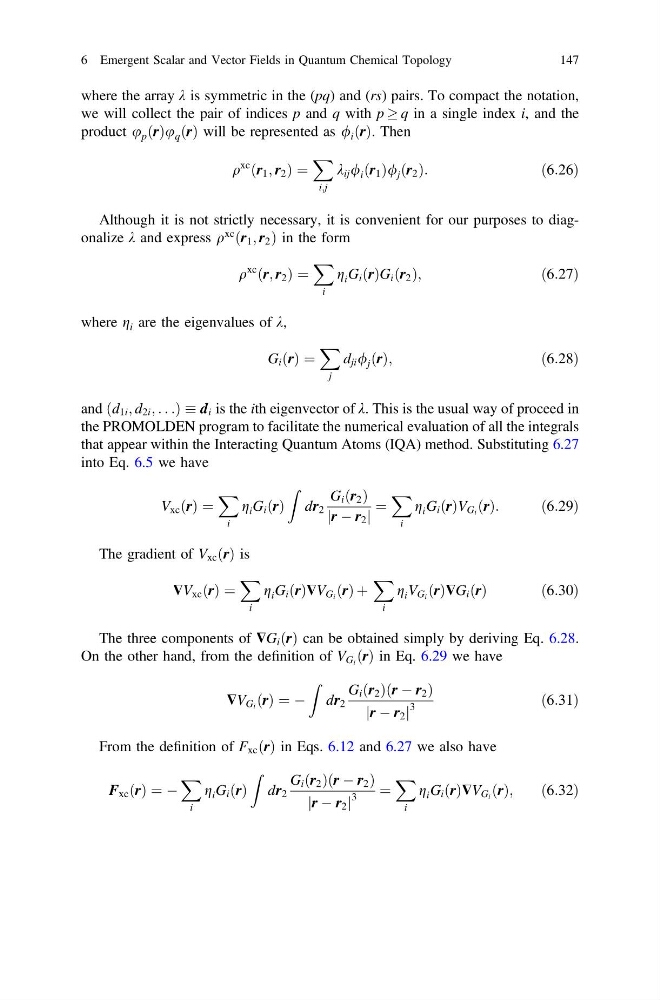
where the array λ is symmetric in the (pq) and (rs) pairs. To compact the notation,
we will collect the pair of indices p and q with p ! q in a single index i, and the
product u p r
ð Þu q r
ð Þ will be represented as / i r
ð Þ. Then
q
xc r 1 ; r 2
ð
Þ¼
X
i;j
k ij / i r 1
ð Þ/ j r 2
ð Þ:
ð6:26Þ
Although it is not strictly necessary, it is convenient for our purposes to diagonalize λ and express q
xc r 1 ; r 2
ð
Þ in the form
q
xc r; r 2
ð
Þ ¼
X
i
g i G i r
ð ÞG i r 2
ð Þ;
ð6:27Þ
where g i are the eigenvalues of λ,
G i r
ð Þ ¼
X
j
d ji / j r
ð Þ;
ð6:28Þ
and d 1i ; d 2i ; . . .
ð
Þd i is the ith eigenvector of λ. This is the usual way of proceed in
the PROMOLDEN program to facilitate the numerical evaluation of all the integrals
that appear within the Interacting Quantum Atoms (IQA) method. Substituting 6.27
into Eq. 6.5 we have
V xc r
ð Þ ¼
X
i
g i G i r
ð Þ
Z
dr 2
G i r 2
ð Þ
jr À r 2 j
¼
X
i
g i G i r
ð ÞV G i r
ð Þ:
ð6:29Þ
The gradient of V xc r
ð Þ is
$V xc r
ð Þ ¼
X
i
g i G i r
ð Þ$V G i r
ð Þ þ
X
i
g i V G i r
ð Þ$G i r
ð Þ
ð6:30Þ
The three components of $G i r
ð Þ can be obtained simply by deriving Eq. 6.28.
On the other hand, from the definition of V G i r
ð Þ in Eq. 6.29 we have
$V G i r
ð Þ ¼ À
Z
dr 2
G i r 2
ð Þ r À r 2
ð
Þ
jr À r 2 j
3
ð6:31Þ
From the definition of F xc r
ð Þ in Eqs. 6.12 and 6.27 we also have
F xc r
ð Þ ¼ À
X
i
g i G i r
ð Þ
Z
dr 2
G i r 2
ð Þ r À r 2
ð
Þ
jr À r 2 j
3
¼
X
i
g i G i r
ð Þ$V G i r
ð Þ;
ð6:32Þ
6 Emergent Scalar and Vector Fields in Quantum Chemical Topology
147
we will collect the pair of indices p and q with p ! q in a single index i, and the
product u p r
ð Þu q r
ð Þ will be represented as / i r
ð Þ. Then
q
xc r 1 ; r 2
ð
Þ¼
X
i;j
k ij / i r 1
ð Þ/ j r 2
ð Þ:
ð6:26Þ
Although it is not strictly necessary, it is convenient for our purposes to diagonalize λ and express q
xc r 1 ; r 2
ð
Þ in the form
q
xc r; r 2
ð
Þ ¼
X
i
g i G i r
ð ÞG i r 2
ð Þ;
ð6:27Þ
where g i are the eigenvalues of λ,
G i r
ð Þ ¼
X
j
d ji / j r
ð Þ;
ð6:28Þ
and d 1i ; d 2i ; . . .
ð
Þd i is the ith eigenvector of λ. This is the usual way of proceed in
the PROMOLDEN program to facilitate the numerical evaluation of all the integrals
that appear within the Interacting Quantum Atoms (IQA) method. Substituting 6.27
into Eq. 6.5 we have
V xc r
ð Þ ¼
X
i
g i G i r
ð Þ
Z
dr 2
G i r 2
ð Þ
jr À r 2 j
¼
X
i
g i G i r
ð ÞV G i r
ð Þ:
ð6:29Þ
The gradient of V xc r
ð Þ is
$V xc r
ð Þ ¼
X
i
g i G i r
ð Þ$V G i r
ð Þ þ
X
i
g i V G i r
ð Þ$G i r
ð Þ
ð6:30Þ
The three components of $G i r
ð Þ can be obtained simply by deriving Eq. 6.28.
On the other hand, from the definition of V G i r
ð Þ in Eq. 6.29 we have
$V G i r
ð Þ ¼ À
Z
dr 2
G i r 2
ð Þ r À r 2
ð
Þ
jr À r 2 j
3
ð6:31Þ
From the definition of F xc r
ð Þ in Eqs. 6.12 and 6.27 we also have
F xc r
ð Þ ¼ À
X
i
g i G i r
ð Þ
Z
dr 2
G i r 2
ð Þ r À r 2
ð
Þ
jr À r 2 j
3
¼
X
i
g i G i r
ð Þ$V G i r
ð Þ;
ð6:32Þ
6 Emergent Scalar and Vector Fields in Quantum Chemical Topology
147