

sigma-algebra.
2 The measure of the basin-derived measurable sets can be the
absolute value of the corresponding integral of V.
The two types of approaches are addressed in the following chapters, and
respective general prerequisites are shortly presented in the following sections.
1.3 Discrete Chemical Topology: Chemical Bonding
and Graph Theory
Within the context of chemistry [26, 27], a molecule is primarily described by a
discrete molecular graph G ¼ ðV; EÞ, where V is the finite set of vertices corresponding to atomic nodes, and E is the set of edges corresponding to two-center
bonds.
3 Therefore, the natural topology of the molecule is the one defined by the
edge set E through the canonical metric of G, where the distance d G ðu; vÞ between
two vertices u and v is the smallest number of consecutive edges (shortest path)
between them.
Topological comparison between molecular graphs is addressed through either
combinatorial analysis or spectral analysis.
Combinatorial analysis of graphs allows the definition of graph invariants (not
depending on the numbering of the nodes), called topological indices, lending
themselves to the search for empirical relationships with physico-chemical properties. This approach first proposed by Wiener in 1949, initiated the today widely
addressed investigation field of Quantitative Structure-Activity Relationships
(QSAR).
The main Wiener index is a global quantitative index of the graph topology [28]
defined as the sum of all the distances of the unordered pairs of vertices:
WðGÞ ¼
X
fu;vg&V
d G ðu; vÞ
ð 1:1Þ
A related index is the Wiener Polarity Index:
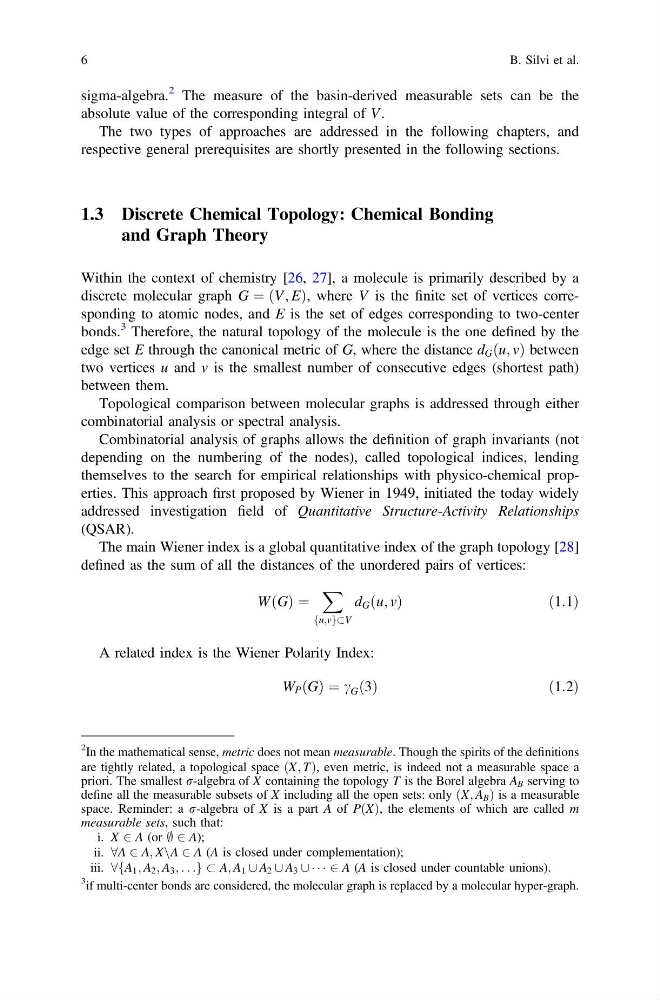
W P ðGÞ ¼ c G ð3Þ
ð 1:2Þ
2
In the mathematical sense, metric does not mean measurable. Though the spirits of the definitions
are tightly related, a topological space ðX; TÞ, even metric, is indeed not a measurable space a
priori. The smallest r-algebra of X containing the topology T is the Borel algebra A B serving to
define all the measurable subsets of X including all the open sets: only ðX; A B Þ is a measurable
space. Reminder: a r-algebra of X is a part A of PðXÞ, the elements of which are called m
measurable sets, such that:
i. X 2 A (or ; 2 A);
ii. 8A 2 A; XnA 2 A (A is closed under complementation);
iii. 8fA 1 ; A 2 ; A 3 ; . . .g & A; A 1 [ A 2 [ A 3 [ Á Á Á 2 A (A is closed under countable unions).
3
if multi-center bonds are considered, the molecular graph is replaced by a molecular hyper-graph.
6
B. Silvi et al.
2 The measure of the basin-derived measurable sets can be the
absolute value of the corresponding integral of V.
The two types of approaches are addressed in the following chapters, and
respective general prerequisites are shortly presented in the following sections.
1.3 Discrete Chemical Topology: Chemical Bonding
and Graph Theory
Within the context of chemistry [26, 27], a molecule is primarily described by a
discrete molecular graph G ¼ ðV; EÞ, where V is the finite set of vertices corresponding to atomic nodes, and E is the set of edges corresponding to two-center
bonds.
3 Therefore, the natural topology of the molecule is the one defined by the
edge set E through the canonical metric of G, where the distance d G ðu; vÞ between
two vertices u and v is the smallest number of consecutive edges (shortest path)
between them.
Topological comparison between molecular graphs is addressed through either
combinatorial analysis or spectral analysis.
Combinatorial analysis of graphs allows the definition of graph invariants (not
depending on the numbering of the nodes), called topological indices, lending
themselves to the search for empirical relationships with physico-chemical properties. This approach first proposed by Wiener in 1949, initiated the today widely
addressed investigation field of Quantitative Structure-Activity Relationships
(QSAR).
The main Wiener index is a global quantitative index of the graph topology [28]
defined as the sum of all the distances of the unordered pairs of vertices:
WðGÞ ¼
X
fu;vg&V
d G ðu; vÞ
ð 1:1Þ
A related index is the Wiener Polarity Index:
W P ðGÞ ¼ c G ð3Þ
ð 1:2Þ
2
In the mathematical sense, metric does not mean measurable. Though the spirits of the definitions
are tightly related, a topological space ðX; TÞ, even metric, is indeed not a measurable space a
priori. The smallest r-algebra of X containing the topology T is the Borel algebra A B serving to
define all the measurable subsets of X including all the open sets: only ðX; A B Þ is a measurable
space. Reminder: a r-algebra of X is a part A of PðXÞ, the elements of which are called m
measurable sets, such that:
i. X 2 A (or ; 2 A);
ii. 8A 2 A; XnA 2 A (A is closed under complementation);
iii. 8fA 1 ; A 2 ; A 3 ; . . .g & A; A 1 [ A 2 [ A 3 [ Á Á Á 2 A (A is closed under countable unions).
3
if multi-center bonds are considered, the molecular graph is replaced by a molecular hyper-graph.
6
B. Silvi et al.