

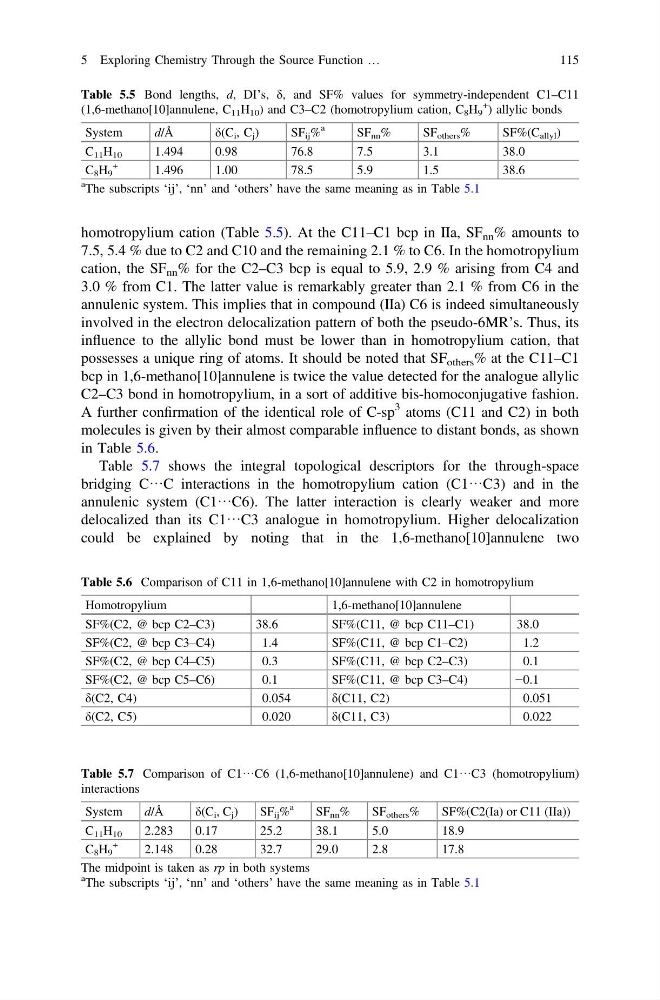
homotropylium cation (Table 5.5). At the C11–C1 bcp in IIa, SF nn % amounts to
7.5, 5.4 % due to C2 and C10 and the remaining 2.1 % to C6. In the homotropylium
cation, the SF nn % for the C2–C3 bcp is equal to 5.9, 2.9 % arising from C4 and
3.0 % from C1. The latter value is remarkably greater than 2.1 % from C6 in the
annulenic system. This implies that in compound (IIa) C6 is indeed simultaneously
involved in the electron delocalization pattern of both the pseudo-6MR’s. Thus, its
influence to the allylic bond must be lower than in homotropylium cation, that
possesses a unique ring of atoms. It should be noted that SF others % at the C11–C1
bcp in 1,6-methano[10]annulene is twice the value detected for the analogue allylic
C2–C3 bond in homotropylium, in a sort of additive bis-homoconjugative fashion.
A further confirmation of the identical role of C-sp
3 atoms (C11 and C2) in both
molecules is given by their almost comparable influence to distant bonds, as shown
in Table 5.6.
Table 5.7 shows the integral topological descriptors for the through-space
bridging C···C interactions in the homotropylium cation (C1···C3) and in the
annulenic system (C1···C6). The latter interaction is clearly weaker and more
delocalized than its C1···C3 analogue in homotropylium. Higher delocalization
could be explained by noting that in the 1,6-methano[10]annulene two
Table 5.5 Bond lengths, d, DI’s, δ, and SF% values for symmetry-independent C1–C11
(1,6-methano[10]annulene, C 11 H 10 ) and C3–C2 (homotropylium cation, C 8 H 9
+ ) allylic bonds
System
d/Å
δ(C i , C j )
SF ij %
a
SF nn %
SF others %
SF%(C allyl )
C 11 H 10
1.494
0.98
76.8
7.5
3.1
38.0
C 8 H 9
+
1.496
1.00
78.5
5.9
1.5
38.6
a The subscripts ‘ij’, ‘nn’ and ‘others’ have the same meaning as in Table 5.1
Table 5.6 Comparison of C11 in 1,6-methano[10]annulene with C2 in homotropylium
Homotropylium
1,6-methano[10]annulene
SF%(C2, @ bcp C2–C3)
38.6
SF%(C11, @ bcp C11–C1)
38.0
SF%(C2, @ bcp C3–C4)
1.4
SF%(C11, @ bcp C1–C2)
1.2
SF%(C2, @ bcp C4–C5)
0.3
SF%(C11, @ bcp C2–C3)
0.1
SF%(C2, @ bcp C5–C6)
0.1
SF%(C11, @ bcp C3–C4)
−0.1
δ(C2, C4)
0.054
δ(C11, C2)
0.051
δ(C2, C5)
0.020
δ(C11, C3)
0.022
Table 5.7 Comparison of C1···C6 (1,6-methano[10]annulene) and C1···C3 (homotropylium)
interactions
System
d/Å
δ(C i , C j )
SF ij %
a
SF nn %
SF others %
SF%(C2(Ia) or C11 (IIa))
C 11 H 10
2.283
0.17
25.2
38.1
5.0
18.9
C 8 H 9
+
2.148
0.28
32.7
29.0
2.8
17.8
The midpoint is taken as rp in both systems
a The subscripts ‘ij’, ‘nn’ and ‘others’ have the same meaning as in Table 5.1
5 Exploring Chemistry Through the Source Function …
115
7.5, 5.4 % due to C2 and C10 and the remaining 2.1 % to C6. In the homotropylium
cation, the SF nn % for the C2–C3 bcp is equal to 5.9, 2.9 % arising from C4 and
3.0 % from C1. The latter value is remarkably greater than 2.1 % from C6 in the
annulenic system. This implies that in compound (IIa) C6 is indeed simultaneously
involved in the electron delocalization pattern of both the pseudo-6MR’s. Thus, its
influence to the allylic bond must be lower than in homotropylium cation, that
possesses a unique ring of atoms. It should be noted that SF others % at the C11–C1
bcp in 1,6-methano[10]annulene is twice the value detected for the analogue allylic
C2–C3 bond in homotropylium, in a sort of additive bis-homoconjugative fashion.
A further confirmation of the identical role of C-sp
3 atoms (C11 and C2) in both
molecules is given by their almost comparable influence to distant bonds, as shown
in Table 5.6.
Table 5.7 shows the integral topological descriptors for the through-space
bridging C···C interactions in the homotropylium cation (C1···C3) and in the
annulenic system (C1···C6). The latter interaction is clearly weaker and more
delocalized than its C1···C3 analogue in homotropylium. Higher delocalization
could be explained by noting that in the 1,6-methano[10]annulene two
Table 5.5 Bond lengths, d, DI’s, δ, and SF% values for symmetry-independent C1–C11
(1,6-methano[10]annulene, C 11 H 10 ) and C3–C2 (homotropylium cation, C 8 H 9
+ ) allylic bonds
System
d/Å
δ(C i , C j )
SF ij %
a
SF nn %
SF others %
SF%(C allyl )
C 11 H 10
1.494
0.98
76.8
7.5
3.1
38.0
C 8 H 9
+
1.496
1.00
78.5
5.9
1.5
38.6
a The subscripts ‘ij’, ‘nn’ and ‘others’ have the same meaning as in Table 5.1
Table 5.6 Comparison of C11 in 1,6-methano[10]annulene with C2 in homotropylium
Homotropylium
1,6-methano[10]annulene
SF%(C2, @ bcp C2–C3)
38.6
SF%(C11, @ bcp C11–C1)
38.0
SF%(C2, @ bcp C3–C4)
1.4
SF%(C11, @ bcp C1–C2)
1.2
SF%(C2, @ bcp C4–C5)
0.3
SF%(C11, @ bcp C2–C3)
0.1
SF%(C2, @ bcp C5–C6)
0.1
SF%(C11, @ bcp C3–C4)
−0.1
δ(C2, C4)
0.054
δ(C11, C2)
0.051
δ(C2, C5)
0.020
δ(C11, C3)
0.022
Table 5.7 Comparison of C1···C6 (1,6-methano[10]annulene) and C1···C3 (homotropylium)
interactions
System
d/Å
δ(C i , C j )
SF ij %
a
SF nn %
SF others %
SF%(C2(Ia) or C11 (IIa))
C 11 H 10
2.283
0.17
25.2
38.1
5.0
18.9
C 8 H 9
+
2.148
0.28
32.7
29.0
2.8
17.8
The midpoint is taken as rp in both systems
a The subscripts ‘ij’, ‘nn’ and ‘others’ have the same meaning as in Table 5.1
5 Exploring Chemistry Through the Source Function …
115