

~
rq
N¼2
Fermion ¼ À
ffiffiffiffiffiffiffiffiffiffiffiffiffiffiffiffi ffi
16a 5 =p 3
q
Exp Àar
2
Â
Ã
~ r
ð4:10Þ
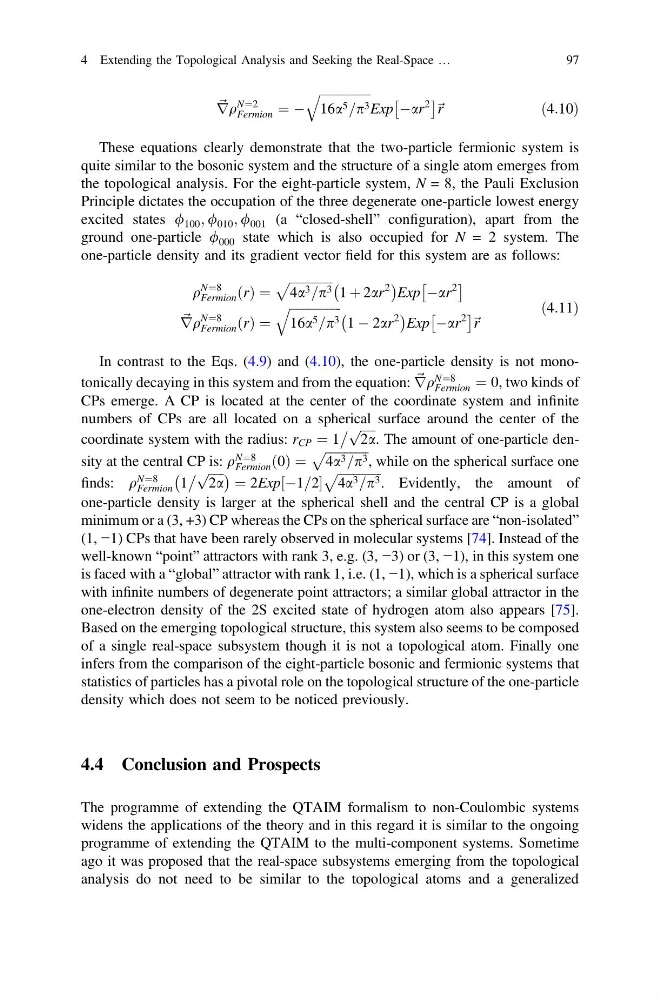
These equations clearly demonstrate that the two-particle fermionic system is
quite similar to the bosonic system and the structure of a single atom emerges from
the topological analysis. For the eight-particle system, N = 8, the Pauli Exclusion
Principle dictates the occupation of the three degenerate one-particle lowest energy
excited states / 100 ; / 010 ; / 001 (a “closed-shell” configuration), apart from the
ground one-particle / 000 state which is also occupied for N = 2 system. The
one-particle density and its gradient vector field for this system are as follows:
q
N¼8
Fermion ðrÞ ¼
ffiffiffiffiffiffiffiffiffiffiffiffiffiffi
4a 3 =p 3
p
1 þ 2ar
2
À
Á
Exp Àar
2
Â
Ã
~
rq
N¼8
Fermion ðrÞ ¼
ffiffiffiffiffiffiffiffiffiffiffiffiffiffiffiffi ffi
16a 5 =p 3
q
1 À 2ar
2
À
Á
Exp Àar
2
Â
Ã
~ r
ð4:11Þ
In contrast to the Eqs. (4.9) and (4.10), the one-particle density is not monotonically decaying in this system and from the equation: ~
rq
N¼8
Fermion ¼ 0, two kinds of
CPs emerge. A CP is located at the center of the coordinate system and infinite
numbers of CPs are all located on a spherical surface around the center of the
coordinate system with the radius: r CP ¼ 1
ffiffiffiffiffi
2a
p
. The amount of one-particle density at the central CP is: q
N¼8
Fermion 0
ð Þ ¼
ffiffiffiffiffiffiffiffiffiffiffiffiffiffi
4a 3 =p 3
p
, while on the spherical surface one
finds: q
N¼8
Fermion 1
ffiffiffiffiffi
2a
p
À
Á ¼ 2Exp À1=2
½
ffiffiffiffiffiffiffiffiffiffiffiffiffiffi
4a 3 =p 3
p
. Evidently, the amount of
one-particle density is larger at the spherical shell and the central CP is a global
minimum or a (3, +3) CP whereas the CPs on the spherical surface are “non-isolated”
(1, −1) CPs that have been rarely observed in molecular systems [74]. Instead of the
well-known “point” attractors with rank 3, e.g. (3, −3) or (3, −1), in this system one
is faced with a “global” attractor with rank 1, i.e. (1, −1), which is a spherical surface
with infinite numbers of degenerate point attractors; a similar global attractor in the
one-electron density of the 2S excited state of hydrogen atom also appears [75].
Based on the emerging topological structure, this system also seems to be composed
of a single real-space subsystem though it is not a topological atom. Finally one
infers from the comparison of the eight-particle bosonic and fermionic systems that
statistics of particles has a pivotal role on the topological structure of the one-particle
density which does not seem to be noticed previously.
4.4 Conclusion and Prospects
The programme of extending the QTAIM formalism to non-Coulombic systems
widens the applications of the theory and in this regard it is similar to the ongoing
programme of extending the QTAIM to the multi-component systems. Sometime
ago it was proposed that the real-space subsystems emerging from the topological
analysis do not need to be similar to the topological atoms and a generalized
4 Extending the Topological Analysis and Seeking the Real-Space …
97
rq
N¼2
Fermion ¼ À
ffiffiffiffiffiffiffiffiffiffiffiffiffiffiffiffi ffi
16a 5 =p 3
q
Exp Àar
2
Â
Ã
~ r
ð4:10Þ
These equations clearly demonstrate that the two-particle fermionic system is
quite similar to the bosonic system and the structure of a single atom emerges from
the topological analysis. For the eight-particle system, N = 8, the Pauli Exclusion
Principle dictates the occupation of the three degenerate one-particle lowest energy
excited states / 100 ; / 010 ; / 001 (a “closed-shell” configuration), apart from the
ground one-particle / 000 state which is also occupied for N = 2 system. The
one-particle density and its gradient vector field for this system are as follows:
q
N¼8
Fermion ðrÞ ¼
ffiffiffiffiffiffiffiffiffiffiffiffiffiffi
4a 3 =p 3
p
1 þ 2ar
2
À
Á
Exp Àar
2
Â
Ã
~
rq
N¼8
Fermion ðrÞ ¼
ffiffiffiffiffiffiffiffiffiffiffiffiffiffiffiffi ffi
16a 5 =p 3
q
1 À 2ar
2
À
Á
Exp Àar
2
Â
Ã
~ r
ð4:11Þ
In contrast to the Eqs. (4.9) and (4.10), the one-particle density is not monotonically decaying in this system and from the equation: ~
rq
N¼8
Fermion ¼ 0, two kinds of
CPs emerge. A CP is located at the center of the coordinate system and infinite
numbers of CPs are all located on a spherical surface around the center of the
coordinate system with the radius: r CP ¼ 1
ffiffiffiffiffi
2a
p
. The amount of one-particle density at the central CP is: q
N¼8
Fermion 0
ð Þ ¼
ffiffiffiffiffiffiffiffiffiffiffiffiffiffi
4a 3 =p 3
p
, while on the spherical surface one
finds: q
N¼8
Fermion 1
ffiffiffiffiffi
2a
p
À
Á ¼ 2Exp À1=2
½
ffiffiffiffiffiffiffiffiffiffiffiffiffiffi
4a 3 =p 3
p
. Evidently, the amount of
one-particle density is larger at the spherical shell and the central CP is a global
minimum or a (3, +3) CP whereas the CPs on the spherical surface are “non-isolated”
(1, −1) CPs that have been rarely observed in molecular systems [74]. Instead of the
well-known “point” attractors with rank 3, e.g. (3, −3) or (3, −1), in this system one
is faced with a “global” attractor with rank 1, i.e. (1, −1), which is a spherical surface
with infinite numbers of degenerate point attractors; a similar global attractor in the
one-electron density of the 2S excited state of hydrogen atom also appears [75].
Based on the emerging topological structure, this system also seems to be composed
of a single real-space subsystem though it is not a topological atom. Finally one
infers from the comparison of the eight-particle bosonic and fermionic systems that
statistics of particles has a pivotal role on the topological structure of the one-particle
density which does not seem to be noticed previously.
4.4 Conclusion and Prospects
The programme of extending the QTAIM formalism to non-Coulombic systems
widens the applications of the theory and in this regard it is similar to the ongoing
programme of extending the QTAIM to the multi-component systems. Sometime
ago it was proposed that the real-space subsystems emerging from the topological
analysis do not need to be similar to the topological atoms and a generalized
4 Extending the Topological Analysis and Seeking the Real-Space …
97