

While the padding with zeroes appears ideal for homologous series such as the
aliphatic hydrocarbons, other approaches may be more adequate when there exists a
“common skeleton” with substituents at a particular location that perturbs the active
group of interest. These substituents may or may not have the same number of
atoms, but are all attached to the same atom of the common skeleton. An example is
provided by the substituted benzoic acids series.
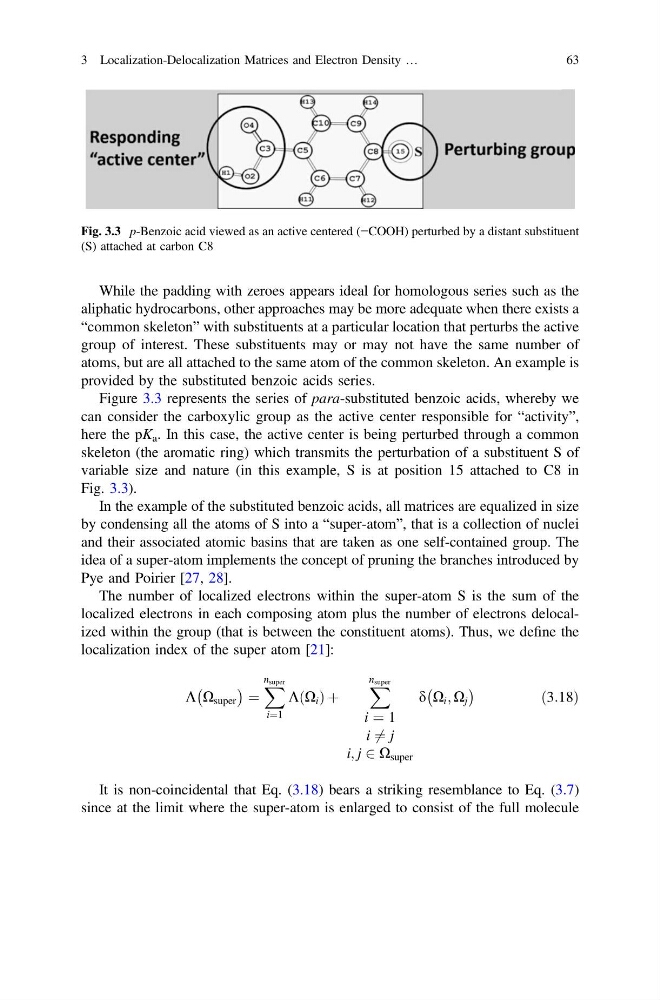
Figure 3.3 represents the series of para-substituted benzoic acids, whereby we
can consider the carboxylic group as the active center responsible for “activity”,
here the pK a . In this case, the active center is being perturbed through a common
skeleton (the aromatic ring) which transmits the perturbation of a substituent S of
variable size and nature (in this example, S is at position 15 attached to C8 in
Fig. 3.3).
In the example of the substituted benzoic acids, all matrices are equalized in size
by condensing all the atoms of S into a “super-atom”, that is a collection of nuclei
and their associated atomic basins that are taken as one self-contained group. The
idea of a super-atom implements the concept of pruning the branches introduced by
Pye and Poirier [27, 28].
The number of localized electrons within the super-atom S is the sum of the
localized electrons in each composing atom plus the number of electrons delocalized within the group (that is between the constituent atoms). Thus, we define the
localization index of the super atom [21]:
K X super
À
Á ¼
X
n super
i¼1
K X i
ð Þþ
X
n super
i ¼ 1
i 6 ¼ j
i; j 2 X super
d X i ; X j
À
Á
ð3:18Þ
It is non-coincidental that Eq. (3.18) bears a striking resemblance to Eq. (3.7)
since at the limit where the super-atom is enlarged to consist of the full molecule
Fig. 3.3 p-Benzoic acid viewed as an active centered (−COOH) perturbed by a distant substituent
(S) attached at carbon C8
3 Localization-Delocalization Matrices and Electron Density …
63
aliphatic hydrocarbons, other approaches may be more adequate when there exists a
“common skeleton” with substituents at a particular location that perturbs the active
group of interest. These substituents may or may not have the same number of
atoms, but are all attached to the same atom of the common skeleton. An example is
provided by the substituted benzoic acids series.
Figure 3.3 represents the series of para-substituted benzoic acids, whereby we
can consider the carboxylic group as the active center responsible for “activity”,
here the pK a . In this case, the active center is being perturbed through a common
skeleton (the aromatic ring) which transmits the perturbation of a substituent S of
variable size and nature (in this example, S is at position 15 attached to C8 in
Fig. 3.3).
In the example of the substituted benzoic acids, all matrices are equalized in size
by condensing all the atoms of S into a “super-atom”, that is a collection of nuclei
and their associated atomic basins that are taken as one self-contained group. The
idea of a super-atom implements the concept of pruning the branches introduced by
Pye and Poirier [27, 28].
The number of localized electrons within the super-atom S is the sum of the
localized electrons in each composing atom plus the number of electrons delocalized within the group (that is between the constituent atoms). Thus, we define the
localization index of the super atom [21]:
K X super
À
Á ¼
X
n super
i¼1
K X i
ð Þþ
X
n super
i ¼ 1
i 6 ¼ j
i; j 2 X super
d X i ; X j
À
Á
ð3:18Þ
It is non-coincidental that Eq. (3.18) bears a striking resemblance to Eq. (3.7)
since at the limit where the super-atom is enlarged to consist of the full molecule
Fig. 3.3 p-Benzoic acid viewed as an active centered (−COOH) perturbed by a distant substituent
(S) attached at carbon C8
3 Localization-Delocalization Matrices and Electron Density …
63